

Every major breach in recent memory had one thing in common: a single point of failure. A trusted server. A central database. One password that unlocked everything. The attackers didn’t need to be brilliant; they just needed to find that one door.
And yet, most security architecture in 2026 still revolves around the same centralised model. Guard the castle. Trust the perimeter. Hope nobody finds the gap.
A growing number of organisations are rebuilding the castle, not by making its walls thicker, but by eliminating the castle.
Introduction
Blockchain technology arrived to solve a very specific problem: how to establish trust between strangers, without a middleman who could be corrupted or compromised? In financial systems, that answer was revolutionary. In cybersecurity, it’s becoming structural.
In 2026, blockchain-based security is no longer confined to crypto wallets and DeFi protocols. It’s embedded in identity management systems, supply chain verification, healthcare data protection, and enterprise threat detection frameworks. The technology has crossed from experimental to operational, and the shift is happening faster than most security teams realise.
The global cost of cybercrime now exceeds $10.5 trillion annually. A cyberattack occurs somewhere every 39 seconds. Centralised systems are increasingly the target. Blockchain, by design, offers something those systems structurally cannot: distributed trust with mathematical certainty.
How Blockchain Security Works
At its core, blockchain is a ledger that nobody owns, and everyone can verify.
Each block of data is cryptographically linked to the one before it. Alter one block, even slightly, and the chain breaks. Every node on the network holds a copy of the full ledger, so there’s no single server to breach, no single database to corrupt. The immutability isn’t enforced by a company policy or a firewall. It’s enforced by mathematics.
Applied to cybersecurity, this architecture creates several distinct advantages:
- Tamper-evident logging: Every event recorded on a blockchain is permanent and auditable. Security logs can’t be quietly deleted after a breach.
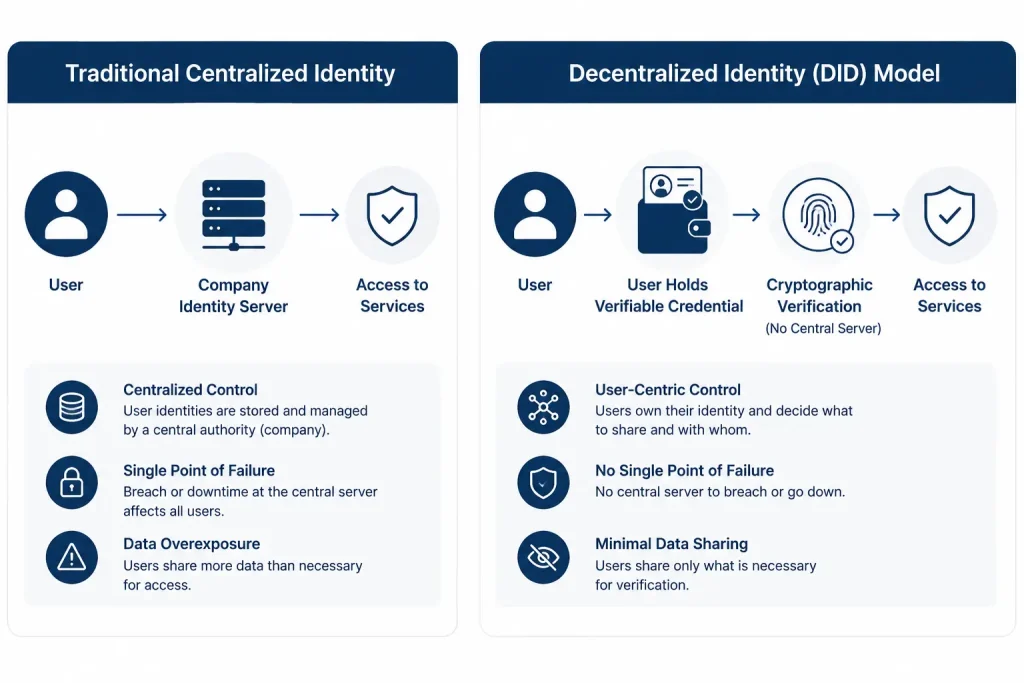
- Decentralised identity (DID): Rather than storing user credentials in a central database, blockchain-based identity systems let individuals hold their own verifiable credentials, cryptographic proofs that can be validated without exposing the underlying data.
- Smart contract automation: Access control rules can be written as self-executing code. No human intermediary. No manual override. No corruption point.
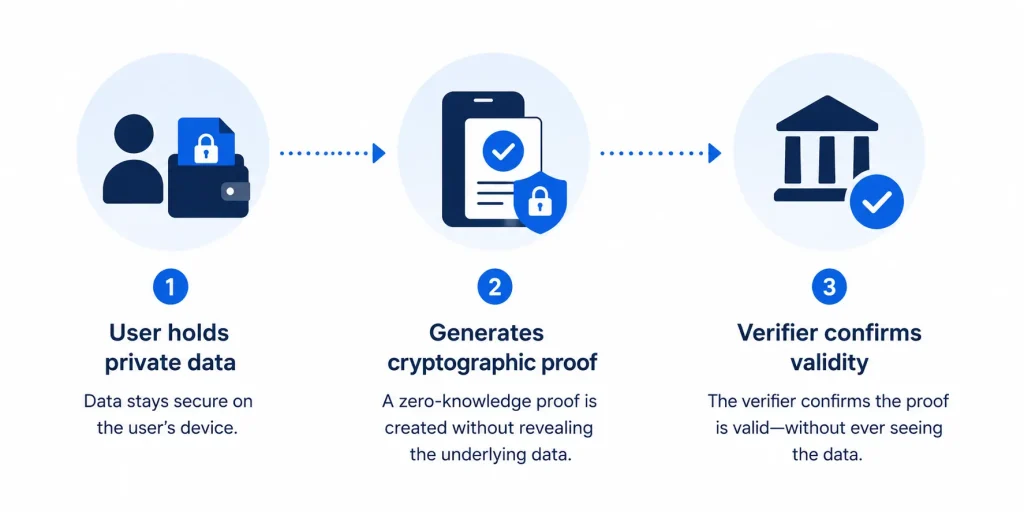
- Zero-Knowledge Proofs (ZKPs): One of 2026’s most significant advancements, ZKPs allow a user to prove they meet a condition (age, clearance level, identity) without revealing any of the actual information, verification without exposure.
Real-World Applications in 2026
The question used to be, can blockchain work in security?
In 2026, the question is, where isn’t it working?
Decentralized Identity Management
The decentralised identity market is projected to grow from $4.89 billion in 2025 to over $41 billion in the coming years, one of the fastest-growing segments in enterprise security. Governments are exploring blockchain-backed digital IDs. Corporations are using verifiable credentials to manage global workforce compliance without maintaining vulnerable centralised credential databases.
The logic is straightforward when credentials don’t live in a server, they can’t be stolen from one.
Supply Chain Integrity
Industrial ransomware cases rose 87% in 2024. Manufacturing bore the brunt, and much of the vulnerability came from third-party supplier access. Blockchain-based supply chain verification creates an immutable record of every vendor interaction, software component, and access event. When something goes wrong, the audit trail is already there, and it can’t be altered retroactively.
Healthcare & Sensitive Data Protection
Healthcare data is among the most frequently breached. Blockchain-secured patient records allow verifiable data access without centralizing storage, meaning a breach of one node doesn’t compromise the entire dataset. In 2026, several healthcare networks have implemented hybrid models, blockchain for access verification, and encrypted distributed storage for the data itself.
Enterprise Threat Intelligence Sharing
One underappreciated application is using blockchain to share threat intelligence across organisations without revealing sensitive internal data. A consortium blockchain lets companies broadcast known attack signatures and IOCs, immutably, pseudonymously, and without exposing their internal architecture to competitors.
What Most People Are Missing
Blockchain doesn’t just secure data. It restructures who’s responsible for it.
The conventional security model places an enormous amount of trust in institutions, cloud providers, enterprises, and government agencies. When those institutions fail (and they do, regularly), the fallout is catastrophic and centralised. Blockchain shifts that responsibility. Under a decentralised identity model, users hold their own credentials. Organisations verify claims without storing them. The liability calculus changes entirely, because there’s no honeypot to protect.
The larger shift underway isn’t just technical. It’s philosophical. Zero-trust architecture is already reshaping enterprise security, and it pairs naturally with blockchain because both reject the premise that anything inside the perimeter is automatically safe. By 2026, Gartner predicted that ZTNA would support 70% of remote access deployments. The pairing of zero-trust principles with blockchain verification creates something genuinely new, an architecture where trust is earned cryptographically, not assumed administratively. This matters because most breaches don’t happen through exotic zero-days. They happen through stolen credentials, misconfigured access, and insider misuse. Blockchain-backed identity systems don’t make these attacks impossible, but they make them structurally harder at scale. When credentials can’t be aggregated, they can’t be mass-compromised.
Limitations & Challenges
None of this is without friction.
- Scalability: Public blockchains remain slower than centralised databases. For high-frequency security operations, real-time access control across millions of requests, permissioned or private blockchains are necessary, which reintroduce some centralisation tradeoffs.
- Smart contract risk: The code is law, until the code has a bug. Smart contract vulnerabilities have led to hundreds of millions in losses in financial contexts. In security contexts, a flawed contract could lock legitimate users out or grant unauthorized access silently.
- Adoption friction: Legacy systems weren’t built for blockchain integration. Retrofitting existing IAM infrastructure, compliance reporting, or endpoint management is expensive and slow. Most enterprises are running hybrid models by necessity.
- Key management: Decentralised identity shifts control to the user, which is powerful until a user loses their private key. Recovery mechanisms exist, but they add complexity and potential new attack surfaces.
- Quantum computing horizon: The cryptographic foundations underpinning current blockchain implementations are not quantum-resistant. Post-quantum cryptography standards are developing, but the migration is not trivial, and the window of risk is uncertain.
No technology solves everything. Blockchain solves a specific and important subset of security problems, particularly those rooted in centralised trust and tamper risk. Understanding that scope clearly matters more than the hype.
Key Takeaways
- Blockchain in cybersecurity is no longer theoretical; it’s operational in identity, supply chain, healthcare, and threat intelligence.
- The decentralized identity (DID) market is one of the fastest-growing security segments, projected to hit $41.73 billion as enterprises move away from central credential databases.
- Zero-Knowledge Proofs (ZKPs) allow verification without data exposure, which fundamentally shifts how identity and authorisation will work.
- Blockchain pairs naturally with zero-trust architecture, both reject implicit trust and demand cryptographic verification at every point.
- Key challenges remain: scalability, smart contract risk, key management, and quantum resistance. None are insurmountable, but none are trivial.
- The most important shift isn’t technical; it’s structural. Blockchain moves security responsibility away from central institutions and toward cryptographic mathematics.
Conclusion
The internet was built on trust that was assumed rather than proven. Decades of breaches have made clear how expensive that assumption is.
Blockchain doesn’t ask you to trust a server, a company, or a certificate authority. It asks you to trust math. And increasingly, in 2026, organisations are deciding that’s the better bet.
The real question isn’t whether blockchain belongs in cybersecurity. It’s whether the institutions that have most to lose from decentralisation will move fast enough to adopt it or wait until they have no choice.
