
Medicine spent the last century building progressively more sophisticated tools to catch cancer early. MRI machines. Genomic sequencers. Liquid biopsies. Each one is more complex, more expensive, more out of reach for the billion people who need it most.
Then a startup in Bengaluru asked a different question.
What if the answer was already living in our homes?
What is Dognosis?
Dognosis is a Bengaluru-based deep-tech startup doing something that sounds unlikely until you look at the science, and then it sounds almost obvious. Founded in 2023 by Akash Kulgod and Itamar Bitan, the company trains dogs to detect cancer from human breath samples, pairing that biological detection capability with a custom-built AI system that interprets and scales what the dogs perceive.
Kulgod grew up in Belgaum in a family of eleven doctors, studied Cognitive Science at UC Berkeley, and built a research career around canine neuroscience. Bitan brought a decade of Special Operations K9 training experience from Israel. Together, they arrived at the same uncomfortable realisation: that the most powerful olfactory sensor ever built had been sleeping at our feet. The company is headquartered on a former pomegranate farm in Nelamangala on the fringes of Bangalore, which tells you something about the culture. This isn’t a startup trying to look like one. It’s a research organisation that happens to be building a product.
The Science Behind the Sniff
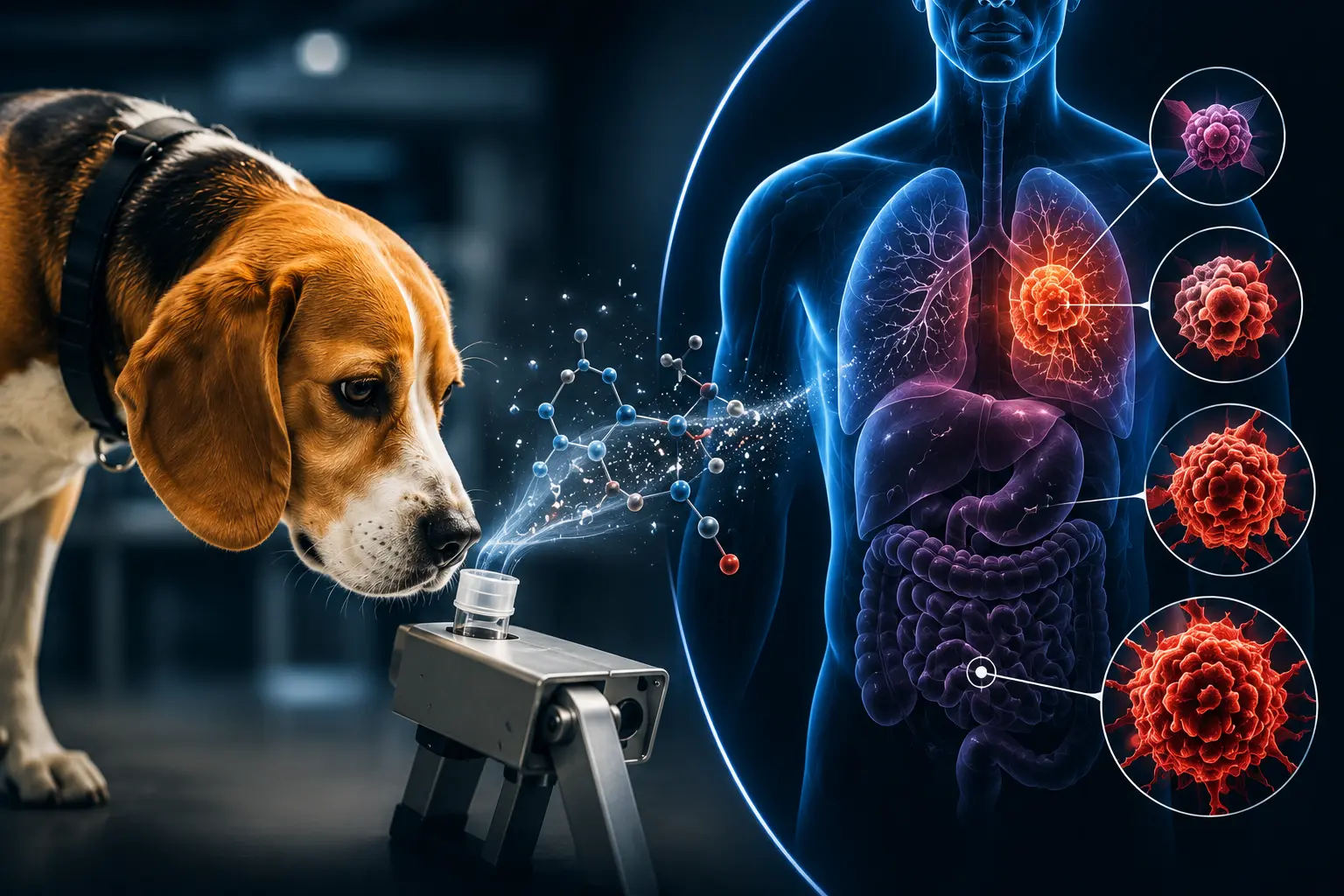
Every human body emits a unique chemical signature, a volatile organic compound (VOC) profile carried in breath, sweat, and urine. When cancer develops, it subtly alters that profile. The change is too faint for current sensors. But not for a dog.
A dog’s nose contains roughly 300 million olfactory receptors, compared to around 6 million in humans. More importantly, the part of the dog’s brain dedicated to analysing smell is proportionally 40 times larger than the human equivalent. Dogs can detect odour concentrations at one part per trillion, roughly equivalent to finding a single drop of liquid in twenty Olympic swimming pools.
Peer-reviewed research has confirmed that dogs can detect cancer from breath and urine samples with high accuracy since at least 2004. The problem wasn’t whether they could detect it. The problem was that nobody had figured out how to standardise, verify, and scale what they were doing.
That’s the gap Dognosis is closing.
How Dognosis Works: The System
Step 1: BreathEasy Collection
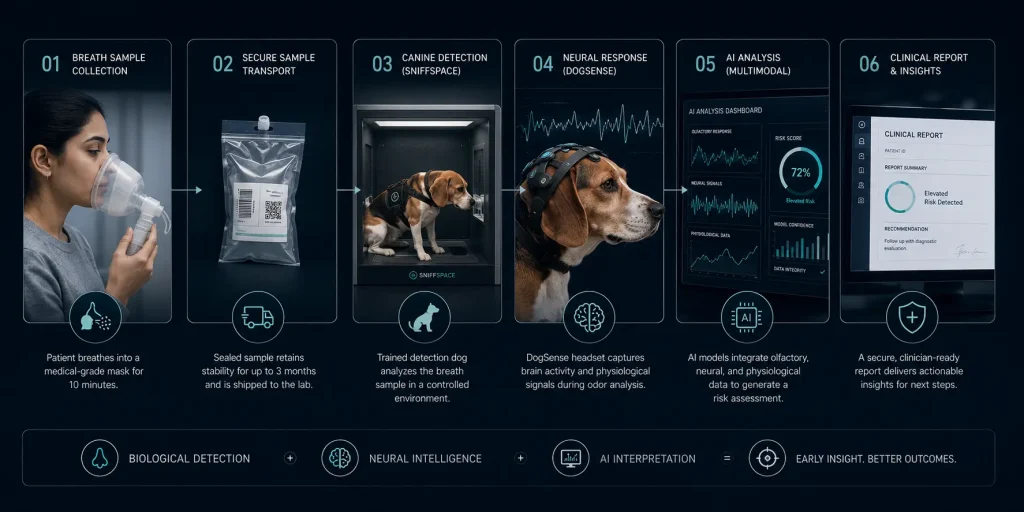
A patient breathes into a specially designed face mask for ten minutes. The mask is sealed and shipped to Dognosis’s lab. Importantly, once sealed, the samples retain potency for up to three months and can travel hundreds or even thousands of kilometres, making this a genuinely distributed screening tool.
Step 2: Canine Analysis
The samples are presented to Dognosis’s trained dogs in a controlled environment using SniffSpace, a custom-built olfactory workstation with automated sample presentation. The system can handle 216 samples per session with distributed VOC containment and release. The dogs don’t go to patients; the samples come to the dogs.
Step 3: DogSense Captures What the Brain Knows
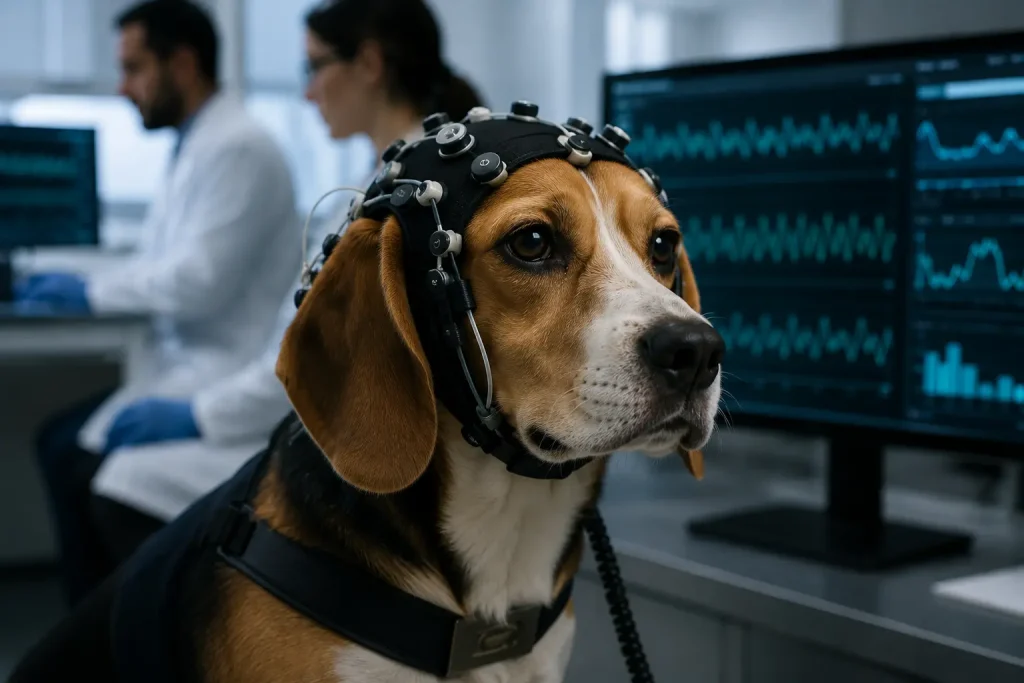
This is where it gets technically remarkable. Each dog wears DogSense, Dognosis’s patented, custom-fitted brain-computer interface that captures EEG signals across 8 channels at 1000Hz. When a dog’s olfactory system registers a disease-associated odour, it produces a specific neural response, and DogSense reads that response in real time. The device also captures respiratory patterns, heart rate, movement via IMU, and behavioural signals via computer vision.
Step 4: DogOS Interprets and Predicts
All that data, EEG, behavioural, and physiological flows into DogOS, Dognosis’s multimodal machine learning platform. DogOS runs signal processing algorithms and ML models to convert the dog’s neural response into a VOC risk score, which is delivered to the patient’s clinician as a report. From there, the clinician decides on follow-up.
Results and Real-World Validation
The numbers are striking. Dognosis’s largest study, published in the Journal of Clinical Oncology and spanning 1,502 participants across six hospitals, reports that BreathEasy achieves 91% accuracy in detecting seven types of cancer. Critically, sensitivity remains equally high at Stages I and II, precisely when early treatment makes the most difference and when most current tools fail.
The clinical findings have been presented at ASCO 2025, AACR FCS 2025, EDCC 2025, and the International Working Dogs Conference 2025, among the world’s leading cancer research forums. A peer-reviewed framework paper published in IOP Science in February 2026 outlines the full bio-digital architecture and validates the approach computationally.
Clinical trials are now expanding to Belagavi, extending the network of hospitals actively involved in validation. The company has raised seed funding from Boost VC and 1517 Fund, two deep-tech focused investors, alongside support from the Government of India and Telangana’s AIC/T-Hub healthtech accelerator. Accel Atoms and gradCapital are also listed among backers.
What Most People Are Missing
“Evolution had already solved the problem. We just hadn’t figured out how to read the answer.”
The conventional framing of Dognosis is “dogs that sniff out cancer.” That framing undersells what’s actually happening.
Dognosis isn’t training dogs to be doctors. They’re using dogs as biological sensors, sensors that happen to outperform every electronic alternative, while building the digital infrastructure to read those sensors at scale. The dog is the hardware.
DogSense and DogOS are the software stack that makes it reproducible, verifiable, and usable in a clinical context.
This distinction matters because it changes the long-term architecture. As the AI system accumulates more labelled data from dog-human pairs, matching neural signals to confirmed diagnoses, the models get smarter. The system learns not just that the dog responded, but how strongly and to what. Over time, DogOS could become a standalone olfaction model trained on thousands of hours of canine neurobiology. The dog teaches the machine. Then the machine generalises.
There’s also a second layer most observers miss: this approach is inherently suited for low-resource settings. The BreathEasy mask costs a fraction of a blood draw. The sample ships in a sealed bag. There’s no hospital visit, no radiation, no needles. For the 1.4 billion people in India, and the billions more across the developing world, where early cancer detection remains a luxury, that matters enormously.
“India has the patients, the data, the talent, and the urgency.” —Akash Kulgod, Co-founder of Dognosis.
Limitations and Open Questions
None of this means the work is done. A startup claiming 91% accuracy at the seed stage should be read with appropriate scientific rigour.
The largest study involved 1,502 participants, meaningful for a clinical trial but not yet sufficient for regulatory approval in most jurisdictions. The system needs multicenter, controlled, peer-reviewed clinical trials that account for confounding factors: diet, medication, and other respiratory conditions. Cancer’s VOC signature must be reliably separable from other systemic changes in breath chemistry.
Standardisation across dogs is another genuine challenge. Individual dogs differ in sensitivity, training responsiveness, and attention span, exactly the kind of variability that clinical systems cannot tolerate. The DogSense BCI helps by capturing neural signals rather than relying purely on behavioural observation, but dog-to-dog consistency remains an active area of research. There’s also the question of the regulatory pathway. CDSCO (India’s drug regulator) has no established framework for a canine-AI diagnostic system. It’s genuinely novel territory. That novelty is both an opportunity and a source of friction.
And then there’s scale. Training a reliable biomedical detection dog takes months and requires skilled handlers. Growing from a team of dogs in Nelamangala to a national screening infrastructure is not a trivial operation.
These are real constraints. The honest answer is that Dognosis is still in the validation phase, with compelling early results and a serious scientific foundation, but not yet a deployed clinical product.
Key Takeaways
- Founded in 2023 in Bengaluru by Akash Kulgod and Itamar Bitan, combining expertise in canine neuroscience and Special Ops K9 training.
- BreathEasy is the flagship product, a non-invasive breath mask that ships to a central lab, where trained dogs analyse the samples using a custom AI-BCI system.
- DogSense is a patented brain-computer interface for dogs, reading EEG signals to capture olfactory recognition as a digital data stream.
- DogOS is the multimodal ML platform that converts canine neural responses into clinical risk scores.
- 91% accuracy across 7 cancer types, with strong early-stage sensitivity, validated in a 1,502-participant study and presented at ASCO, AACR, and EDCC 2025.
- Backed by Boost VC, 1517 Fund, Accel Atoms, and the Government of India.
Conclusion
There’s a version of Dognosis’s story that’s easy to write off. Dogs sniffing for cancer sounds like something between a science fair project and a headline designed for clicks. It isn’t.
What Dognosis is actually building is a biological-digital hybrid diagnostic platform, one that uses fifteen thousand years of evolutionary refinement as its sensor layer and modern machine learning as its interpretive layer. It’s not trying to replicate what technology already does. It’s borrowing from biology to do what technology cannot yet do.
The science is real. The results are early but serious. The architecture is genuinely novel. And the ambition, to build a cancer screening tool capable of reaching the billion people who currently have no access to early detection, is one of the most important problems in global health.
If it works at scale, Dognosis won’t just be a startup success story.
It’ll be a case study in how the most powerful innovations sometimes come not from building something new, but from finally paying attention to something ancient.
