
Every AI assistant you’ve ever used has the same quiet flaw. You spend twenty minutes giving it context. Your project structure, your naming conventions, your preferred approach to a recurring problem. The model helps. The session ends. And the next time you open a chat window, it’s a stranger again.
That isn’t a bug anyone is rushing to fix. For most AI companies, the session boundary is a feature. Clean state. Predictable billing. No liability for what the model “remembers.”
But it also means every AI tool you use today is, structurally, amnesiac. And a tool that forgets everything it learns about you has a natural ceiling on how useful it can ever become.
That ceiling is exactly what Hermes Agent was built to break.
Introduction
Released in February 2026 by Nous Research, the lab behind the Hermes, Nomos, and Psyche model families, Hermes Agent is an open-source autonomous AI agent that runs on your own server, 24 hours a day, and gets meaningfully better the longer it operates. Not in a vague, aspirational sense. In a concrete, architectural one.
Within two months of its release, it surpassed 60,000 GitHub stars. By May 2026, that number had crossed 140,000, making it the fastest-growing open-source AI agent project of the year. As of this writing, it holds the #1 global ranking on OpenRouter by daily usage, across all productivity, coding, and personal agent categories.
The timing isn’t accidental. Something has been shifting in how developers and power users think about AI. The initial excitement around chat interfaces is maturing into a quieter, more practical question: can I build something that actually compounds over time?
Hermes Agent is one of the first credible answers to that question.
“The value no longer comes only from raw model intelligence. It comes from memory, workflow recovery, tool orchestration, and repeatability.” — Stanford HAI AI Index 2026
The Architecture Behind the Agent
Most AI agents are stateless by design. They receive a prompt, they respond, and whatever reasoning happened in between evaporates. Hermes Agent is built around the opposite assumption.
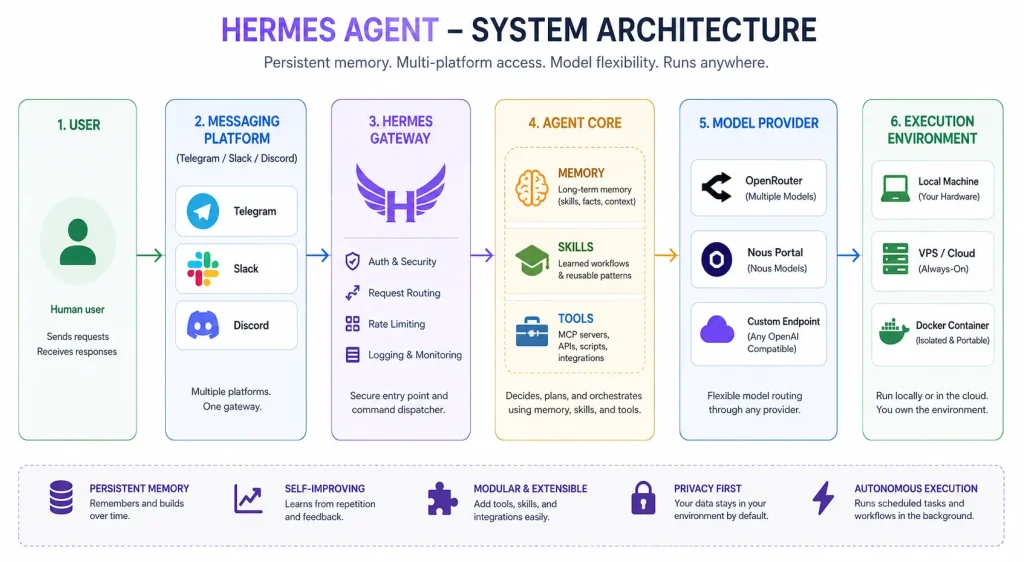
At its core, the system runs on three interlocking mechanisms:
1. Persistent Memory
Rather than vector databases or RAG (Retrieval-Augmented Generation) pipelines that “search” past conversations, Hermes stores everything, memories, preferences, conversation history, and project context in a local SQLite database on your own machine. Nothing passes through third-party cloud services. A compressed memory snapshot is injected into each session’s system prompt, giving the agent instant access to who you are and what you’ve been working on. Cross-session search is powered by FTS5 full-text retrieval, which means the agent can surface relevant context from three months ago as easily as yesterday.
2. The Skill Loop
This is the part that makes Hermes structurally different from everything else. After any complex task, defined as five or more tool calls, the agent automatically distils what worked into a Skill Document: a Markdown file capturing the approach taken, edge cases encountered, and domain knowledge reconstructed along the way. The next time a similar task arrives, the agent loads the relevant skill and applies it, rather than reasoning from scratch.
As of v0.12.0, a background Skill Curator runs on a seven-day cycle, automatically grading, consolidating, and pruning the skill library. The current release ships with over 600 bundled skills across coding, research, content, and productivity workflows, but the most valuable ones are the ones the agent writes itself, tailored specifically to how you work.
3. Model Agnosticism
Hermes is not tied to any single model provider. It supports 200+ models via OpenRouter, plus direct integration with Nous Portal, OpenAI, NVIDIA NIM, Kimi/Moonshot, MiniMax, Hugging Face, and any custom endpoint. Switching models requires a single command, hermes model, with no code changes. This alone can reduce API costs by up to 90% for users routing to smaller, efficient models for routine tasks.
The agent runs across 18 messaging platforms, Telegram, Discord, Slack, WhatsApp, Signal, WeChat, Feishu/Lark, and more, from a single gateway. You can issue a command from your phone while the agent executes tasks on a cloud VM. It also supports subagent spawning for parallel workstreams and native MCP (Model Context Protocol) server integration for extended tool capabilities.
Real-World Applications
The users who find Hermes most valuable tend to share one characteristic: they do the same kinds of work, repeatedly, and want their tools to improve alongside them.
Developers use it to maintain a persistent understanding of their codebases. Rather than re-explaining project architecture every session, the agent builds a running model of how the system works, what the naming conventions are, which patterns the team prefers, and where the technical debt sits. After a month of consistent use, the gap between day-one performance and current performance is measurable.
Product managers deploy it to automate recurring workflows such as weekly status digests, competitive intelligence summaries, and stakeholder update drafts. The skill loop means the second time a workflow runs, it’s faster and cleaner than the first. The tenth time, it’s nearly invisible.
Researchers and writers value the cross-session recall. The ability to ask “what did I learn about X three weeks ago”, and receive a genuinely useful answer changes how a project accumulates knowledge over time.
NVIDIA has validated Hermes for local deployment on RTX PCs and DGX Spark hardware, specifically highlighting its design for reliability and self-improvement in always-on local inference environments. The agent can run on a $5 VPS, a GPU cluster, or serverless infrastructure that costs nearly nothing when idle, making production deployment accessible at essentially any budget.
“The agent writes its own skills. Three months of use yields dramatically better performance than day one.” — Hermes Agent documentation
What Most People Are Missing
The surface-level story about Hermes Agent is that it has good memory and runs on your own hardware. That’s accurate. But it undersells what’s actually happening architecturally.
Most AI tools are consumption tools. You put in a prompt, you extract an output, the tool is unchanged. Hermes Agent is a production tool. Every time it completes a task, it deposits something back into the system, a skill, a memory, a refined model of who you are. It compounds.
And compounding, in any system, is where the serious value starts.
This also shifts the nature of what “open-source AI” means. The typical open-source AI story is about model weights: the community can inspect, fine-tune, and redistribute. Hermes extends that into the behavioural layer. Skills are portable, shareable, and community-contributed via the agentskills.io open standard. A skill someone developed for processing legal documents can be imported and applied immediately. If a genuine skill registry emerges, with versioning, curation, and quality signals Hermes starts to look less like a tool and more like a platform.
There’s also a subtler shift worth naming. The agent builds a “deepening model of who you are.” Not a surveillance profile, everything stays local, nothing leaves your machine. But a genuine behavioural map, constructed from repeated interaction, that makes the agent better at predicting what you need before you ask for it. That’s a qualitatively different relationship than any chat interface offers.
According to the Stanford HAI AI Index 2026, AI agents moved from question answering toward task completion in 2025, with benchmark accuracy on structured tasks rising from roughly 12% to 66.3%, within six percentage points of human performance. In that environment, the differentiating factor is no longer raw model capability. It’s memory, repeatability, and workflow recovery. Hermes is built precisely for that phase of the curve.
Limitations and Honest Tradeoffs
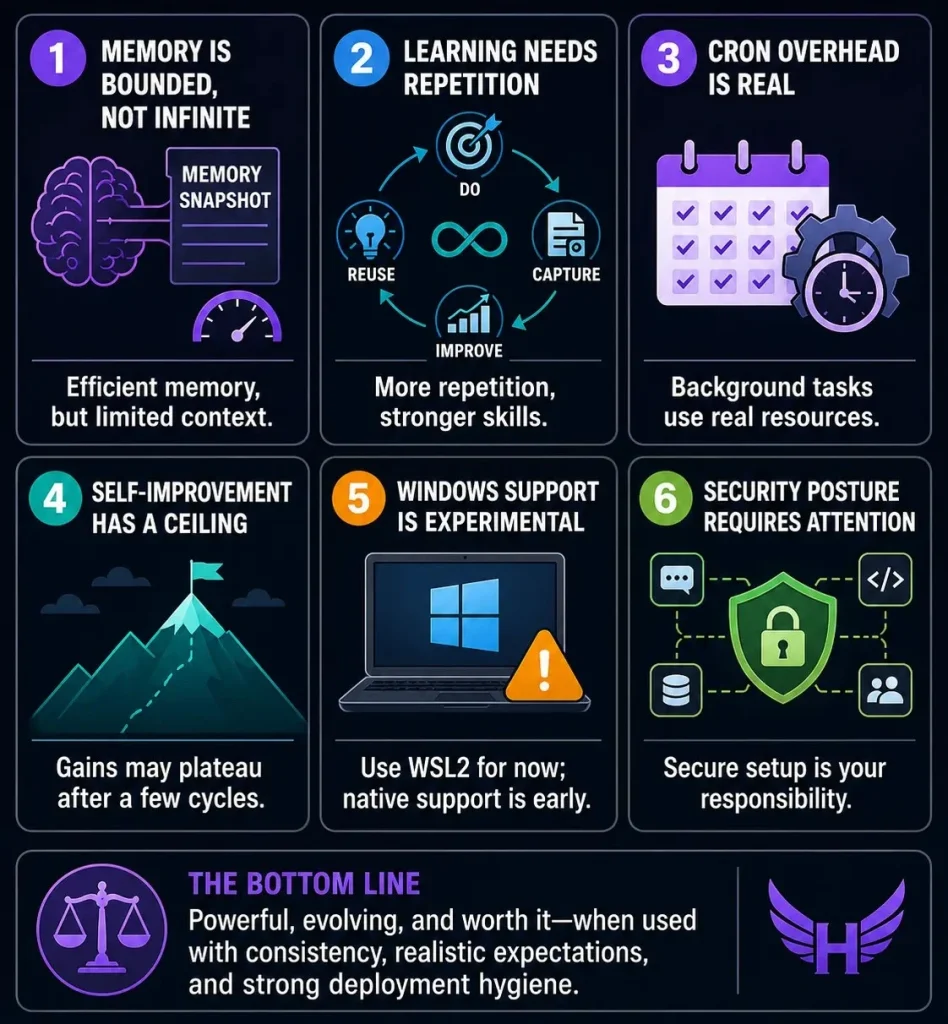
Hermes Agent introduces a powerful new approach to AI agents, one that remembers, adapts, and improves over time. But like any advanced system, it comes with practical tradeoffs. Its memory is efficient but limited, learning works best through repeated workflows, and background automation can consume system resources. Some features, like native Windows support and long-term self-improvement, are still evolving. Since Hermes is self-hosted and deeply connected to tools and messaging platforms, secure deployment also becomes the user’s responsibility. In short, Hermes is highly capable, but it rewards thoughtful setup, consistency, and realistic expectations.
Key Takeaways
- Released February 2026 by Nous Research; 140,000+ GitHub stars within three months, #1 global agent on OpenRouter.
- Not a chatbot. A persistent, self-hosted autonomous agent that runs 24/7 on your own infrastructure.
- The skill loop is the core differentiator: after five or more tool calls, it writes a reusable skill document and improves it over time.
- Model-agnostic: 200+ models supported; switching costs a single command; API costs reducible by up to 90%.
- Best fit for: recurring structured workflows, consistent users, and environments where long-term improvement matters more than broad one-off coverage
- MIT licensed, fully open-source: skills are portable and community-shareable via the agentskills.io standard.
- Real tradeoffs: bounded memory, skill loop needs repetition. Windows support is still experimental.
Conclusion
Every major shift in software tools follows the same arc. First, people use the new thing the way they used the old thing. Then someone builds for what the new thing actually enables, and that’s when the gap opens.
Most people using AI agents today are using them the old way: one session, one task, one result. Hermes Agent is a bet that the next phase looks different. That the tools worth building are the ones that get better as you use them, that accumulate knowledge instead of discarding it, and that, over time, start to feel less like utilities and more like collaborators.
Whether that bet pays off at scale, whether the skill ecosystem develops the network effects it needs, and whether the self-improvement loop compounds in the ways the research suggests, is still being answered. But the architecture is serious, the traction is real, and the problem it’s solving is one that every AI power user already feels.
The question isn’t whether AI agents will eventually learn from experience. It’s who gets to own that memory and whether it stays with you.
