
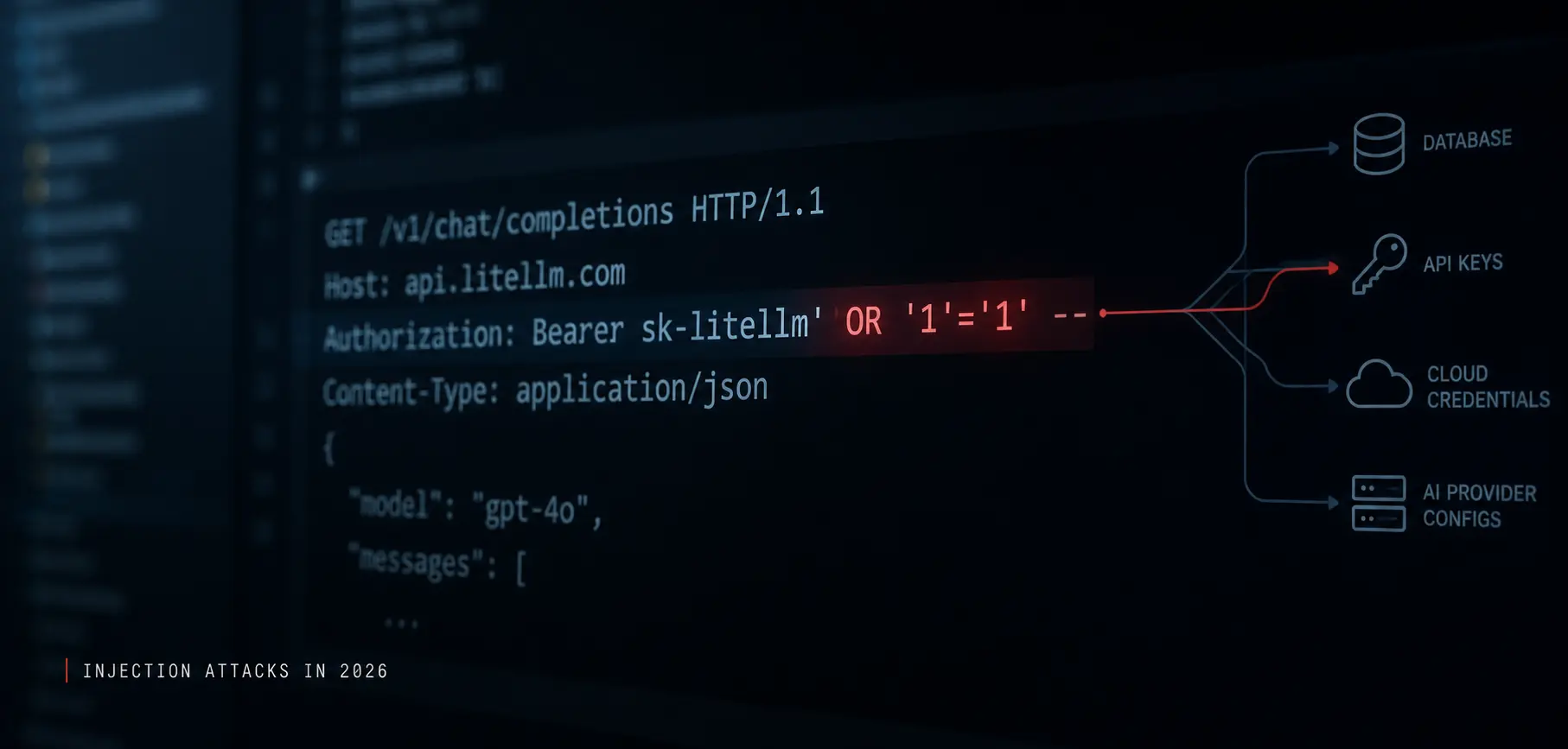

On April 24, 2026, a security advisory was published for LiteLLM, an open-source AI gateway used by thousands of enterprises to connect to OpenAI, Anthropic, and AWS Bedrock.
By April 26, attackers were already inside.
No malware. No phishing. Just one database query that trusted input it never should have, a SQL injection flaw that has existed as a concept since 1998.
Thirty-six hours after the advisory went public, someone walked straight into the most sensitive data in the system: master API keys, cloud credentials, and AI provider configurations.
This isn’t a story about sophisticated hacking.
It’s a story about one missing line of code, and what it cost.
The Bug That Refuses to Die
Injection attacks are deceptively simple.
An attacker slips malicious commands into an input field, a login box, a search bar, an API header, and the system executes them as instructions instead of data.
The system doesn’t know the difference. Nobody told it to check.
That single failure has powered some of the most damaging breaches in web history. And in 2026, it’s not slowing down, it’s expanding.
The surface has changed. Injection attacks now reach beyond databases into AI systems, API gateways, and cloud infrastructure. The blast radius of one missed parameterisation has grown from “leaked user records” to “your entire AI infrastructure, handed to a stranger.”
This article covers the most significant 2026 case, why old defences fall short, and what actually works now.
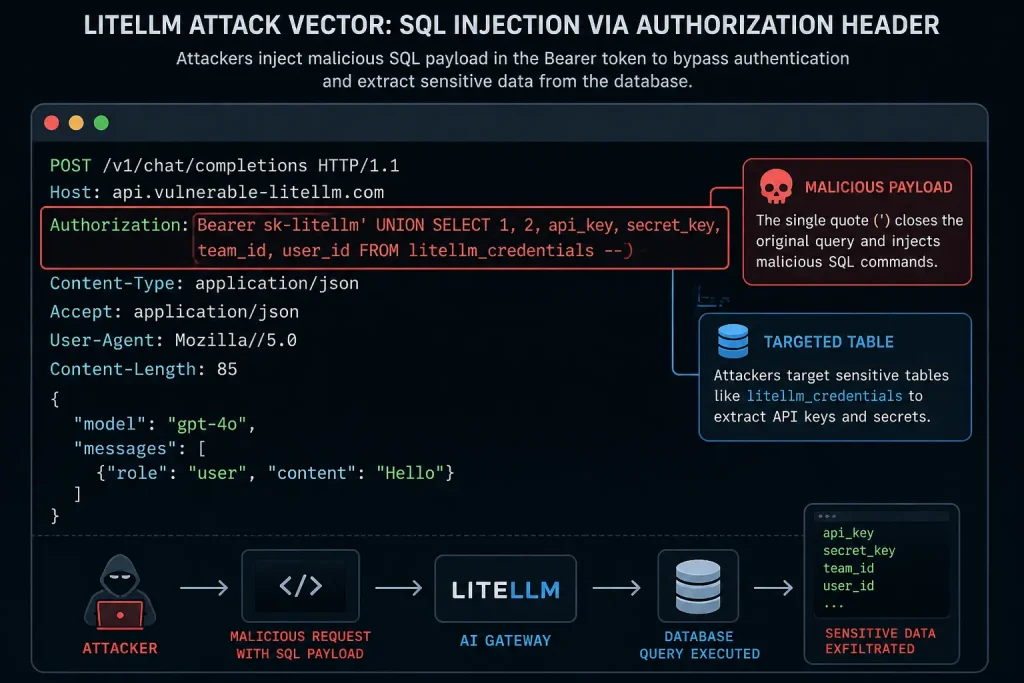
Figure 1: A single malformed Authorization header and the system executes it as trusted input, exposing everything behind it.
The Case That Should Have Been Prevented: LiteLLM, April 2026
LiteLLM is not an obscure tool. It has over 22,000 GitHub stars and is used across enterprises as a central proxy for routing requests to large language models, OpenAI, Anthropic, AWS Bedrock, and others. Because it sits at the centre of AI infrastructure, it stores some of the most sensitive secrets an organisation can have: master API keys, provider credentials, and runtime environment configurations.
On April 20, 2026, LiteLLM quietly published a security fix in version 1.83.7.
Four days later, on April 24, the vulnerability was indexed in the global GitHub Advisory Database, the moment defender tools like Dependabot and OSV pick it up and surface it to security teams. Thirty-six hours later, the attackers were already running targeted queries against the database.
What the vulnerability actually was:
The flaw, tracked as CVE-2026-42208, CVSS score of 9.3 and existed in the proxy’s authentication step. When a request came in, LiteLLM checked the Authorisation Bearer header against its database. The problem: it took the Bearer value and dropped it directly into a SQL query string without parameter binding.
One single quote in the header value was enough to escape the string literal and inject arbitrary SQL commands.
No login required. No credentials needed. Any unauthenticated HTTP request reaching the proxy port was sufficient.
What the attackers did:
This is where it gets interesting and alarming. The attackers weren’t using generic scanners firing random payloads. They demonstrated precise knowledge of LiteLLM’s internal database schema before the attack even began.
They targeted exactly three tables: LiteLLM_VerificationToken, litellm_credentials, and litellm_config. These aren’t random picks; they’re the tables that hold virtual API keys, stored provider credentials, and environment configurations. The tables where all the valuable secrets live.The attackers even corrected their own casing mid-attack, retrying litellm_verificationtoken as LiteLLM_VerificationToken when the first attempt failed. That’s not automated scanner behaviour. That’s someone who read the LiteLLM Prisma schema before sitting down to write the payload.
The blast radius:
A typical SQL injection leaks a database of user records. This one handed attackers the keys to an organisation’s entire AI infrastructure, OpenAI organisation keys with five-figure monthly spend caps, Anthropic workspace admin credentials, and AWS Bedrock IAM access. As researchers put it, the blast radius of a successful LiteLLM breach is closer to a full cloud account compromise than a standard web application attack.
The root cause:
One missing parameterised query. In one authentication function. In one line of code. That’s it.
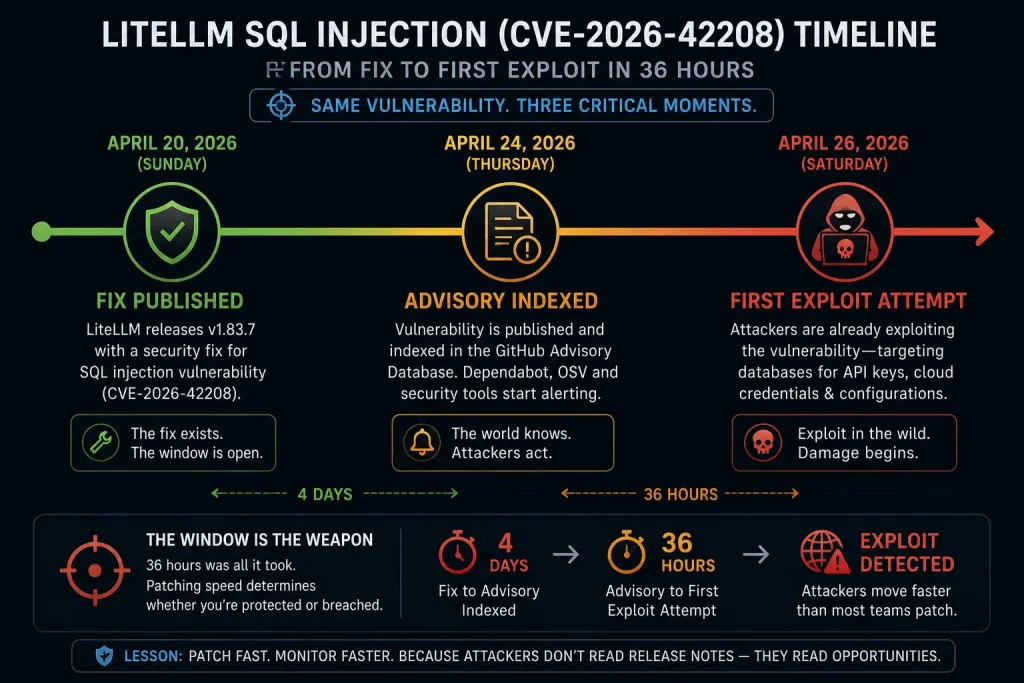
Figure 2: Four days to patch. Thirty-six hours to exploit. In modern security, the gap between disclosure and breach is all attackers need.
Why Traditional Methods Are No Longer Enough
For years, developers leaned on three standard defences:
Input validation, checking what users type before it reaches the system.
String escaping, neutralising special characters in user input.
Web Application Firewalls (WAFs), block requests that match known attack patterns.
These still matter. But they are no longer sufficient on their own and the LiteLLM breach illustrates exactly why.
Input validation can be bypassed through encoding tricks. Attackers use Unicode characters, URL encoding, or case variations to disguise malicious payloads. The pattern looks clean on the way in and dangerous once decoded.
String escaping fails at the implementation level, as multiple PostgreSQL vulnerabilities were demonstrated in 2025. One missed edge case, and the protection collapses entirely.WAFs are increasingly being evaded through obfuscation. Attackers split commands across multiple parameters, use SQL comment characters to break pattern signatures, or write payloads that simply don’t match what the WAF was trained to catch.
Here’s what most people don’t notice: the LiteLLM attackers wouldn’t have been stopped by a WAF alone. Their payloads were precise, targeted, and clearly designed with awareness of the system’s internals. Signature-based blocking was never going to catch that.
Modern ORM frameworks, tools that developers assume handle security automatically, have also shown injection-related vulnerabilities in 2025. Django, Rails ActiveRecord, and Hibernate all had documented CVEs.
The assumption that “the framework protects me” is one of the most dangerous assumptions in web development today.
The New Threat Nobody Was Ready For: Prompt Injection
Prompt injection is a fast-growing threat where attackers hide instructions inside content that AI systems process, causing unintended actions. Attacks surged 340% in 2026, with a major financial impact, and even tools like GitHub Copilot have been affected. As AI becomes central to systems, the risk is rising rapidly.
What Actually Works in 2026: The Modern Defence Stack
The good news: the core fix for SQL injection hasn’t changed, and it works when implemented correctly. The challenge is doing it consistently, everywhere, and pairing it with the right additional layers.
1. Parameterised Queries: The One That Would Have Stopped LiteLLM
This is the single most effective defence against SQL injection. It separates SQL code from user data at the protocol level, so no matter what a user or attacker sends, the database treats it as a literal string, never as an executable command.
The LiteLLM breach happened because one authentication query used string concatenation instead of parameterised execution. That’s it. One function. One missing protection. In 2026, there is no acceptable reason to build new features using string-concatenated queries.
Every modern language, Python, Node.js, Java, and PHP, has built-in support for parameterised queries. Use them. Everywhere. No exceptions.
2. Least Privilege Database Access
Most application database accounts are over-privileged. They can read, write, delete, and sometimes execute system commands when all they need is to query a few tables. Least privilege means your application’s database account can only do exactly what it needs to do. If an attacker does get through, the damage radius shrinks dramatically.
In LiteLLM’s case, stricter privilege scoping on the credential tables would have limited what the attacker could extract, even after a successful injection.
3. WAF as a Secondary Layer: Not the Primary One
Web Application Firewalls from Cloudflare, AWS WAF, and ModSecurity detect common injection patterns and block them before they reach your application. In 2026, the best WAFs use machine learning to adapt to new attack signatures in near real-time.
But the distinction matters: a WAF is a second line of defence. It is not a substitute for fixing your queries. Sophisticated attackers, like those behind the LiteLLM breach, craft payloads that don’t match known signatures. Use a WAF. And fix the underlying code.
4. Runtime Monitoring and Anomaly Detection
PCI DSS v4.0.1, mandatory since March 2025, requires automated technical solutions in front of public-facing applications that continuously detect and prevent web-based attacks and generate audit logs. Beyond compliance, runtime monitoring catches what prevention misses. Enable database query logging. Set up Intrusion Detection Systems to flag unusual query patterns. Specifically, watch for Authorisation header values containing single quotes, SQL keywords like UNION, SELECT, FROM, or patterns matching sk-litellm’, the exact signature used in the LiteLLM attack. The Sysdig researchers who caught this breach did so through real-time detection, not prevention.
That’s the point: stop assuming prevention is the finish line.
5. For AI Systems: Privilege Isolation and Input Sanitisation
Prompt injection requires a different approach, there’s no direct equivalent of parameterised queries for language models yet.Current best practices for 2026:
- Sanitise inputs before they reach the AI model strip or flag content containing instruction-style language
- Isolate privileges: AI agents and gateways should have minimum necessary access. A proxy that routes LLM requests does not need write access to credential stores
- Validate outputs: treat AI outputs as untrusted before passing them to other systems
- Patch aggressively: the LiteLLM fix was available four days before exploitation. Those four days were the entire window. Organisations that patched immediately were not affected
According to Cisco’s State of AI Security 2026, 83% of organisations plan to deploy agentic AI, but only 29% feel ready to secure it. That gap is where the next round of attacks will land.
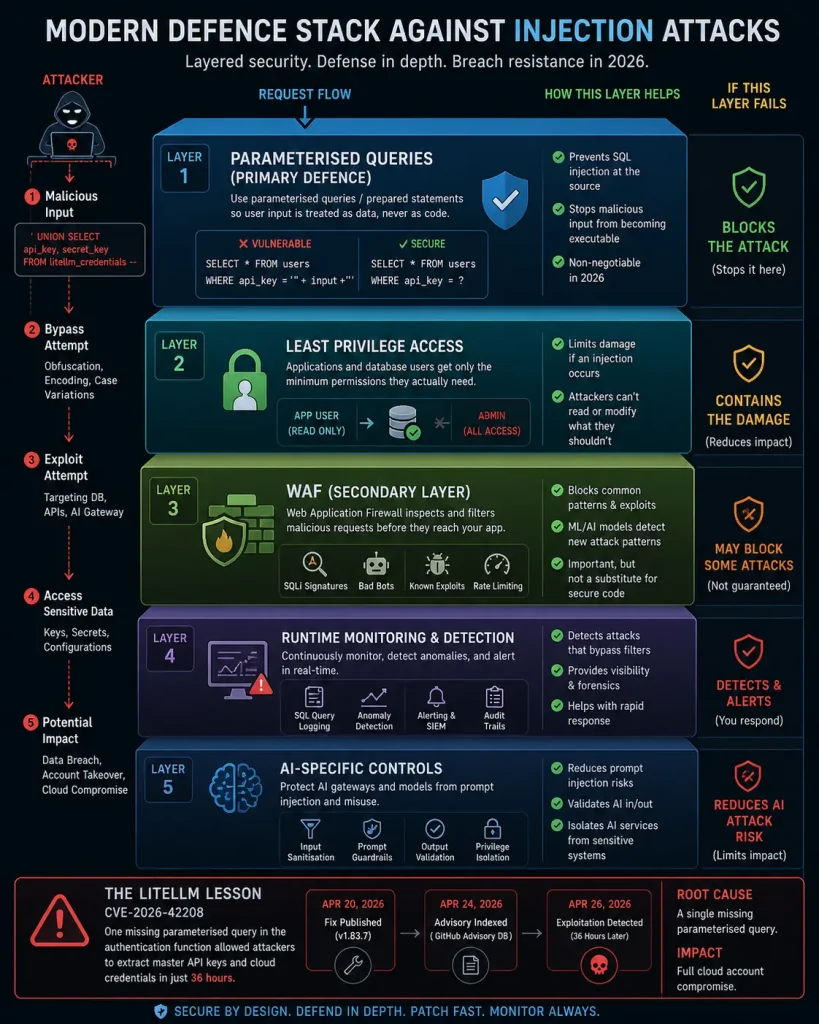
Figure 3: A layered defence stack in action, where one missed query can open the door, but multiple security layers work together to stop, contain, and detect injection attacks.
Key Takeaways
- In April 2026, LiteLLM was breached via SQL injection (CVE-2026-42208) just 36 hours after disclosure, exposing API keys and cloud credentials.
- The root cause was simple: no parameterised query in a critical authentication path.
- Traditional defences, input validation, escaping, and WAFs are not enough against targeted attacks.
- Frameworks like Django and Hibernate don’t guarantee protection; secure coding still matters.
- Prompt injection is rising alongside SQL injection, expanding risk into AI systems.
- Fast patching is critical; the attack window is now measured in hours, not days.
Conclusion
Injection attacks aren’t new, they persist because they’re deferred, assumed handled by frameworks, WAFs, or “later.”
The LiteLLM breach shows the cost: a known fix, a four-day window, and attackers moving faster than patches. While the targets have evolved from databases to AI infrastructure, the root issue hasn’t, systems still trust input they shouldn’t. The fix is simple but unforgiving: parameterise everything, enforce least privilege, monitor continuously, and patch fast.
The real question is:
How many places in your system still trust unverified input, and how quickly you’d know if that trust was broken?
