
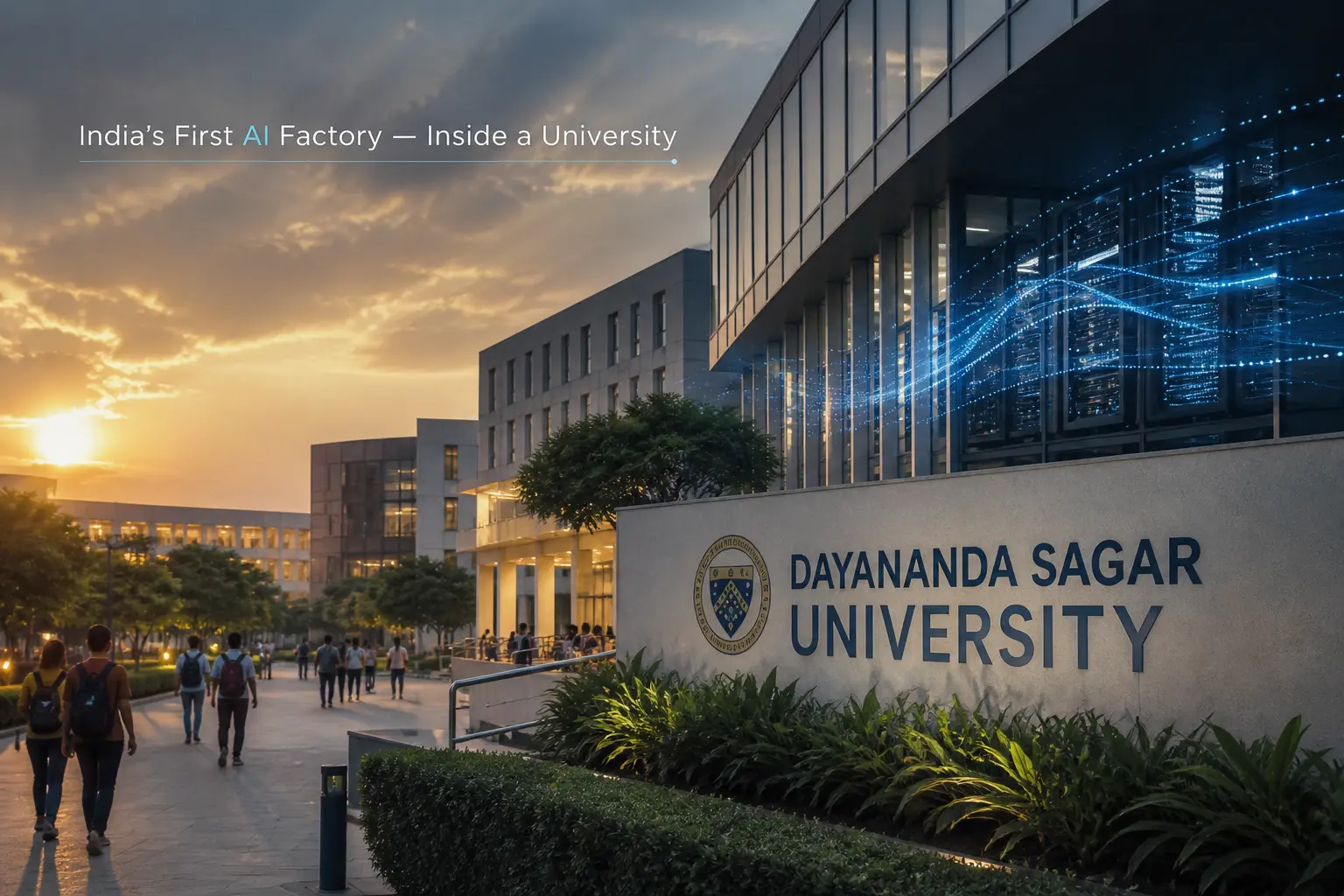

Somewhere in Bengaluru, inside a university campus, India’s most ambitious AI bet is being placed.
Not in a government building. Not in a tech park. In a college.
And the question worth asking before the excitement takes over is a simple one:
When a university spends ₹175 crore on an AI factory, who is it really doing it for?
Introduction
In early 2026, Dayananda Sagar University in Bengaluru announced a landmark partnership with NVIDIA, one of the world’s most powerful names in artificial intelligence, to build what they’re calling India’s first AI factory on campus.
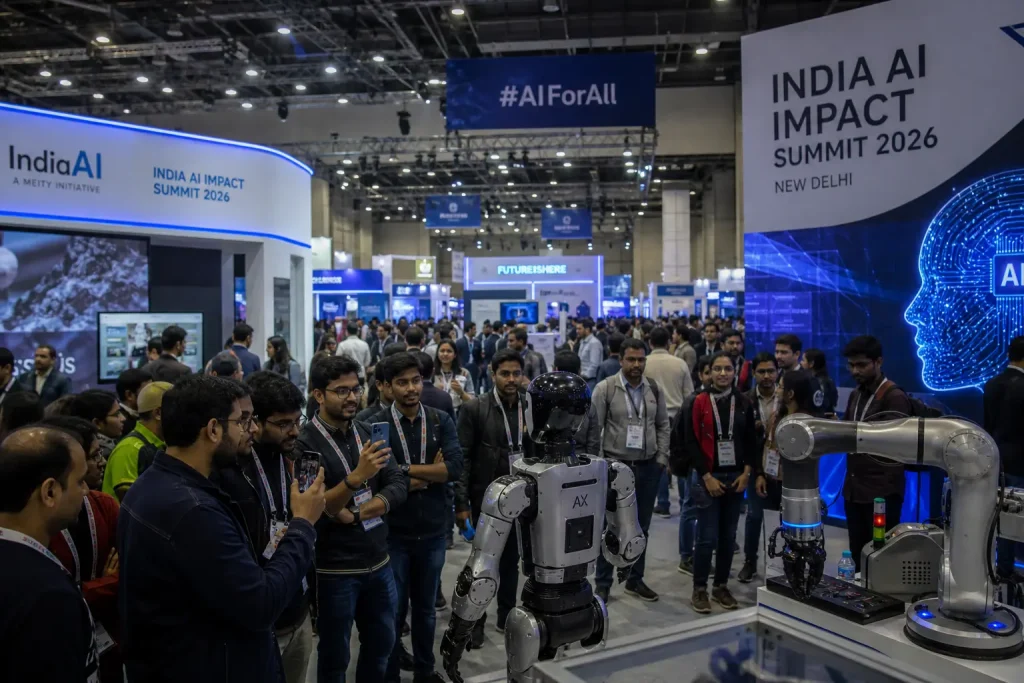
The announcement came with all the trimmings. A major summit in New Delhi. Humanoid robot demonstrations. Talk of national pride, sovereign technology, and future-ready students. It was designed to impress. And it did. But once the spectacle settles, a few honest questions are worth sitting with.
What does this actually mean for students? Is the education angle as genuine as it sounds? And is there something else quietly happening underneath all this?
So What Exactly Is an “AI Factory”?
Forget the word factory for a moment; it sounds industrial, and that’s almost the point.
In plain terms, this is a massive, high-powered computing setup that can train and run large AI systems. Think of it as the engine room of modern AI, the kind of infrastructure that makes the AI tools you use every day actually work. It’s not a classroom upgrade. It’s not a new computer lab. It’s serious, production-level technology that most private companies in India don’t even have access to.
That’s what DSU is putting on a college campus. And to be fair, that’s genuinely rare. India has long had a painful gap between students who learn about AI and the actual tools that run AI in the real world. Most students graduate having studied the theory but never touched the machine.
DSU is, at least on paper, trying to change that. Whether it changes it for the student or for the university is where things get interesting.
The Promise That’s Hard to Ignore
Here’s the context that makes this announcement land so hard in India right now.
Engineering graduates are everywhere. Jobs that match their skills are not. Every year, thousands of young people finish their degrees and enter a market that wasn’t quite ready for them or that they weren’t quite ready for. The gap between what colleges teach and what companies actually need has become one of the most talked-about problems in Indian education.
Into that gap, DSU drops this offer: Study here, train on world-class AI infrastructure, and get hands-on experience that most graduates never get. It’s a powerful pitch.
And in a country where parents are the real decision-makers in education, it’s almost impossible to argue against. No parent sitting across from a university counsellor, hearing about AI training and internship pathways, is going to say no easily. The anxiety around employment is too real. The offer is too tempting. This is where the branding story begins, and it’s more powerful than anyone is saying out loud.
The Branding Play Every Other University Missed
The thing about this ₹175 crore investment that the press releases don’t quite say directly: it may be one of the smartest branding moves a private Indian university has ever made. India has thousands of engineering colleges. Most of them are fighting the same quiet battle. How do you stand out? How do you convince a family that your institution is worth the fees, worth the years, worth the bet?
DSU just answered that question in a way no other university in the country can match right now. They are the only college in India that can say: We have an AI factory, your child will train on it.
That’s not just a feature. That’s a category of its own. And when word spreads, and it will, because this is exactly the kind of thing that travels through parent WhatsApp groups and relatives’ conversations, the admissions interest will follow. You don’t need advertising when you have a story this good.
Is the AI factory an education initiative dressed as branding? Or branding dressed as an education initiative? Honestly, it might be both. And that’s not automatically wrong. Universities that grow can invest more. More investment can mean better outcomes. But the order of intention matters, and it’s worth naming.
What DSU Is Actually Claiming?
Most universities bury their real pitch in the admissions brochure.
DSU put theirs on the homepage.
Their official NVIDIA AI Factory page skips the academic language almost entirely. No research breakthroughs. No faculty publications. Just one argument: your career.
GPU-certified engineers earn more. Google, Meta, and Microsoft recruit from universities with this infrastructure. Come here, get ahead. That’s not an education pitch. That’s a placement pitch wearing an education badge.
And honestly? It’s not wrong. It’s just more transparent than most universities dare to be.
What About the Actual Students?
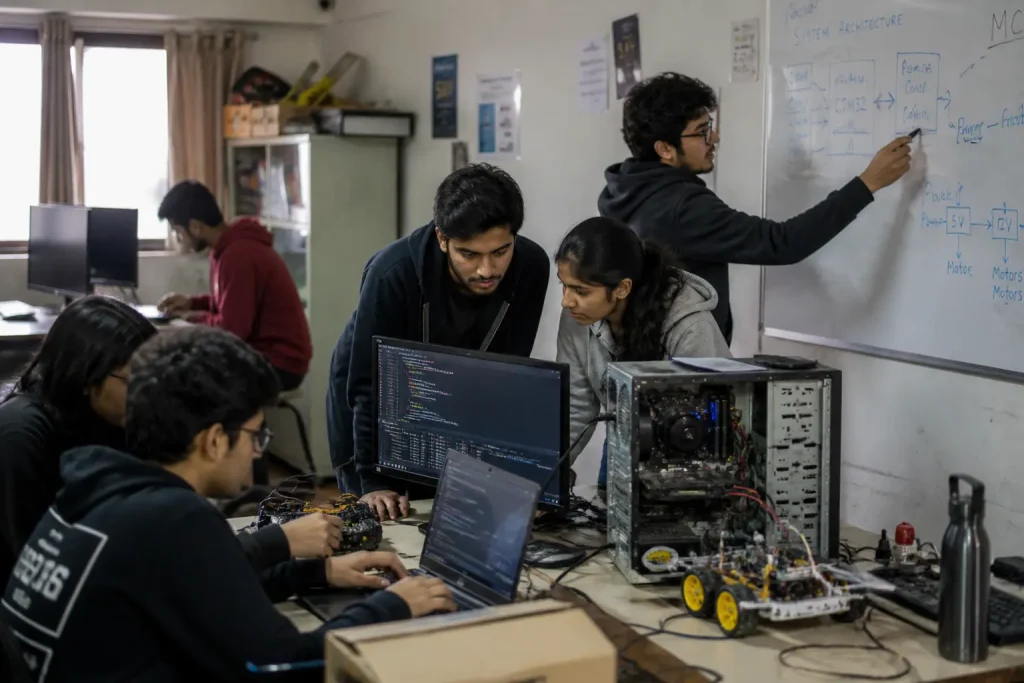
This is the question that deserves the most honest answer. DSU has spoken about skilling thousands of students across disciplines giving them exposure to AI tools, preparing them for roles in healthcare technology, cybersecurity, robotics, and more. Six focused research and industry hubs are planned, covering areas that genuinely matter for India’s future.
That sounds like real intent.
And for students who get meaningful access to this infrastructure who actually work on live projects, who build real things, who walk out with experience and not just a certificate, it could be genuinely life-changing.
But here’s what doesn’t get said: an AI factory, by its very nature, doesn’t need many people to operate it. It needs a small, highly specialised team. The announcement itself mentions the university is hiring expert architects and senior engineers to run the facility. Those are not student roles. Those are professional roles.
So, when 20,000 students are promised “skilling”, what does that actually look like in practice? A few months of exposure? A short internship? A workshop series? Or a deep, employment-ready experience? The difference matters enormously.
Especially in a country where the word “internship” is sometimes the full extent of what institutions mean when they say “industry experience.” Skilling students and employing students are two very different things. The line between them is where the real promise lives or gets lost.
At the India AI Impact Summit 2026 in New Delhi, a representative from the university laid out their vision directly, the infrastructure, the student skilling goals, the national ambition. It’s worth watching, not because it changes the questions this article is asking, but because it shows you how confidently and fluently this vision is being communicated at the highest levels.
Why a University and Not a Tech Company?
This is the part of the story that doesn’t get enough attention. India’s government has been actively pushing for AI investment building domestic capability, reducing dependence on foreign technology, and making India a creator of AI rather than just a consumer of it.
That’s a legitimate and important goal.
But when a large tech company or a multinational announces this kind of infrastructure investment in India, the questions start immediately. What’s the environmental cost of running this much computing power? Who owns the data? How many local jobs does it actually create? Who really benefits? Those are fair questions. And they’re harder to ask politically, publicly, when the same infrastructure sits inside a university.
Because suddenly, it’s for the students.
It’s for the nation’s youth.
It’s for education.
And nobody wants to be the person arguing against education.
Data centres globally, and an AI factory is essentially a specialised data centre, are increasingly under scrutiny for their energy appetite and water consumption.
Communities near Meta’s data centres in Louisiana and El Paso have raised concerns about carbon emissions, water depletion, and power grid strain. India isn’t there yet in terms of public debate, but the infrastructure reality is the same regardless of what sits around it. Routing big compute through academic institutions is quietly becoming a pattern in how governments and companies navigate the friction of AI expansion.
It’s smoother. It’s more palatable. It looks better in a press release.
That doesn’t make it dishonest. But it’s worth seeing clearly.
What’s Genuinely New Here
To be fair, what DSU is doing has no real parallel in India.
No university in the country has previously built this kind of AI infrastructure on campus. The ambition is real. The investment is real. The partnership with one of the world’s leading technology companies is real. If the six research centres actually deliver applied work. If students get genuine, hands-on time with meaningful projects. If graduates walk out more prepared than their peers at other institutions, then this is a story about India getting something right. The pieces are there. A serious infrastructure. Industry partnerships. A sustainability angle through DSU’s collaboration with Siemens. A clear goal of preparing students for the jobs that are actually coming.
The question is always whether the pieces connect in the way they’re described or whether, a few years from now, the factory hums quietly in the background while students attend lectures in the building next door.
The Underneath Story
Every big announcement has a surface story and an underneath story.
The surface story here is clean and compelling: a university is giving students access to world-class AI infrastructure, bridging the gap between education and industry, and contributing to India’s technological future.
The underneath story is a little more layered. A massive infrastructure investment gets built in India under an educational banner, making it harder to question, easier to approve, and very good for enrollment numbers.
Parents, hungry for any edge in a brutal job market, rush toward the promise of hands-on AI experience. And a private university cements its brand in a way that no amount of conventional marketing could achieve. Both stories are true.
They’re not mutually exclusive. The students who genuinely engage with this infrastructure will benefit. The research that comes out of it may matter. The internships, however limited, are better than nothing.
But if five years from now, the primary outcome is a lot of certificates, a busy factory floor running on a skeleton crew, and an admissions brochure that sells on the word NVIDIA, then the story will need to be told differently.
The honest version isn’t cynical. It’s just more complete.
Key Takeaways
- Dayananda Sagar University has made a bold, unprecedented move in Indian higher education, partnering with NVIDIA to bring production-grade AI infrastructure directly onto a university campus, backed by an investment of over ₹175 crore.
- The promise to students is real and genuinely compelling, especially in a country where engineering graduates are struggling to find relevant work. The hands-on experience angle, the industry partnerships, and the range of research areas all point to genuine ambition.
- DSU’s own official page frames this explicitly as a placement differentiator, not just an educational upgrade. That framing deserves attention.
- But the branding power of this move is just as significant and arguably more immediate in its impact. No other Indian university can make this offer right now, and parents will notice.
- The gap between skilling students and actually employing them remains wide. That gap deserves honest tracking, not just hopeful language.
- And the broader pattern of routing large AI infrastructure investments through educational institutions to reduce friction is worth watching as India’s AI ambitions grow.
Conclusion
There’s something genuinely exciting about a student in Bengaluru getting access to AI infrastructure that most companies in India can’t even afford. That shift is real, and it matters.
But excitement has a way of drowning out the right questions. And this announcement, for all its ambition, comes with questions that deserve real answers, not just more press releases.
If the students who enrol on the strength of this promise actually come out the other side with skills, experience, and careers that reflect what was offered, this will look like a visionary moment in Indian education. If the factory runs, the branding works, the admissions numbers climb, and the students get a certificate and a workshop, it will look like something more familiar.
The infrastructure is in place. The story has been told well.
Now comes the harder part: living up to it.
Because a promise made to an anxious parent and a hopeful student is not the kind of promise you get to walk back quietly.
