
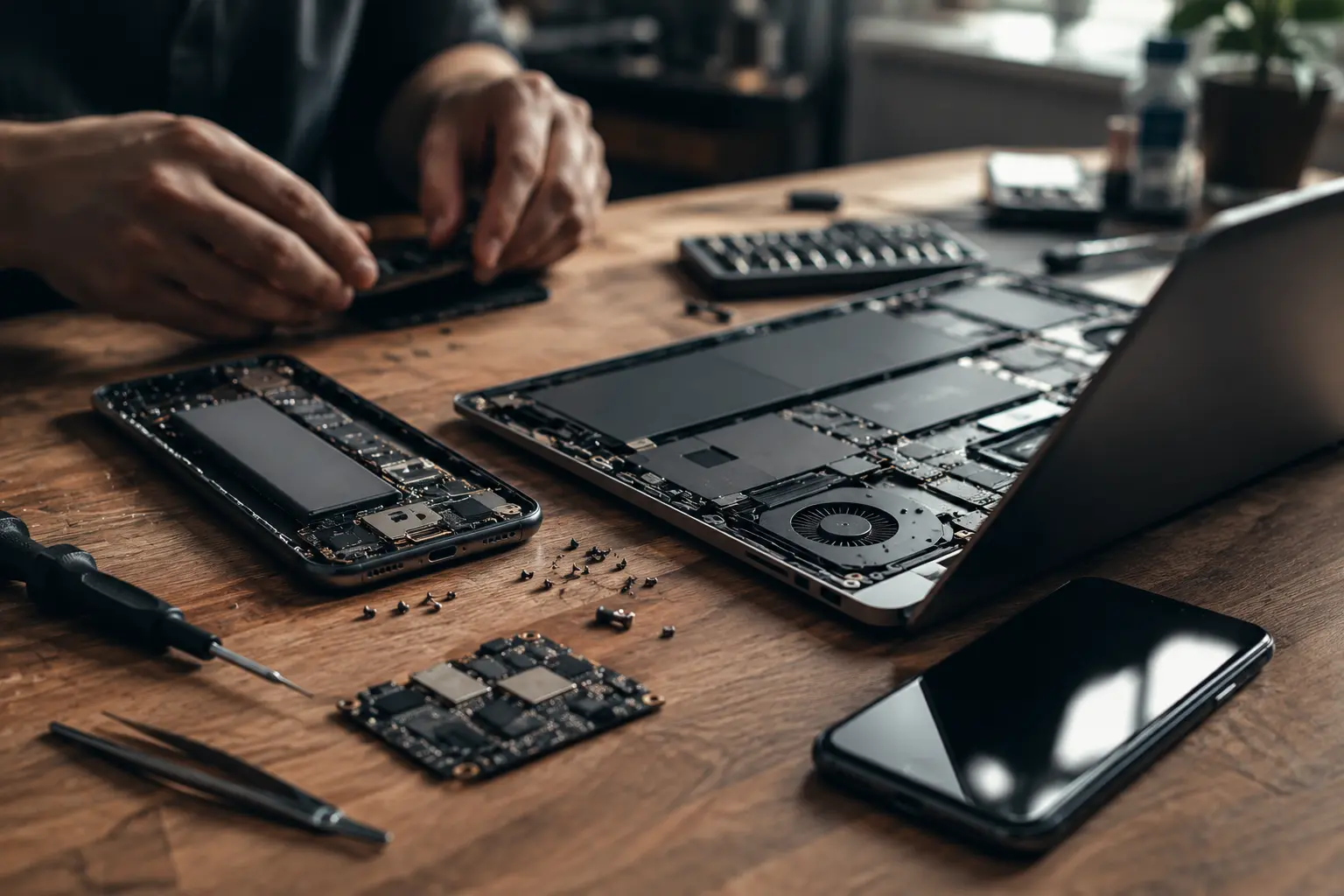

Somewhere between the moment you dropped your phone on a tiled floor and the moment the new model dropped on a Tuesday morning, an entire industry quietly built itself around the gap.
Not around selling you the new device. Around the one you left behind.
And it turns out that gap is worth nearly $79 billion.
Introduction
Refurbishing electronics, the process of restoring used or returned devices to working condition and reselling them, has graduated from niche to necessary. What once meant a sketchy listing on a classifieds site now means a certified, warranty-backed device that has passed 130-plus functional tests before it reaches your hands.
People care about it now because two things happened simultaneously: new flagship phones crossed the $1,300 mark, and the world started keeping score on e-waste. Those two forces, economics and conscience, collided. And refurbishing was already waiting at the intersection.
How It Actually Works
Most people imagine refurbishing as a quick wipe-down and a fresh box. It isn’t. A properly refurbished device goes through a layered process that mirrors what a manufacturer does, just applied to hardware that already has a history.
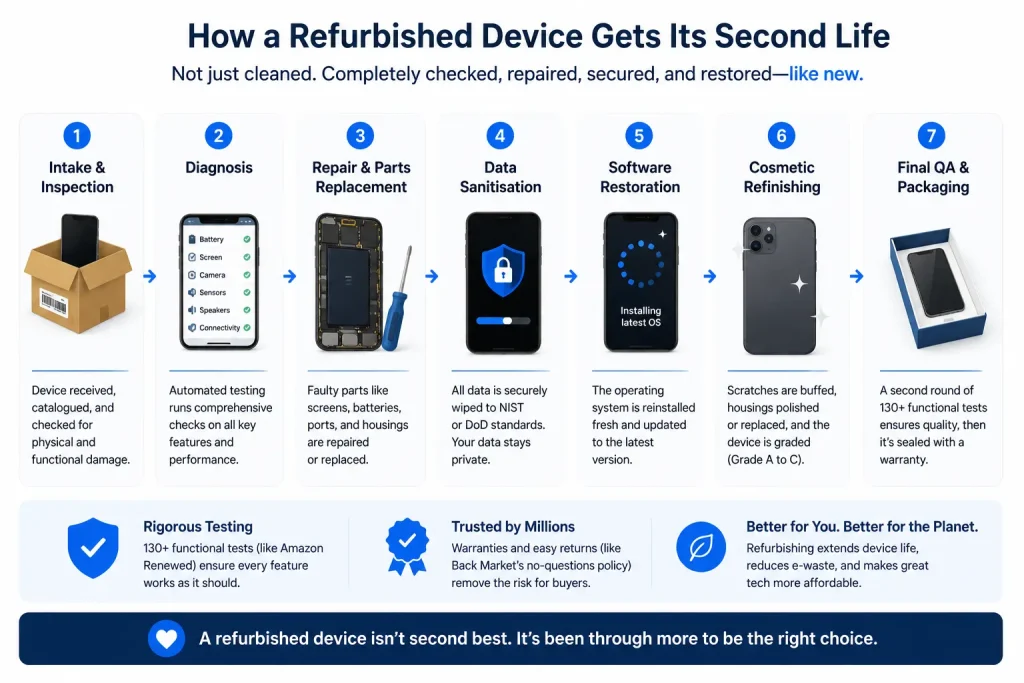
The refurbishment pipeline typically runs like this:
- Intake & inspection: The device is received, catalogued, and assessed for physical and functional damage.
- Diagnosis: Automated testing suites run checks on battery health, screen calibration, camera, sensors, speakers, and connectivity.
- Repair & parts replacement: Broken screens, degraded batteries, faulty charging ports, and damaged housings are repaired or swapped.
- Data sanitisation: All previous user data is securely wiped, typically to NIST or DoD standards, in enterprise refurbishment.
- Software restoration: The OS is reinstalled fresh. For phones, this means factory reset to the latest supported OS version.
- Cosmetic refinishing: Scratches are buffed, housings polished or replaced, and the device graded cosmetically (Grade A through C in most systems).
- Final QA & packaging: A second round of functional testing, then sealed with a warranty.
Platforms like Amazon Renewed require 130-plus functional tests before a device can list. Back Market, which reported €320 million in revenue in 2023, built its reputation on warranties and no-questions returns, structurally removing the risk that previously scared buyers away.
That’s not a grey market. That’s an industry.
Who Is Driving This and Where
The market isn’t one audience. It’s four overlapping ones simultaneously.
Consumers in emerging markets are the volume engine. India’s refurbished phone market is projected to grow at 14.5% CAGR through 2033, the fastest of any single market globally. The reason is structural: smartphone penetration sits at 68% worldwide, but flagship prices have outpaced income growth. Refurbishment bridges that gap.
Enterprises are quietly becoming major buyers. Enterprise demand for refurbished devices is climbing at 8.52% annually, driven not just by cost-cutting but by corporate ESG commitments. Buying 500 refurbished laptops instead of new ones is a sustainability metric that boards care about now.
Students and young professionals in mature markets are choosing refurbished as a deliberate identity choice, not a compromise. Surveys show that 62% of millennials and Gen Z buyers have no hesitation purchasing refurbished devices, a figure that would have been unthinkable a decade ago.
And then there’s the Right to Repair movement, which has found legislative momentum in the EU and several US states. Extended warranties and repair-first regulations have, as of 2026, increased average device longevity by roughly 24 months. That’s two extra years of useful life extracted from hardware that already exists.
Two extra years. Think about what that means at scale.
What Most People Are Missing
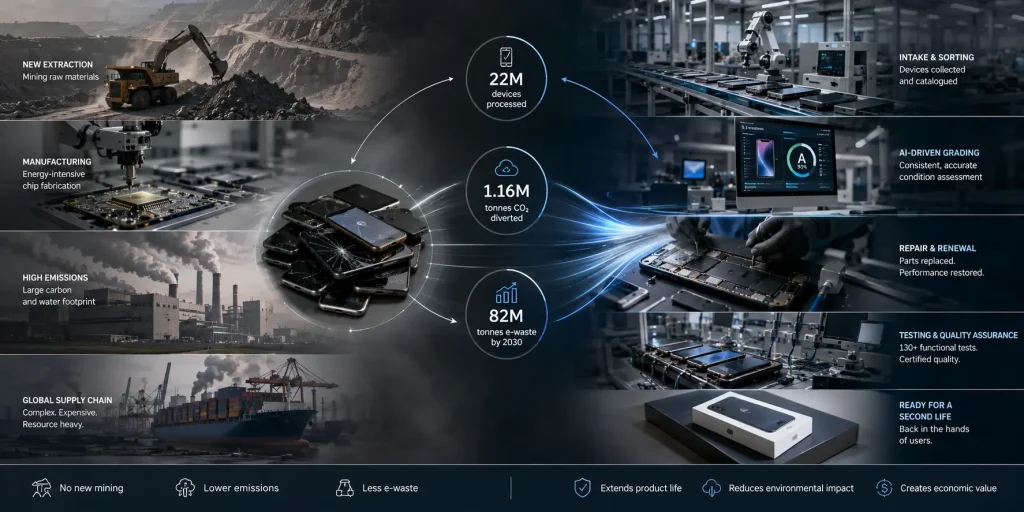
Here’s the part that rarely makes the headline: refurbishing isn’t just a consumer trend. It’s a supply chain rethink.
When Assurant processed 22 million devices in a single year, returning $3 billion to owners and diverting 1.16 million tonnes of CO₂ equivalent, that’s not a recycling program. That’s an alternative manufacturing pipeline. One that doesn’t require new silicon, new mining, or new energy-intensive fabrication.
The UN’s Global E-Waste Monitor 2024 projects e-waste reaching 82 million tonnes by 2030. Currently, less than 13% of e-waste globally is properly recycled. Refurbishing, while not a complete solution, is the most immediate, scalable intervention that already works.
And technology is accelerating the model. AI-driven grading systems can now assess device condition with higher consistency than human inspectors. Automated refurbishment lines are being deployed at an industrial scale. The European Investment Bank saw enough conviction here to extend a €17 million loan to Swappie, an iPhone refurbisher, in 2024.
This isn’t a niche anymore. It’s an asset class.
Limitations and Challenges
Refurbishing isn’t without friction. Approximately 20% of potential buyers still hesitate due to battery health concerns and uncertainty around warranty depth. That hesitation is often justified, grading standards vary significantly between sellers, and a ‘Grade A’ device from one refurbisher may not equal another’s. Supply consistency is a structural challenge. The best inventory, recent-model, well-maintained flagship devices, flows through trade-in programmes that manufacturers control. Independent refurbishers compete for the remainder, which means quality and availability are uneven.
Regulatory inconsistency across markets adds friction for cross-border refurbishers. What meets EU standards may not satisfy requirements elsewhere. And low-cost new devices, particularly from Chinese OEMs, apply constant price pressure at the entry level, squeezing the value proposition of basic refurbished models.
Consumer education remains incomplete. Despite market growth, awareness of the refurbishment process itself, what testing actually occurs, and what warranties mean in practice, is still low enough that buyer confidence lags behind market supply.
Key Takeaways
- The global refurbished phone and device market reached ~$78.6 billion in 2026, projected to grow to $135 billion by 2033.
- Refurbished devices typically sell for 30–60% less than new equivalents while offering certified functionality and warranty.
- The mid-price tier ($200–$350) dominates with 54% market share, driven by balance of affordability and premium features.
- Asia-Pacific leads with 36% of global market share; India is the fastest-growing individual market at 14.5% CAGR.
- AI-powered grading and automated testing lines are standardising quality and reducing human inconsistency.
- E-waste reaches 50 million+ tonnes annually; refurbishing is the most scalable immediate intervention.
- Enterprises, students, and emerging-market consumers are the three engines of current demand growth.
- Right to Repair legislation in the EU and US is extending device lifespans by an average of 24 months.
Conclusion
There’s a version of this story that gets told as a market report, and that version stops at the revenue numbers. But the more compelling version is simpler.
A phone you stopped using is still a fully functioning, rare-earth-mineral-rich piece of engineering. Somewhere in the supply chain, someone figured out it was worth more restored than discarded. They were right. And now an entire industry, worth billions, touching millions of lives, has been built around that one insight.
The question isn’t whether refurbishing matters. The question is why it took us this long to notice.
