

Somewhere in a Walmart distribution centre, a food safety investigator types a query. Seven years ago, the answer would have taken seven days: calls to suppliers, emails to distributors, paper trails across three countries.
Today, it takes 2.2 seconds.
That’s not a software upgrade. That’s a different kind of infrastructure entirely, one where the record of every farm, processor, and handler is immutably logged on a shared ledger that nobody owns, and nobody can quietly edit.
Blockchain cybersecurity generates a lot of architecture diagrams and market projections. This piece skips those. What follows are the actual companies, actual deployments, and actual numbers, across four domains where the technology is no longer being piloted. It’s running.
1. Decentralised Identity Management
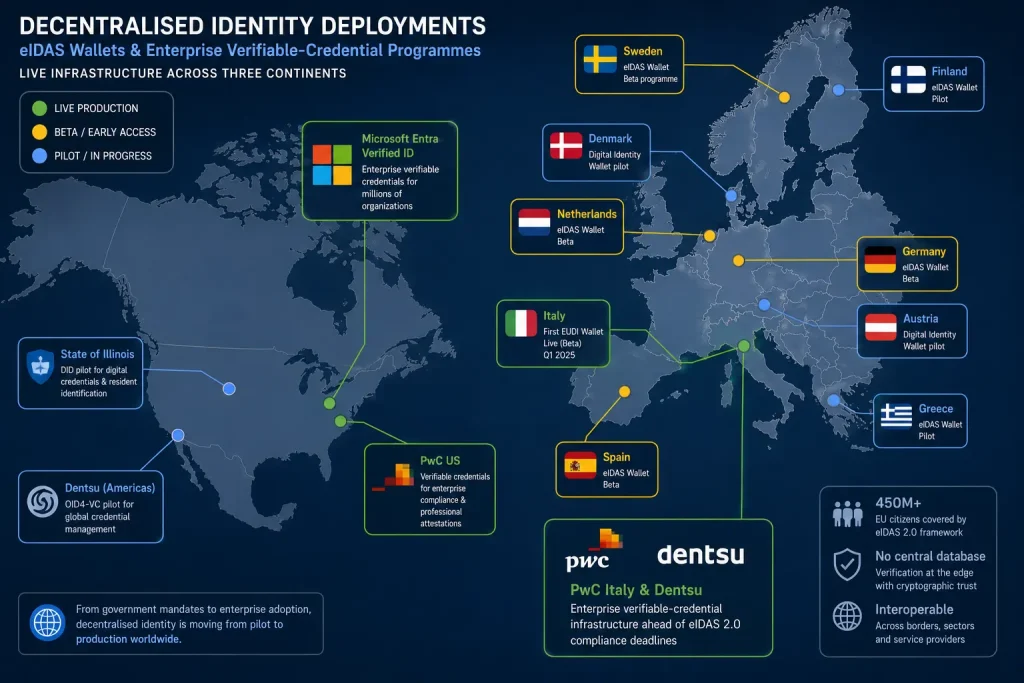
Microsoft: Entra Verified ID
Microsoft did not announce a blockchain identity pilot. It shipped one as a default feature.
Entra Verified ID, part of the Microsoft Entra identity suite, allows organisations to issue, request, and verify tamper-proof credentials anchored to a decentralised identifier (DID) on a blockchain. It’s now embedded in Office 365 tenants. For the millions of enterprise customers already running Microsoft infrastructure, the adoption barrier dropped from a multi-year integration project to a configuration toggle.
The practical outcome: employee credentials, academic qualifications, and professional certifications can be verified without calling back to a central directory. A hiring manager in one country can verify an applicant’s credentials issued by an institution in another, cryptographically, in seconds, without intermediaries.
11.2% Microsoft’s share of the decentralised identity market in 2025, the single largest slice in a fragmented field (Global Market Insights).
EU Governments: eIDAS 2.0 Wallets
The European Union’s updated eIDAS 2.0 framework mandates that member states make certified digital identity wallets available to citizens by 2026. Italy launched the first EUDI (European Digital Identity) Wallet in late 2024, entering beta testing in Q1 2025. Germany and others followed.
These wallets use Decentralised Identifiers (DIDs) and Verifiable Credentials (VCs), the same standards underpinning enterprise blockchain identity systems. A citizen can prove age, residency, or professional accreditation to any compliant service provider, without exposing the underlying document.
The security implication is direct: no central EU identity database holding records for 450 million people. No single breach point. Verification happens at the edge, cryptographically, between the citizen’s wallet and the requesting service.
2. Supply Chain Integrity
Walmart & IBM Food Trust: The 7-Day Problem
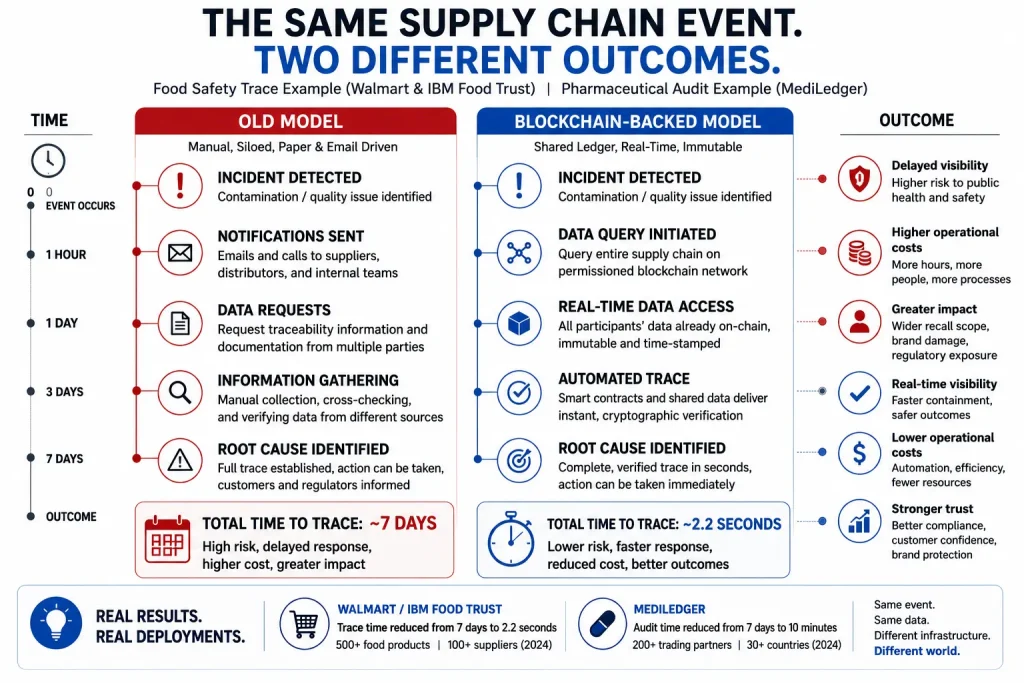
In 2016, Walmart faced a question they couldn’t answer fast enough: where did a contaminated food product come from? Tracing it through their supply chain took seven days, long enough for a safety incident to become a public health crisis.
Working with IBM’s Food Trust platform built on Hyperledger Fabric, Walmart rebuilt the traceability layer of their food supply chain. Every movement, farm, processor, distributor, and store is logged to a shared, permissioned blockchain accessible to all stakeholders in the chain.
The result: the same traceability task that took seven days now takes 2.2 seconds.
7 days → 2.2 seconds Time to trace a food product’s origin at Walmart, before and after blockchain deployment (IBM Food Trust).
By 2024, Walmart was tracking over 500 food products from more than 100 suppliers using the system. Carrefour and Nestlé joined IBM Food Trust as additional participants, extending the network’s reach and its shared audit trail across supply chain participants who are, in some markets, direct competitors.
DHL & Accenture: Pharmaceutical Serialisation
The pharmaceutical supply chain has a different kind of forgery problem: counterfeit medications. In markets where cold-chain integrity and dosage accuracy can be life-critical, the stakes of a compromised supply chain are immediate.
DHL and Accenture developed a blockchain-based serialisation prototype for tracking pharmaceuticals from manufacturer to end consumer. Every step, temperature, handling, location, and timestamp is recorded immutably. For temperature-sensitive medications where a deviation in transit can render a batch ineffective, the ability to prove chain of custody with a complete, unalterable record is regulatory as much as it is operational. 100% Compliance with temperature-sensitive medication requirements in DHL’s blockchain pharmaceutical tracking prototype.
3. Healthcare Data Protection
Germany & Spain: 3 Million Patient-Consent Tokens
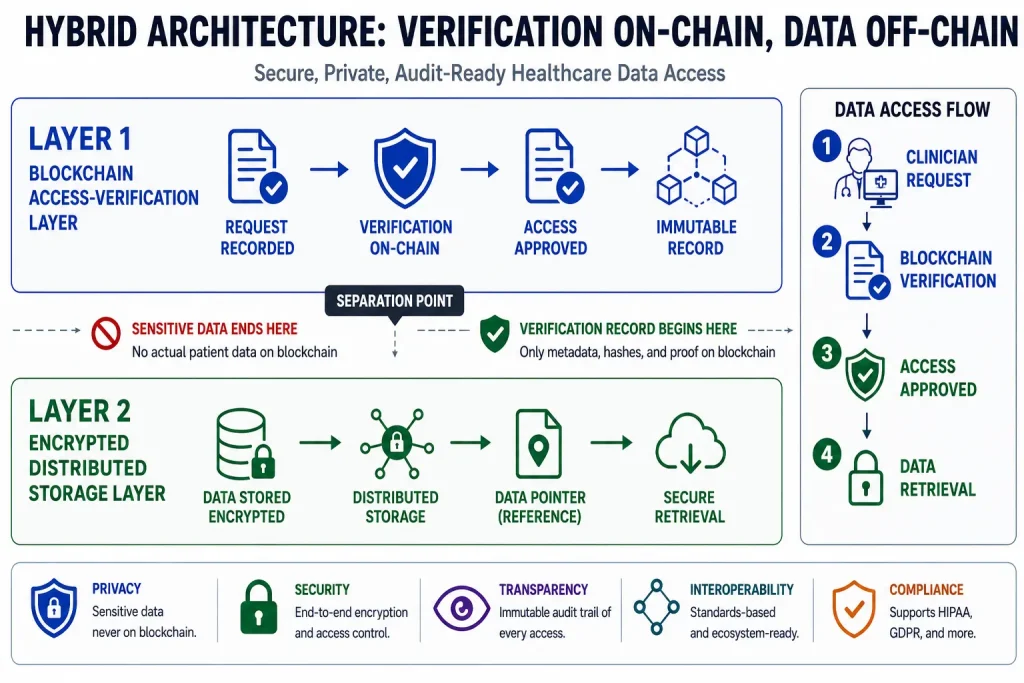
In 2025, a consortium of leading hospital networks in Germany and Spain issued over 3 million patient-consent tokens on Hyperledger Fabric. The model they implemented is deliberately hybrid: blockchain handles access verification, while encrypted distributed storage holds the data itself.
Why split the architecture? Because the blockchain ledger doesn’t need to store medical records, it needs to store the cryptographic record of who is authorised to access them, and when. The sensitive data stays in distributed, encrypted storage. A breach of one storage node doesn’t compromise the verification layer.
A clinician requesting access to a patient record generates a verification event on the blockchain. If they’re authorised, access is granted, and that event is permanently logged. If they’re not, access is denied. In either case, the event is immutable. An auditor examining the record six months later sees every access event, every denial, every authorisation change.
That’s not just better security. That’s a compliance infrastructure that generates its own audit trail automatically.
3 million+ Patient-consent tokens issued on Hyperledger Fabric by German and Spanish hospital networks in 2025
Frere Provincial Hospital: A Smaller-Scale Example
Not every case study involves a major tech company and a Fortune 500 rollout. Frere Hospital in the Eastern Cape province of South Africa implemented a Hyperledger Fabric-based EHR management system to address a specific problem: fragmented, inaccessible paper-based records that delayed treatment.
The system uses a permissioned blockchain where medical practitioners are granted temporary access to patient records, a time-bound cryptographic permission that expires automatically. Patients retain control of their records. Practitioners access only what they’re authorised to see, for only as long as the treatment requires.
The deployment is modest in scale. Its significance is that it demonstrates the same architecture works at a regional hospital, not just in billion-dollar networks. The technology isn’t gatekeeping healthcare blockchain to large institutions.
4. Threat Intelligence Sharing
BlockIntelChain: What a Production Framework Looks Like
BlockIntelChain, a recently published consortium blockchain framework for cyber threat intelligence sharing, demonstrates the technical architecture that serious threat-sharing infrastructure now runs on.
Built on an Ethereum consortium chain, it uses:
- Zero-Knowledge Proofs (ZKPs): to verify the intelligence is authentic without revealing the source’s internal data.
- Homomorphic encryption: allowing analysis to run on encrypted threat data without decrypting it first.
- Federated Learning: trains threat detection models across participant nodes without centralising the raw data.
In empirical testing, the federated model achieved 94.7–96.4% detection accuracy versus 93.2% for centralised baselines, while simultaneously reducing training latency by 28% and communication overhead by 35%.94.7–96.4% Threat detection accuracy in blockchain-based consortium intelligence sharing vs. 93.2% for centralised baseline (BlockIntelChain, Scientific Reports, 2025).
IBM X-Force & CrowdStrike: The Direction of Enterprise Intelligence
At RSA 2026, IBM and CrowdStrike announced an expanded strategic collaboration integrating CrowdStrike’s Charlotte AI with IBM’s Autonomous Threat Operations Machine (ATOM), a coordinated, machine-speed investigation and containment framework across shared intelligence feeds.
The partnership isn’t blockchain-native in its current form, but it represents the commercial direction: threat intelligence shared at machine speed, across organisational boundaries, with accountability for every action. As blockchain-based audit trails become standard infrastructure, they slot naturally into this layer. The threat environment makes the pace clear. According to the CrowdStrike 2026 Global Threat Report, the average eCrime breakout time has dropped to 29 minutes. The fastest was observed in 27 seconds. Manual intelligence-sharing cannot respond at that speed. The infrastructure that needs to be immutable, trusted, and distributed by design.
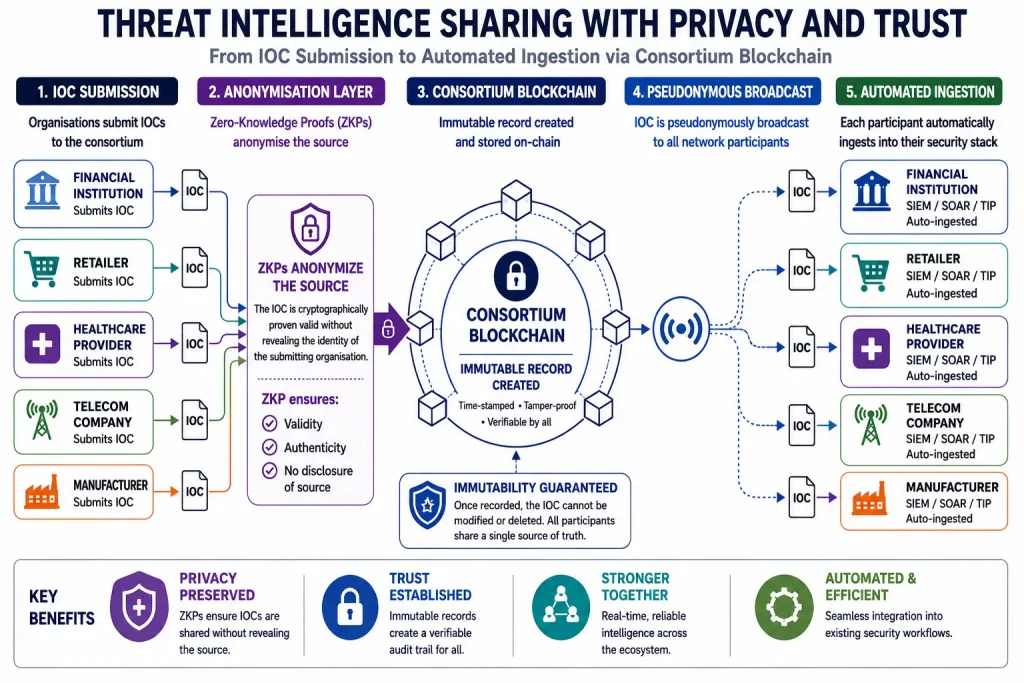
Figure 4: Threat intelligence moves across the consortium in real time, while cryptographic verification and ZKPs protect the identity of the organisation that submitted it.
What the Case Studies Collectively Show
In every case, blockchain was deployed not to add security on top of an existing system, but to change the trust model of that system. Walmart didn’t make its existing supply chain database faster. It replaced the database with a shared ledger where no single participant controls the record. Microsoft didn’t strengthen its central identity directory. It distributed the credentials out of the directory entirely.
The pattern is consistent: centralised trust gets replaced by cryptographic verification. And in every case where that replacement has been measured, the outcomes are better, faster, more accurate, and less exposed than the system it replaced. In every deployment where the numbers were measured, blockchain didn’t just improve performance. It restructured who owns the record and who can be held accountable for it. Walmart’s seven-day problem became a 2.2-second answer. That’s not a faster version of the same architecture. It’s a different architecture entirely.
Key Takeaways
- Blockchain cybersecurity has moved beyond pilots into active production systems across identity verification, healthcare, supply chains, and threat intelligence networks.
- Microsoft, EU governments, Walmart, DHL, and major hospital networks are already using blockchain infrastructure to reduce verification time, improve auditability, and remove single points of failure.
- The core architectural shift is not just stronger security, but replacing centralised trust with cryptographic verification shared across multiple participants.
- Hybrid blockchain models are becoming the dominant approach in sensitive sectors like healthcare, where blockchain verifies access permissions while encrypted off-chain systems store the actual data.
- Real-world deployments are showing measurable operational gains, including Walmart reducing food traceability from seven days to 2.2 seconds and blockchain threat-sharing systems outperforming centralised security models in both speed and detection accuracy.
Conclusion
Every number in this article came from something that actually ran.
Seven days to 2.2 seconds. Ninety days to 72 hours. Ninety-four per cent detection accuracy. Three million consent tokens. Those aren’t projections from a research firm, they’re measurements from production systems, taken after deployment, by organisations with reputational and operational skin in the game.
The argument for blockchain in cybersecurity used to require explaining why the architecture was theoretically superior. That argument is now easier to make because you no longer have to make it theoretically.
You just have to point to what’s already running.
The question that remains is whether the organisations that haven’t deployed yet are waiting for the technology to mature, or waiting for a breach to force the decision. Those are very different kinds of waiting. And historically, in security, only one of them ends well.
