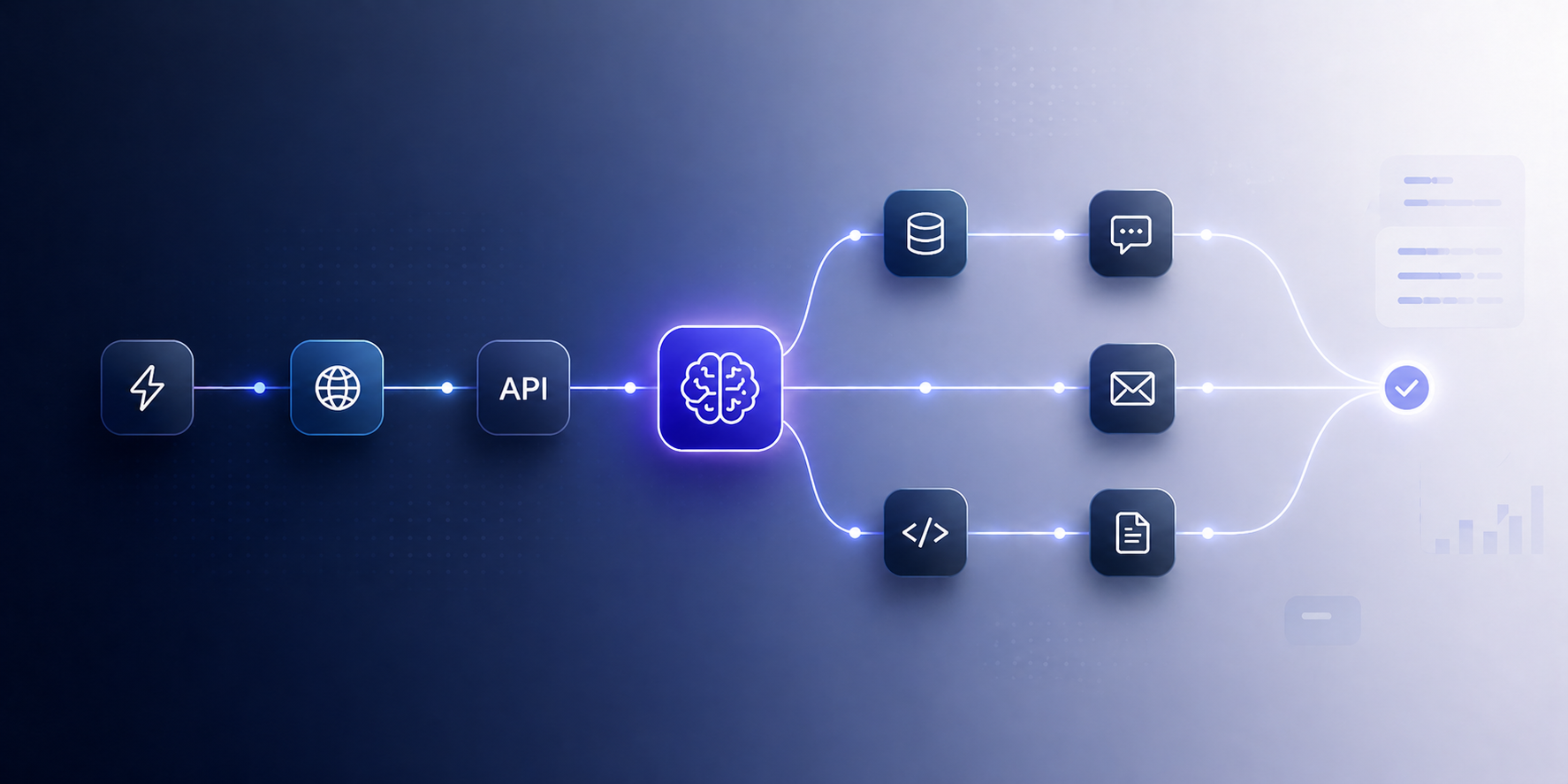

Most automation tools are built for one kind of person. Either you’re technical enough to write the code yourself, or you’re not, in which case you get a simplified, locked-down interface with invisible limits.
n8n was built for the people caught in between, the ones who can write code but shouldn’t have to for every small task.
This guide covers how n8n works, what AI agent capabilities look like in practice, why self-hosting matters, and real use cases worth knowing about in 2026.
What Is n8n?
n8n is a source-available platform that lets you build automated workflows using a visual drag-and-drop canvas. You connect nodes, each node representing a trigger, an action, a logic step, or an API call, and the platform handles the rest.
The name is short for “node to node.”
It combines AI capabilities with business process automation, giving technical teams the flexibility of code with the speed of no-code. It’s not trying to replace your engineers. It’s trying to stop them from spending Tuesday afternoon moving data between a spreadsheet and a CRM.
Where It Came From
n8n burst onto the developer scene in October 2019 with a radical premise:
What if workflow automation were powerful enough for engineers, transparent enough to inspect, and free enough to self-host?
It was founded by Jan Oberhauser — a former VFX artist who worked on Hollywood blockbusters like Maleficent and Happy Feet Two, and grew from a scrappy Berlin side project into a $2.5 billion automation platform.
It was Sequoia’s first seed investment in Germany. Today, it has over 183,000 GitHub stars, 230,000 active users worldwide, a 141% increase over 2025, and more than 400 native integrations with tools like Slack, HubSpot, Google Workspace, Shopify, and Stripe. That kind of growth doesn’t happen because the landing page is good.
It happens because the tool actually works.
How It Works
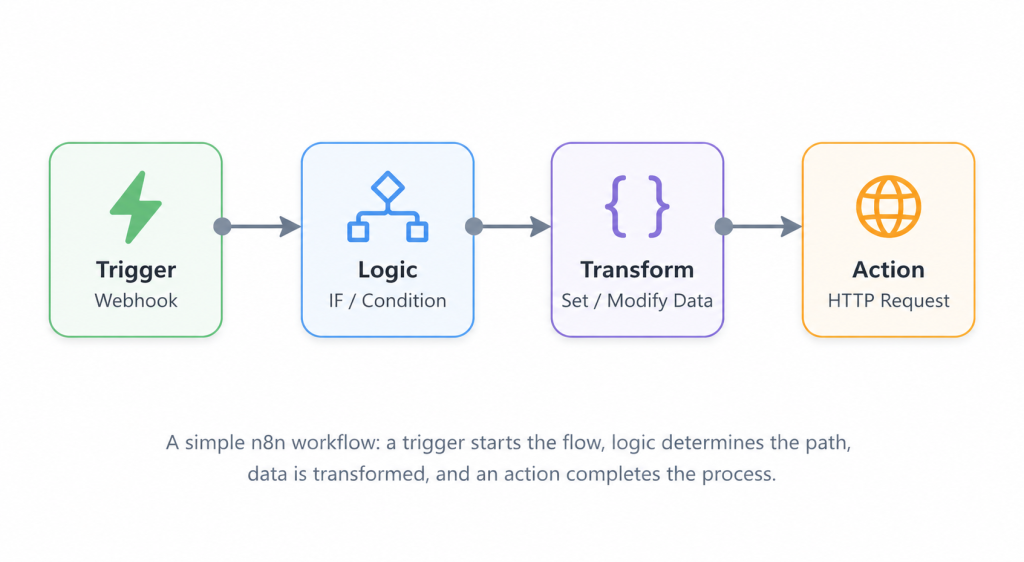
Every n8n workflow starts with a trigger, a webhook, a schedule, an incoming email, or a form submission.
That trigger fires the first node, which passes data to the next, and the next, until the workflow completes.
What makes n8n different from simpler tools is what you can put between those nodes. Conditional logic. Loops. Custom JavaScript. HTTP requests to any API. Data transformations. And increasingly, AI.
The platform supports AI Agent nodes that connect to any major LLM, including OpenAI, Anthropic Claude, Google Gemini, and self-hosted models. You can build RAG pipelines with native vector database integrations, and it supports Anthropic’s Model Context Protocol, which has already seen over 8 million server downloads.
Real Use Cases
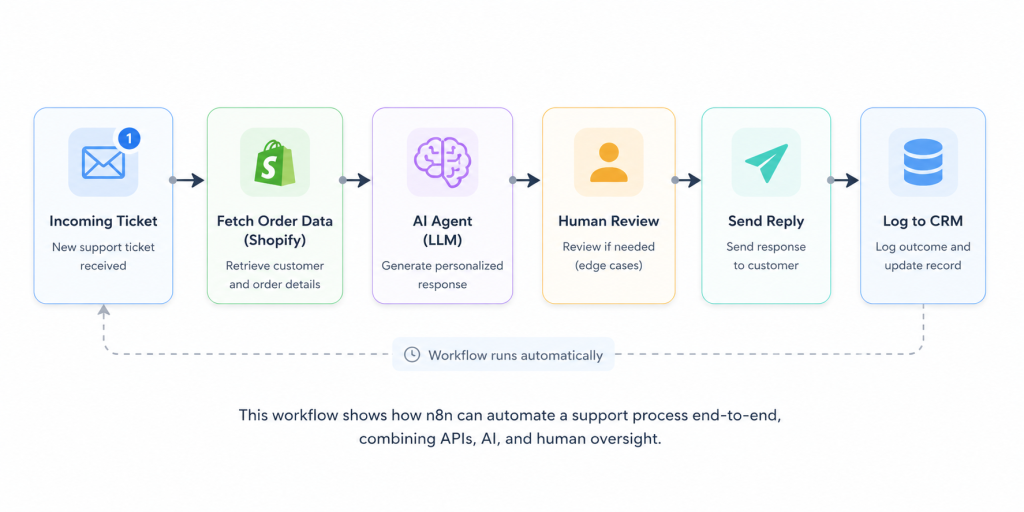
The real measure of any automation platform is what teams actually build with it.
Here’s what n8n looks like in practice:
Customer support automation: A workflow reads an incoming support ticket, queries purchase history in Shopify, searches an internal knowledge base, drafts a personalised reply via an LLM, escalates edge cases to a human reviewer, and logs the outcome, all without a line of custom application code.
Internal ops pipelines: Finance and ops teams use n8n to sync data between spreadsheets, CRMs, and ERPs on a schedule, replacing fragile manual exports with auditable, version-controlled workflows.
AI-assisted content workflows: Marketing teams route new content briefs through an LLM for first-draft generation, push drafts into Notion or Google Docs for review, and notify Slack when approval is needed.
Compliance-sensitive data processing: Regulated industries (healthcare, fintech, legal) self-host n8n to run sensitive document processing pipelines entirely within their own infrastructure, with no third-party access to the data in transit.
Developer tooling: Engineering teams trigger n8n workflows from GitHub events to run automated checks, post to internal dashboards, or update project management tools when PRs merge or issues close.
Why Self-Hosting Changes Everything
Most automation platforms are cloud-only.
That’s fine until your data has compliance requirements, or your company operates in a regulated industry, or you simply don’t want a third party holding your API credentials.
With self-hosting, teams retain full control over their own data, execution, and compliance. The Docker setup gives full access to logs, execution history, custom nodes, and the ability to persist data. This is the reason enterprises are choosing n8n over Zapier for sensitive workloads.
n8n offers a 10 to 50x cost advantage over Zapier for complex workflows, and when you’re running thousands of executions, that gap becomes impossible to ignore.
What’s New in 2026
The biggest recent shift is n8n’s move toward becoming a serious AI orchestration layer, not just a task automator.
n8n 2.0 introduced a clear distinction between saving a workflow and publishing it, addressing a major pain point where saving could inadvertently change the behaviour of running production automations. It also delivered 10x SQLite performance improvements for self-hosted instances.
On the business side, n8n is opening offices in New York and London to serve enterprise customers, and its partnership with Deutsche Telekom focuses on developing agentic AI solutions. The roadmap signals broader model coverage, stronger agent orchestration, new interfaces beyond the current canvas, and deeper evaluation tools for testing AI reliability.
The Part Most People Overlook
n8n isn’t just a time-saving tool. It’s a way for small technical teams to operate like much larger ones.
The convergence of low-code platforms with AI agents is creating a new category where citizen developers are approaching a 4-to-1 ratio with professional developers. That ratio is the real story. It means the gap between what a two-person team and a twenty-person team can build is closing faster than most organisations realise. The teams that learn to build reliable, well-structured n8n workflows today are building operational leverage that compounds.
The ones that don’t will eventually hire for tasks that could have been automated.
Key Takeaways
- n8n launched in 2019 as a self-hostable, developer-friendly alternative to tools like Zapier.
- It combines a visual workflow builder with the ability to write custom code when needed.
- Native AI agent support lets teams build multi-step autonomous workflows without custom infrastructure
- Real use cases span customer support automation, compliance pipelines, AI content workflows, and internal ops, all without custom application infrastructure.
- Self-hosting gives full data control, critical for compliance-heavy industries.
- n8n 2.0 brought major stability improvements, including publish/save separation and 10x database performance.
- Security vulnerabilities in early 2026 were patched quickly but highlighted real self-hosting responsibilities.
- Cost and flexibility advantages over cloud-only tools are significant at scale.
Conclusion
n8n sits in an interesting place.
It’s too flexible to be dismissed as a simple no-code tool, and too accessible to be reserved for infrastructure engineers. It’s for the developer who’s tired of glue code, the ops team that needs automations they actually own, and the AI team that wants to orchestrate agents without rebuilding the plumbing from scratch each time.
The question worth sitting with isn’t whether your team needs automation.
It’s whether the automations you’re building today will still be serving you in two years or whether you’ll be starting over inside someone else’s pricing model.
