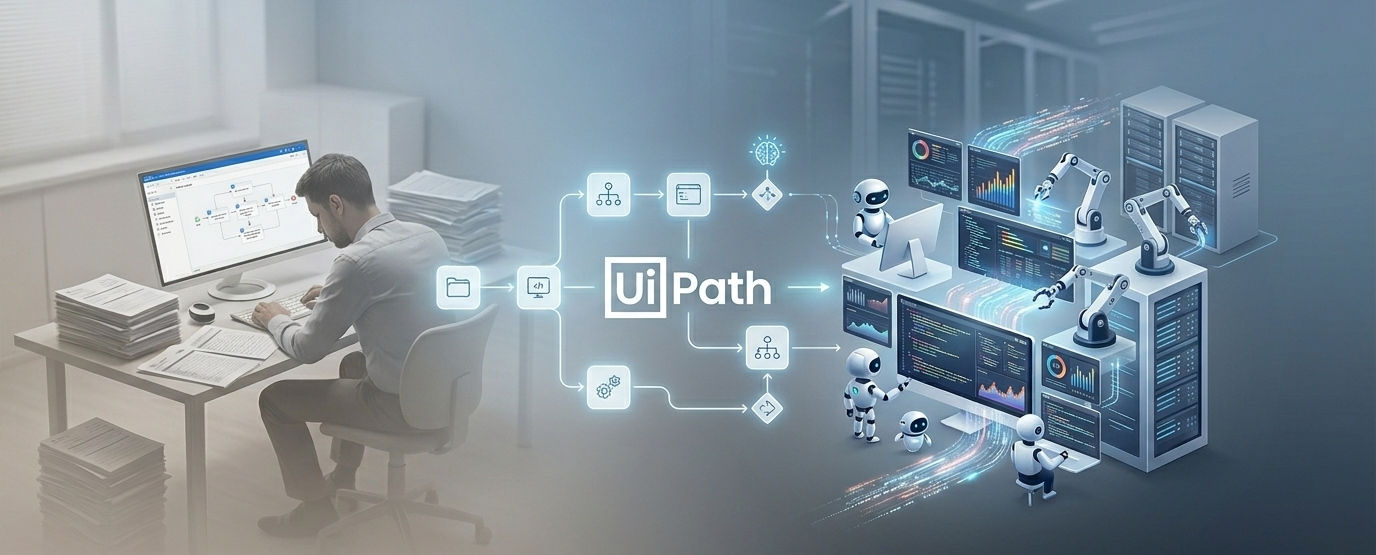

Somewhere in a bank, a claims processor used to spend 4 hours a day copy-pasting data between systems.
Now, a bot does it in seconds, and nobody trained it on day two.
That’s not science fiction. That’s UiPath.
Introduction
Most automation tools promise to save time.
UiPath actually does and then keeps going. What started as a small software project in a Bucharest apartment in 2005 has grown into one of the most influential enterprise platforms in the world. Today, UiPath is trusted by over 10,700 organisations globally, including more than 60% of the Fortune 500.
But in 2026, something bigger is happening.
UiPath isn’t just automating tasks anymore; it’s teaching software to think its way through them.
The Origin Story: A Quiet Start in Romania

Source: Forbes
“He wanted UiPath to be a kind of Romanian Google or Facebook.” — Daniel Dines
In 2005, Daniel Dines, a former Microsoft engineer, returned to Romania with an idea. He founded a small company called DeskOver, building automation toolkits for developers. It wasn’t glamorous. For nearly a decade, he bootstrapped the company with almost no outside funding.
Then in 2013, he pivoted. DeskOver began building tools that could automate repetitive desktop tasks, the kind of work that quietly drains hours from every office worker’s day. By 2015, the company rebranded as UiPath, secured its first seed funding, and opened offices across London, New York, Bangalore, Singapore, and Tokyo.
The growth that followed was hard to explain with conventional logic. By 2019, UiPath had raised $568 million in a single round and was valued at over $7 billion. In April 2021, it went public on the New York Stock Exchange in one of the largest US software IPOs in history, raising $1.3 billion at a valuation of nearly $35 billion.
A small startup from Eastern Europe had quietly become a global tech titan.
What Is UiPath, Actually?
Think of UiPath as a digital workforce manager. It builds software robots often called “bots” that can log into systems, fill out forms, process documents, extract data, and even make decisions, all without a human clicking a single button. This technology is called Robotic Process Automation (RPA).
If you’ve ever watched someone at work spend 30 minutes copy-pasting data from one spreadsheet to another, UiPath automates that. Completely. But here’s what most people don’t notice: UiPath doesn’t just run on its own. It integrates with the tools your team already uses, SAP, Microsoft, Google Cloud, Salesforce, and weaves automation quietly into existing workflows. You don’t rebuild your operation. You just make it faster.
How It Works
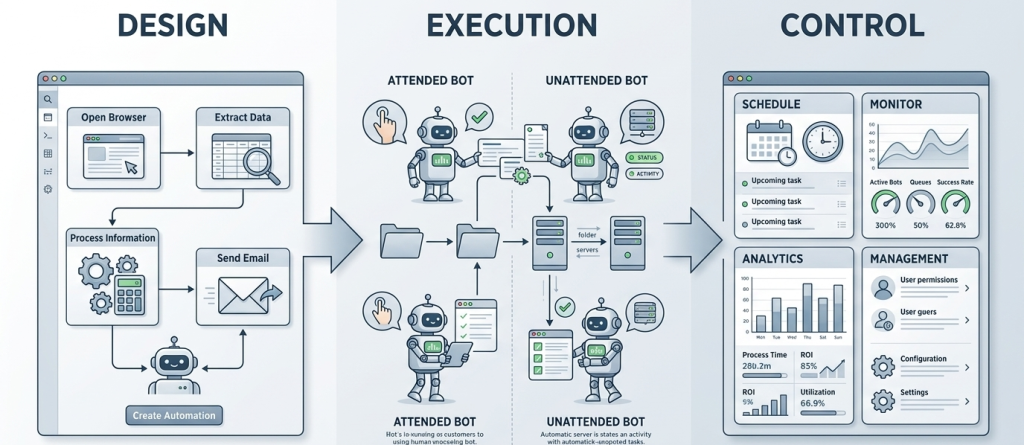
UiPath has three core layers:
1. UiPath Studio, a visual drag-and-drop designer where teams build automation workflows. No deep coding required. If you can map out a process on a whiteboard, you can automate it here.
2. UiPath Robot, the worker. It executes the workflow, running automations either attended (alongside a human) or unattended (completely on its own, 24/7).
3. UiPath Orchestrator, the control room. It manages, schedules, monitors, and reports on every bot running across an organization.
Together, these layers cover the full lifecycle of automation, from design to deployment to oversight.
The Benefits That Actually Matter
There are dozens of reasons companies adopt UiPath. These are the ones worth paying attention to:
- Speed: What takes a human hours takes a bot minutes. Consistently.
- Accuracy: Bots don’t mistype. They don’t get tired. Error rates drop sharply.
- Scalability: You can run thousands of automations simultaneously without adding headcount.
- Cost savings: Reduced manual labour directly impacts operational costs, often showing ROI within months.
- Employee focus: When routine tasks are automated, people shift to higher-value, more fulfilling work.
In industries like banking, insurance, healthcare, and government, where compliance and precision are non-negotiable, this kind of reliability is transformative.
UiPath in 2026: The Agentic Era Begins
Here’s where things get genuinely interesting.
In 2024, founder Daniel Dines returned as CEO with a clear mission: evolve UiPath from an automation company into an agentic AI platform.
The difference matters. RPA bots follow fixed instructions. AI agents reason. They adapt. They decide.
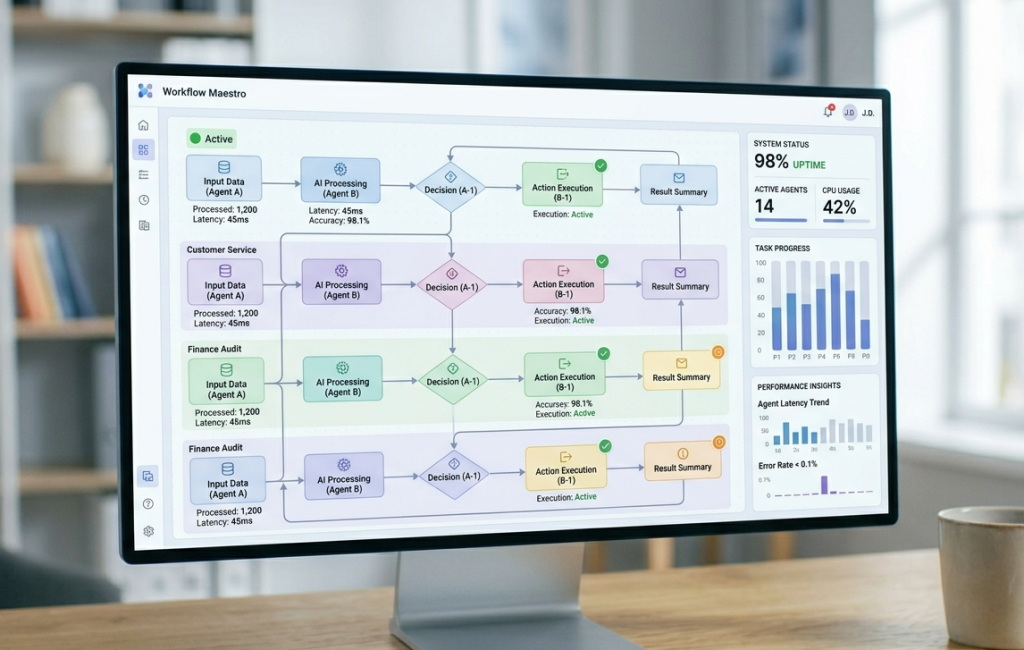
UiPath’s latest platform now enables AI agents to handle complex, multi-step processes, analysing unstructured data, responding to changing conditions, and orchestrating outcomes across multiple systems, all with minimal human involvement.
The centrepiece of this shift is UiPath Maestro™, a unified orchestration layer that coordinates AI agents, robots, humans, and data sources across entire business workflows.
“Agents reason, robots act, and people lead.”
In April 2026, UiPath announced a major partnership with Databricks, one of the world’s leading data and AI companies. The integration allows UiPath agents to securely access real-time enterprise data from Databricks and act on it immediately within automated workflows. This closes the gap between having insights and doing something about them.
Around the same time, UiPath also expanded its collaboration with Deloitte to deliver agentic software testing through Deloitte’s ASCEND platform, automating test design, execution, and failure analysis in ways that were simply not possible before.
And in the same month, UiPath celebrated its fifth anniversary on the NYSE, ringing the opening bell as a company that looks very different from the one that listed in 2021.
Why This Moment Is Different
The original wave of automation was about efficiency, doing the same things faster.
What UiPath is building now is something else entirely: autonomous operations. Software systems that can receive data, interpret it, make decisions, and execute tasks with humans setting the direction, not every individual step. For enterprises dealing with fragmented systems, mountains of data, and limited bandwidth, this is the shift they’ve been waiting for.
Here’s the honest question worth sitting with: If your systems can already think and act on their own, what exactly is left for people to do?
The optimistic answer, and the one UiPath seems to be building toward, is that people get to lead.
Strategy. Creativity. Judgment. The work that actually requires being human.
Key Takeaways
- UiPath was founded in 2005 in Bucharest, Romania, and went public in 2021 in one of the largest US software IPOs in history.
- Its core technology, Robotic Process Automation (RPA), automates repetitive, rule-based tasks across enterprise systems.
- The platform includes UiPath Studio (design), Robot (execution), and Orchestrator (management).
- In 2026, UiPath is evolving into an agentic AI platform, with tools like Maestro™ enabling AI agents to reason and act autonomously.
- Recent partnerships with Databricks and Deloitte signal a major push into data-driven, intelligent enterprise automation.
- Over 10,700 organisations worldwide, including 60%+ of the Fortune 500, rely on UiPath today.
Conclusion
Twenty years ago, a software engineer came back to Romania with an idea that nobody took seriously.
Today, that idea processes millions of tasks every day across some of the world’s largest organisations, and it’s getting smarter by the quarter.
UiPath’s journey from a bootstrapped startup to an agentic AI platform isn’t just a business story. It’s a preview of how enterprise software is being reimagined, not as a tool you use, but as an intelligent layer that runs alongside you. The real question isn’t whether automation will change how your organisation works.
It’s whether you’ll be the one designing that change or catching up to it.
