
For years, a YouTuber with a million subscribers couldn’t get a home loan.
Not because they weren’t earning, but because a bank didn’t know what to call them.
That particular absurdity just ended.
What’s This All About?
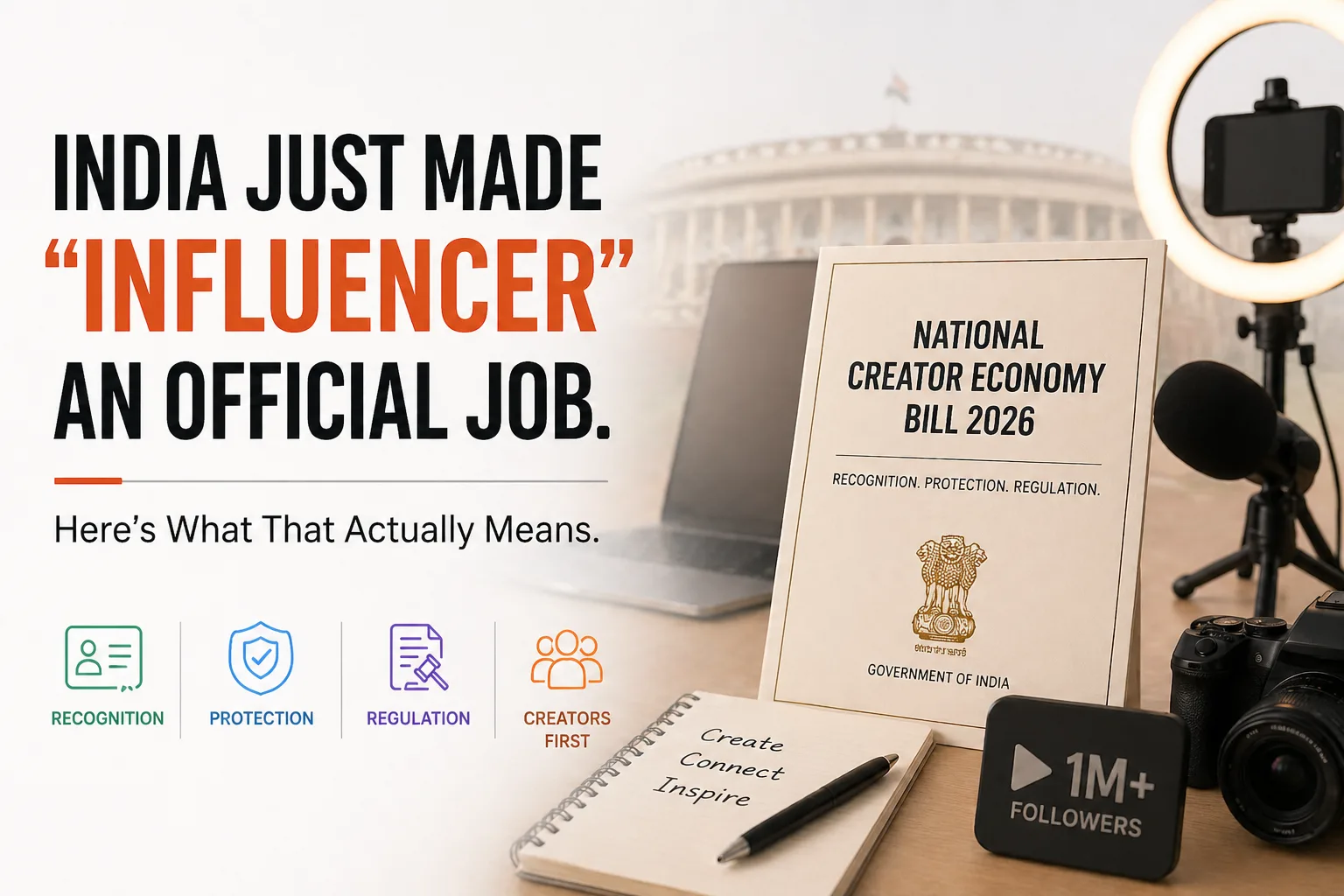
On April 14, 2026, the Rajya Sabha passed the National Creator Economy Bill 2026, formally recognising social media influencers, YouTubers, digital artists, and content creators as professionals under Indian law for the first time.
This isn’t symbolic.
India’s digital creator economy generated over ₹2,200 crore in influencer marketing spend in 2024 alone, an economy operating without a legal identity until now. The Bill awaits Presidential Assent, but its implications for creators, brands, and platforms are already being felt.
What the Bill Actually Does
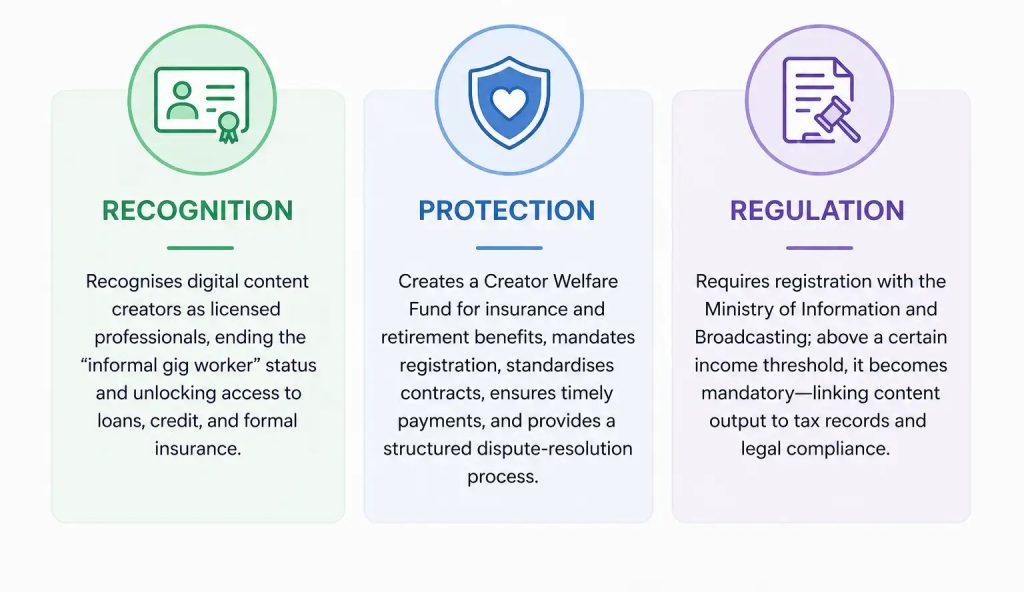
At its core, the legislation does three things: recognises, protects, and regulates.
Those three things don’t always pull in the same direction.
Recognition is the headline. The most significant shift is the formal recognition of digital content creators as licensed professionals, eliminating the “informal gig worker” status that has historically made it difficult for creators to secure bank loans, credit cards, or formal business insurance.
Protection comes through the Creator Welfare Fund. The legislation introduces a dedicated fund for insurance and retirement benefits, alongside mandated registration for professional creators. For people whose income arrives as brand deal payments and ad revenue, this is the first real safety net built specifically for them.
The bill also cleans up the commercial side of the industry. It mandates template contracts between creators, agencies, and platforms that guarantee minimum protections, transparent payment timelines, and clear deliverables, along with a structured dispute-resolution mechanism.
Regulation is where it gets complicated. The threshold for professional status is registration with the Ministry of Information and Broadcasting.
Above a certain income level, registration becomes mandatory, linking content output directly to tax records and formal compliance.
The IT Rules Running Alongside It
The Creator Economy Bill doesn’t stand alone. It works in tandem with the IT Amendment Rules of February and March 2026. Paid collaborations must now be explicitly disclosed by law.
AI-generated or significantly altered content must be legally labelled as “synthetically generated information” (SGI). There’s also a dramatically tightened removal window.
Platforms must remove flagged content within two to three hours of notice, a substantial contraction from the previous 24 to 36-hour frameworks.
A post could disappear before most of its audience has seen it.
Platforms that refuse government orders risk losing their “safe harbour”, the legal shield that protects them from liability over third-party content. That’s not a suggestion. That’s a structural lever over what stays online.
What Most People Are Overlooking
The benefits are real. Professional status, welfare access, standardised contracts, legal recourse, these are protections creators have needed for years. But recognition always has a price.
The bill simultaneously locks creators into stricter tax brackets, mandatory GST compliance, and stringent disclosure protocols; the era of operating informally is over.
The reach also extends beyond Indian borders. A US-incorporated influencer marketing agency running campaigns targeting Indian users is fully subject to IT Rules 2026. Jurisdiction follows the audience, not the server. Creators based abroad, making content watched in India, fall squarely under these rules.
Challenges Worth Naming
The compliance burden is unequal. A large channel with a legal team can absorb registration requirements and GST filings. A solo creator just above the income threshold faces the same obligations with none of the infrastructure.
The amendments would bring content posted by private individuals, YouTubers, Instagram reels creators, influencers, under a three-tier oversight mechanism previously reserved exclusively for professional media organisations. That’s a meaningful expansion of state oversight over everyday digital speech, and critics have been vocal.
Whether India’s creator economy thrives under accountability or suffocates under surveillance may depend on how loudly that pushback is heard.
Key Takeaways
- National Creator Economy Bill 2026 passed Rajya Sabha on April 14, 2026, awaiting Presidential Assent.
- Creators formally recognised as professionals for the first time, unlocking loans, insurance, and retirement benefits.
- Creator Welfare Fund provides a dedicated social security net funded by a digital advertising cess.
- High-earning creators must register with government, linking content to tax records
- AI-generated content must be labelled SGI, paid collaborations require mandatory legal disclosure
- Platforms face a 2–3 hour takedown window, down sharply from 24–36 hours.
- Foreign creators and agencies targeting Indian audiences are subject to these rules regardless of location.
- Compliance burden falls disproportionately on smaller, independent creators.
Conclusion
India has done something most governments haven’t managed: it looked at an economy built on attention and creativity, and decided it was real enough to both protect and regulate.
A creator who can now access health insurance, resolve a contract dispute through a legal framework, and apply for a home loan without explaining what a “sponsored reel” is, that’s a more stable profession than the one that existed last month.
But stability and freedom don’t always arrive together. The same law that grants recognition also creates surveillance.
The same framework that offers protection also demands compliance.
The question for India’s 50 million creators isn’t whether this changes things.
It’s whether the people who wrote the bill understood what it would actually feel like to create under it.
