

Every major regulation in history created a new profession.
GDPR gave us Data Protection Officers. Sarbanes-Oxley gave us compliance auditors. Now the EU AI Act, the world’s first comprehensive AI law, is doing the same thing.
Except this time, most companies don’t have the people yet. And the deadline is August 2026.
Introduction
If you’ve read about the EU AI Act (and if you haven’t, start here), you know what it demands: risk classifications, technical documentation, human oversight, conformity assessments, and ongoing monitoring.
What nobody talks about is the obvious follow-up question: who is actually going to do all of this?
The answer is a new category of professional, part legal, part technical and part ethicist, that barely existed two years ago and is now one of the fastest-growing hiring areas in enterprise technology.
Here’s what these roles look like, what they actually do, and why the gap between demand and supply is becoming a problem.
The Role Everyone Is Scrambling to Fill: AI Compliance Officer
This is the most in-demand new role the EU AI Act has created.
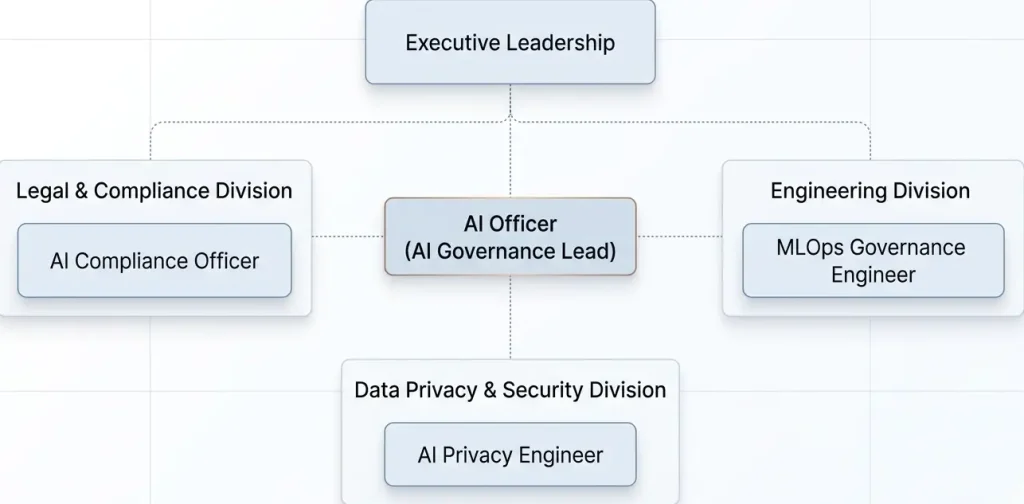
An AI Compliance Officer owns the entire compliance programme for an organisation’s AI systems, especially anything classified as high-risk. They interpret what the regulation actually requires, translate that into operational controls, coordinate documentation, manage audit timelines, and act as the internal bridge between legal, engineering, privacy, and security teams.
Think of them as the person who ensures the gap between what the law says and what the product does is as small as possible.
Most organisations don’t have a complete picture of where AI is running inside their own walls. Shadow AI tools, vendor-integrated models, automated workflows, and compliance can’t happen without first knowing what exists.
The Officer the EU Act Is Quietly Pushing For: The AI Officer
The EU AI Act doesn’t technically mandate a Chief AI Officer. But it strongly recommends one for any organisation deploying high-risk AI, and in practice, that recommendation is increasingly being treated as a requirement.
The AI Officer oversees conformity assessments across the full AI system lifecycle, maintains technical documentation and transparency records, monitors deployed systems for incidents, and serves as the primary point of contact for regulators and market surveillance authorities.
Just as GDPR elevated data protection to board-level concern, the EU AI Act is doing the same for AI governance. Directors can face personal liability under fiduciary duties if AI risk governance is consciously ignored. That changes the conversation at the top fast.
The Technical Roles That Are Changing Too
Compliance isn’t just a legal problem. It lives inside the code.
MLOps Governance Engineers embed compliance and fairness directly into ML pipelines. They ensure models are built with auditability in mind, documented design decisions, data lineage and bias testing not as an afterthought, but from day one.
AI Privacy Engineers build the technical safeguards that protect user data inside ML systems, sitting at the intersection of engineering, privacy law, and AI ethics.
AI Model Validators independently assess AI models for accuracy, bias, and regulatory compliance, a particularly critical role in financial services, where credit-scoring AI falls squarely in the high-risk category.
These aren’t soft roles. They require people who can speak both languages: technical enough to understand what a model is actually doing, and legally literate enough to know why that matters.
Is There Actually Hiring Happening?
The hiring is real, but it’s concentrated. Roles like AI Compliance Officer and AI Ethics Consultant are up approximately 45% year-over-year, and about 60% of enterprises are expected to establish AI ethics boards by the end of 2026. The EU AI Office itself is actively posting positions. In regulated sectors, financial services, healthcare, and large tech, dedicated governance hires are happening now.
But here’s what most articles won’t tell you: only 24% of enterprises have begun compliance prep, even though 87% use AI in their operations. Most companies aren’t creating new headcount; they’re adding AI governance responsibilities to whoever already exists. The DPO gets an expanded brief. The legal team learns the regulation. The compliance officer adds AI to their portfolio.
Dedicated roles are largely a large-enterprise story right now. Small and Medium-sized Enterprises(SMEs) are mostly not hiring; they’re redistributing.
This Isn’t Just a Compliance Problem: It’s a People Problem
Here’s what most organisations are missing.
Many teams assumed regulation would only create work for Legal. In practice, it creates work at the intersection of product, engineering, security, and HR.
The EU AI Act doesn’t just add paperwork. It changes how AI systems are designed, deployed, and monitored, which means it changes who needs to be in the room from the very beginning of a product’s lifecycle.
The organisations that treat this as a legal checkbox will hire one compliance officer, hand them a framework, and wait for August. The ones that understand what the regulation is actually asking will rebuild how their AI teams operate.
One of those approaches creates a compliance programme. The other creates a compliant culture. The difference will show up in audit results and in breach reports. The market is starting to reflect this shift.
LinkedIn’s 2026 Skills on the Rise data confirms that Governance, Ethics and Compliance, including risk management, ethical decision-making, and policy development, is a fast-growing skill cluster across the UK, US, Canada, Australia, and Singapore.
The demand is real. But right now it’s showing up more as a skills gap inside existing roles than as a wave of new job postings.
The hiring surge is coming. But the organisations waiting for it to arrive before they act are already behind.
Key Takeaways
- The EU AI Act is generating a new category of professional roles, AI Compliance Officers, AI Officers, MLOps Governance Engineers, AI Privacy Engineers, and AI Model Validators that barely existed two years ago.
- The AI Officer role, while not strictly mandated, is strongly encouraged by the Act and increasingly treated as essential for any organisation deploying high-risk AI.
- The majority of organisations currently lack dedicated AI governance staffing, making this one of the most in-demand and undersupplied skill sets in tech right now.
- These roles sit across legal, technical, and ethical domains, requiring professionals who can operate fluently across all three.
- Compliance isn’t just a legal team problem; it requires engineers, product managers, data scientists, and HR leaders to all shift how they work.
- Salaries reflect the scarcity: Director-level AI governance roles are commanding $190K–$250K+ in the US market.
Conclusion
The EU AI Act created a law. What it’s also creating, quietly and practically, is an entire profession.
The people who will carry the weight of compliance aren’t sitting in Brussels. They’re in engineering teams, legal departments, and product organisations, and most of them don’t have the title yet, or the training, or the headcount.
That gap closes by August 2026 or it becomes a liability.
The regulation is written. The deadline is real. The question now is simpler than it sounds:
Does your organisation have the people to actually do what the law is asking?
