
Krutrim’s software was real.
The models were benchmarked. The multilingual capabilities were genuine. The vision of India’s own AI, understanding 22 languages, built from the ground up, trained on Indian data, was technically credible.
And yet, by April 2026, its flagship consumer product had been quietly pulled from the internet. No announcement. No explanation. Just a maintenance message that never went away.
This isn’t a story about a bad idea. It’s a story about what happens when great software meets infrastructure that isn’t ready for it.
What Krutrim Actually Built
When Bhavish Aggarwal founded Krutrim in April 2023, the ambition was explicit: build India’s complete AI computing stack. Not just a chatbot, the whole thing. Models, cloud, chips, data centres, and a consumer product on top.
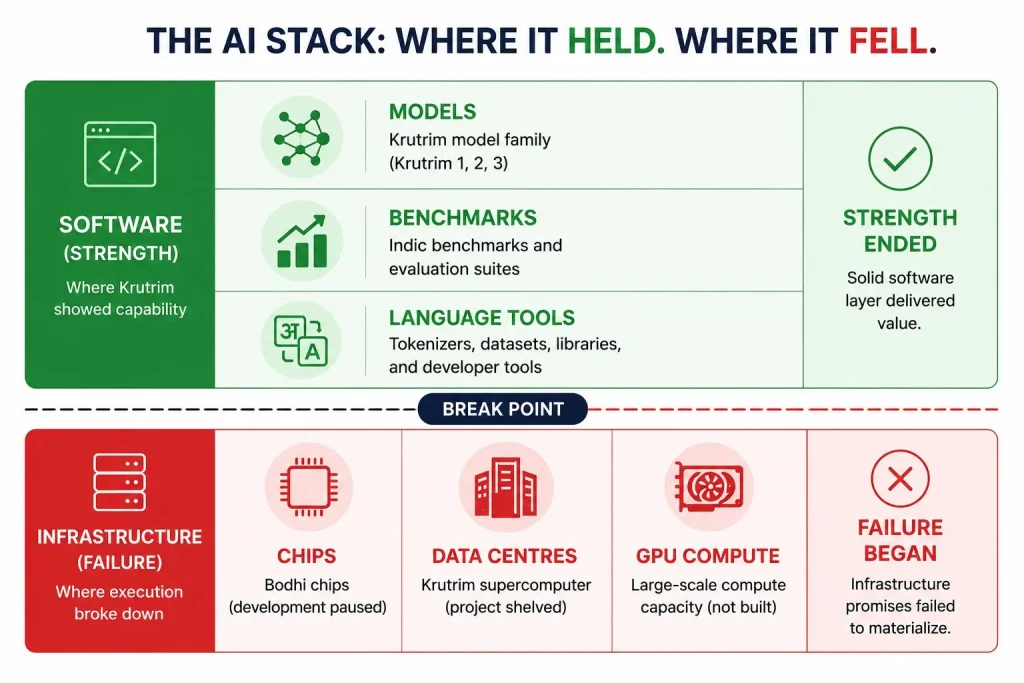
By early 2025, the software layer had delivered more than most expected. Krutrim open-sourced five distinct models, including Krutrim-2 (its base LLM), Chitrarth-1 (India’s first Vision Language Model), and Dhwani-1 (India’s first Speech Language Model for translation). It created BharatBench, a dedicated evaluation framework for Indic AI performance. On multilingual benchmarks, Krutrim matched or outperformed many global models of similar scale.
The software team built something genuinely differentiated. That part deserves acknowledgement because what failed wasn’t the code.
“India needs a solution that is thought grounds up for itself. For India to be an AI-first economy, we need to build the whole stack at Indian performance levels, Indian cultural relevance and Indian cost structure.” — Bhavish Aggarwal
Where the Foundation Cracked
India in 2023 was not infrastructure-ready for the AI ambitions being placed on it.
Despite generating nearly 20% of the world’s data, India held just 3% of global data centre capacity. The US AI Diffusion Framework capped India’s imports of Nvidia H100-class GPUs at 50,000 units until 2027. Global GPU allocation worked on a simple principle: the largest buyers, AWS, Azure, Google, and major Chinese labs, were served first. A $50 million Indian startup was near the bottom of that queue.
This was the ground Krutrim was building on. And it wasn’t stable.
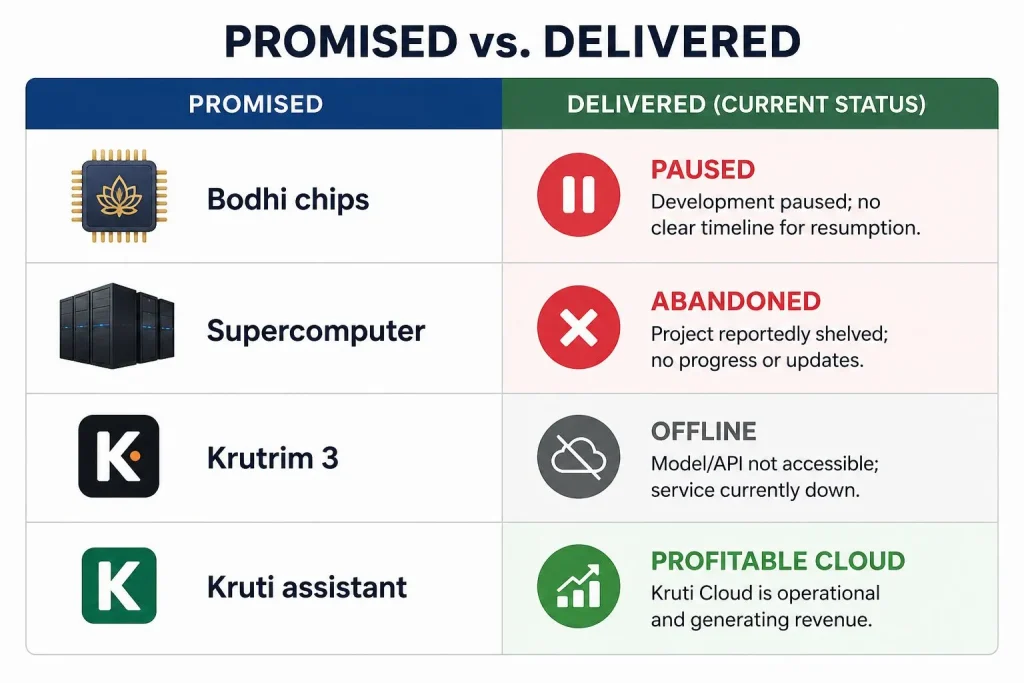
Aggarwal announced Krutrim’s own AI chip program, named Bodhi, alongside a partnership with NVIDIA to deploy India’s first GB200 cluster, a collaboration with Lenovo to build India’s largest supercomputer, and plans for Krutrim 3, an ambitious model at 350 billion parameters. Each announcement landed with genuine excitement.
Every single one was later quietly abandoned.
By late 2025, chip design was paused. The supercomputer partnership produced no public output. Krutrim 3 went silent after the linguistics team, the people actually building the multilingual training data, was cut across three rounds of layoffs totalling roughly 200 people.
That last part is the sharpest cut. You cannot build a multilingual Indian AI by dismantling the team doing the language work.
The Cost Nobody Talked About
Here is the number that puts everything in context.
The performance gap between a globally competitive frontier model and a mediocre one is roughly equivalent to $450 million in compute spend. Krutrim’s entire equity raise was $50 million.
That’s not a criticism of Bhavish Aggarwal. It’s a structural reality. OpenAI, Google, and Anthropic spend multiples of Krutrim’s total funding on compute alone, every quarter. Chip design, at the level Krutrim was proposing, typically takes five to ten years and billions of dollars, even for companies with existing semiconductor infrastructure.
Krutrim tried to close that gap with ambition. Ambition is necessary. But it doesn’t substitute for computing.
What Survived And Why
The one layer that held was Krutrim Cloud, and it held for a specific reason: Ola itself became its first major customer.
In May 2025, Aggarwal moved all of Ola’s workloads off Microsoft Azure onto Krutrim’s own cloud infrastructure. That single internal migration gave Krutrim a revenue anchor nobody else could take away.
By FY26, Krutrim reported ₹300 crore in revenue, three times the previous year and its first annual net profit with margins above 10%. It now serves over 25 enterprise customers across telecom, healthcare, finance, and logistics.
The regulatory tailwind helped, too. India’s data localisation laws are progressively tightening, creating a genuine procurement preference for compute providers operating under Indian jurisdiction. That’s a moat no global hyperscaler can easily cross.
The Lesson
Krutrim’s story is not about a founder who dreamed too big. Bhavish Aggarwal built three unicorns. The instinct to think at full-stack scale is exactly right for India’s AI future.
The lesson is about sequencing.
Great software needs infrastructure to run on. Infrastructure needs capital that compounds over years, not months. And consumer products need working models before they face public scrutiny.
Krutrim launched its chatbot before the models were ready. It announced chips before it had the capital to build them. It cut its language team while its differentiation was still in Indian languages.
Each decision made sense in isolation. Together, they created a company that was ahead in every direction and stable in none.
“India does need its own AI. Krutrim proved the software can be built. What it also proved is that software alone isn’t enough, the infrastructure has to be ready to hold it.”
Key Takeaways
- Krutrim’s software layer was genuinely strong, with multilingual models, open-source releases, and Indic benchmarks all delivered.
- India’s AI infrastructure gap, GPU limits, data centre shortage, and no domestic chips were country-level constraints, not just a company-level one.
- Chip design and supercomputing require capital and timelines that $50M in equity simply cannot support.
- Cutting the linguistics team while building multilingual AI was the most self-defeating single decision.
- Krutrim Cloud survived because Ola’s data localisation move gave it a guaranteed anchor customer
- The path forward for Indian AI isn’t building everything at once; it’s building the infrastructure layer first, then stacking software on top.
Conclusion
In May 2026, Krutrim is profitable, focused, and quieter than it has ever been.
The unicorn headlines are gone. The supercomputer announcements are gone. The consumer assistant is gone. What remains is a cloud business, 25 enterprise customers, and a founder who built something real, just in the wrong order.
India’s AI infrastructure is now growing rapidly. Data centre capacity, GPU pools, and government compute programs are all accelerating. When the road is finally built, the engine Krutrim designed may matter more than it does today.
The question worth sitting with:
Was Krutrim ahead of its time or did it simply mistake ambition for a roadmap?
