

The number that changed everything
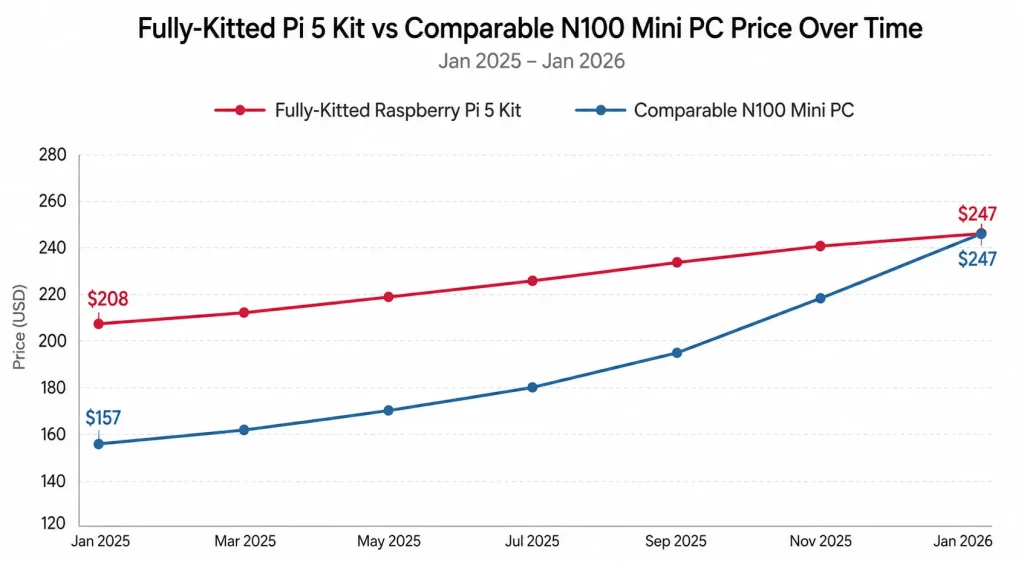
In January 2025, a fully kitted-out Raspberry Pi 5 cost $208. A comparable Intel N100 mini PC costs about $157. The choice was obvious.
By January 2026, both cost $247.
Almost to the cent. The DRAM (Dynamic Random Access Memory) market, gorged by AI server demand, squeezed by tariff pressures, had lifted both platforms to price parity almost simultaneously. And with that, a question that was once settled by budget became genuinely interesting again:
Which one do you actually want?
Two very different things at the same price
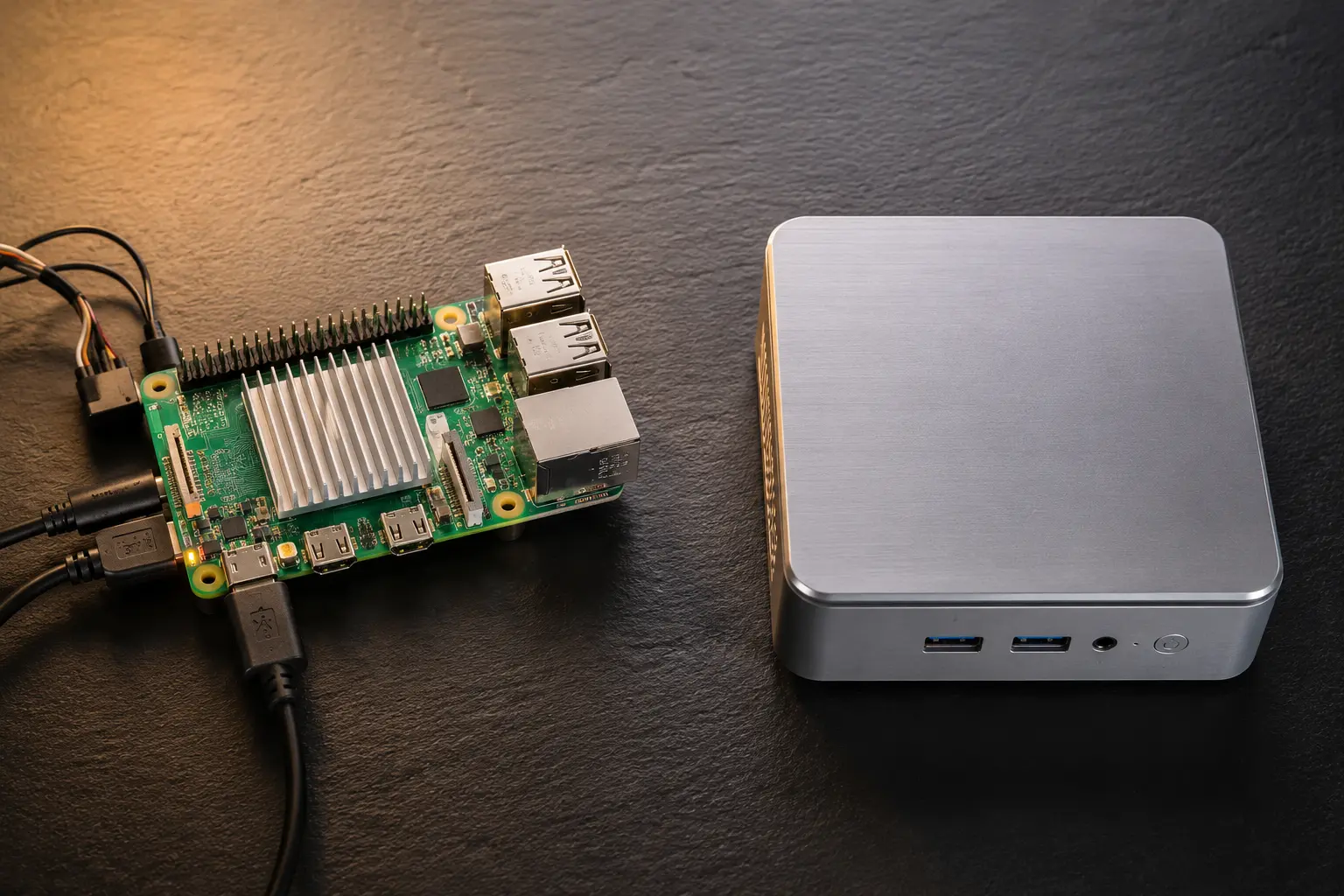
The Raspberry Pi is a single-board computer, a circuit board the size of a credit card that has been, for fifteen years, the default answer whenever someone wanted to tinker with hardware on a budget. It runs on an ARM processor, has a row of GPIO pins that let you wire it directly to sensors, motors and relays, and has amassed an ecosystem of tutorials, operating systems, and community knowledge that nothing else comes close to.
The Mini PC, specifically the Intel N100-based models from brands like GMKtec, Beelink, and Geekom, is a fully enclosed computer, roughly the size of a hardback book, running x86 architecture. It ships with Windows or Linux, plugs into a monitor, and performs like a real computer because, essentially, it is one. More memory headroom, hardware video encoding, upgradeable storage, and native compatibility with every piece of software ever built for x86.
They’ve always competed for the same hobbyist dollar. But they were never really the same thing. The price gap just made it easy to pretend otherwise.
What you’re actually choosing between
| Features | Raspberry Pi 5 (16GB) | Intel N100 Mini PC |
| Price (Jan 2026) | ~$247 (fully kitted) | ~$247 (fully kitted) |
| Architecture | ARM (Cortex-A76) | x86 (Alder Lake-N) |
| CPU Speed | 2.4 GHz quad-core | 3.4 GHz quad-core (turbo) |
| Power use (load) | 5–10W | 6–15W |
| GPIO pins | 40-pin header (built-in) | None (add-on only) |
| Video encode/decode | Decode only (H.265) | 4K encode + decode, AV1 |
| OS compatibility | ARM Linux / Pi OS | Windows, Linux (all) |
| Storage | microSD + NVMe via HAT | Built-in M.2 NVMe slot |
| RAM upgrade | Fixed (soldered) | Upgradeable DDR4/DDR5 |
| Community & guides | Enormous, specialized | General Linux/Windows |
| Production guarantee | Until Jan 2036 | Varies by brand |
What people actually use them for
This is where the comparison gets honest. Both devices have clear homes. The confusion only starts when people try to force either one into a role it wasn’t built for.
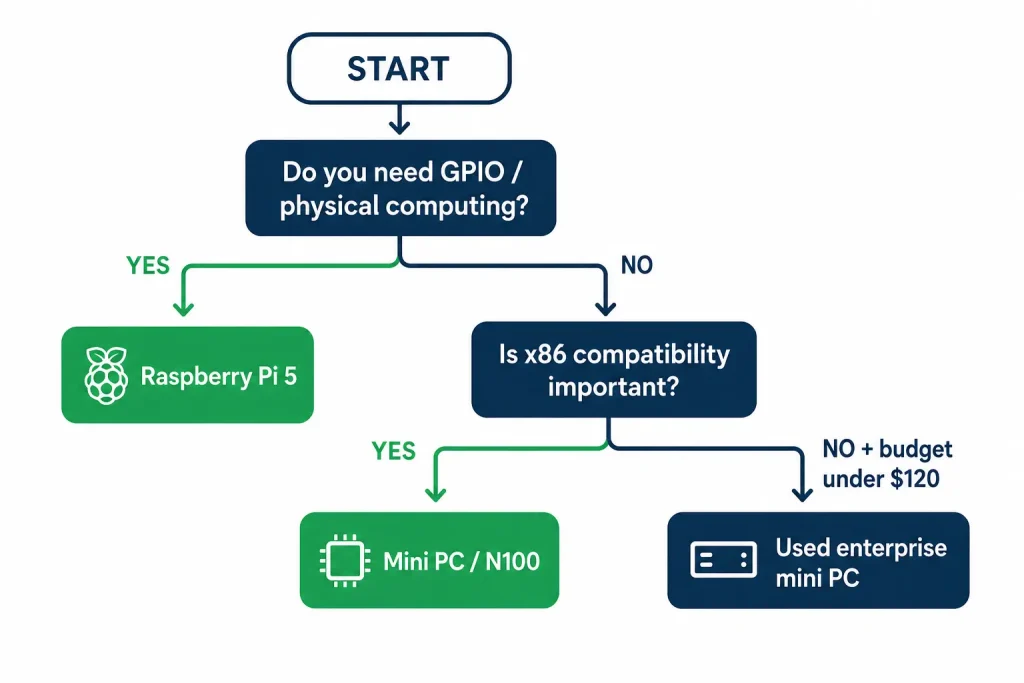
Use a Raspberry Pi 5 if: you’re building something that talks to the physical world. Weather stations, home automation, robotics, hydroponics controllers, smart mirrors, anything that involves wiring to sensors, motors, or LEDs. The 40-pin GPIO header is the Pi’s irreplaceable feature. No x86 mini PC ships with one. You’d need to add an Arduino or breakout board, which costs extra and adds friction.
The Pi also wins for education. Schools, bootcamps, and online courses are built around Raspberry Pi OS and GPIO Zero. If you’re learning to code alongside hardware, the ecosystem around the Pi is still unmatched.
Use a Mini PC if: you’re building a home server, running Docker or Kubernetes, handling media transcoding, or setting up a homelab where x86 software compatibility matters. Native hardware video encoding on the N100 makes Plex and Jellyfin dramatically smoother. The ability to run any Linux distribution, any Windows software, any Docker image, without hunting for an ARM-compatible version, is a genuine quality-of-life difference.
There’s also a growing case for buying used enterprise mini PCs. A refurbished Lenovo ThinkCentre M720q Tiny or HP EliteDesk 800 Mini with a Core i5, 16GB RAM, and 256GB NVMe can be had for $80–120 on eBay. More computing power than either a Pi or a new N100 unit, at half the price.
What the price parity actually reveals
“The price gap was never really the point. It was just the thing that let people avoid making a harder decision.”
For years, the Raspberry Pi’s cheapness allowed a comfortable fiction: that it was the sensible default for all small-scale computing projects. And for many of those years, it was. But the real reason most homelab builders chose a Pi wasn’t GPIO or ARM architecture, it was that paying $35–120 for a board felt low-stakes enough to experiment.
Now that both options cost the same, the question shifts entirely. And the question is actually: what kind of person are you? Are you someone who wants to wire things together and build something physical? Or are you someone who wants a reliable, software-compatible node that just runs?
These are different hobbies that overlap in ways the marketing has always obscured. The Pi was never a mini PC. The mini PC was never a single-board computer. The price gap just made it easy to buy one without confronting which one you actually needed.
“DRAM prices didn’t create a crisis. They removed an excuse.”
The deeper shift here is in the homelab community’s values. Jeff Geerling, whose independent price investigation triggered much of this conversation, noted that 2026 will likely be defined not by buying new hardware but by upcycling existing machines. Used enterprise gear, repurposed laptops, second-hand NUCs. A quiet countermovement to the increasingly expensive new hardware market.
Where each one falls short
Raspberry Pi 5 Limitations
- ARM still has Docker compatibility gaps for some apps and containers.
- No hardware video encoding, so Plex and Jellyfin media streaming can struggle.
- Soldered RAM means no future upgrades.
- NVMe storage needs an extra HAT board, adding cost and bulk.
- Micro HDMI ports are fragile and less convenient than full-size HDMI.
- The 16GB model at ~$205 feels expensive compared to some mini PC alternatives.
Mini PC (N100) Limitations
- No GPIO support, so hardware and electronics projects need extra add-ons.
- Higher idle power consumption compared to a Raspberry Pi.
- Long-term brand and production support is still uncertain.
- Smaller hobbyist community means fewer tutorials and project guides.
- DRAM price increases affect mini PCs more because of larger memory capacities.
- Larger and heavier design makes embedded deployments less convenient.
Key takeaways
- Price parity is real: As of January 2026, a fully equipped Raspberry Pi 5 (16GB + 512GB NVMe) and a comparable N100 mini PC both cost ~$247.
- The DRAM shortage, driven partly by AI server demand, hit both platforms simultaneously, erasing a gap that defined hobbyist computing for years.
- Choose a Raspberry Pi 5 if you need GPIO for physical computing, IoT, robotics, or education. It’s irreplaceable there.
- Choose a Mini PC if you’re running a home server, Docker, Kubernetes, media transcoding, or anything where x86 compatibility and video encoding matter.
- The used enterprise market is the hidden third option, a Lenovo ThinkCentre or HP EliteDesk Mini with 16GB RAM often goes for $80–120 on eBay, offering more compute than either.
- Jeff Geerling and the homelab community expect 2026 to favor upcycling and repurposing over buying new, as both platforms become harder to justify at current prices.
The question was always this
Here’s what the Raspberry Pi conversation has really been about, underneath all the spec comparisons: there are two types of people who buy small computers.
One type wants to build things that interact with the world. They want a board they can wire to a sensor, a relay, a motor. They want a community of people who have solved the exact problem they’re facing. For them, the Pi isn’t just a computer. It’s an entry point into physical computing.
The other type wants a reliable, low-power node that runs whatever software they need, without wrestling with ARM compatibility or HAT boards or micro HDMI adapters. For them, a mini PC is simply the more capable tool.
For fifteen years, price obscured this distinction. At $35, the Pi was the obvious answer even for people who didn’t need GPIO. At $247, you have to actually know what you want.
Maybe that’s not a problem. Maybe that’s just clarity.
The harder question, the one neither side of this debate talks about, is what happens if DRAM prices keep rising. At $300, at $350, the Raspberry Pi stops being a hobbyist platform entirely and becomes a professional tool with a professional price. And that would be a different conversation altogether.
