

The power was always the problem
Before anyone debates whether AI is overhyped, consider this:
A proposed data centre in Utah is projected to consume more electricity than the entire state of Wyoming currently does.
Not a region. A state. And the AI buildout is still early.
That’s the number most people haven’t sat with long enough.
The compute race is easy to follow: GPUs, model sizes and inference speeds. The energy race is quieter, more constrained, and in many ways more consequential. Grids are struggling. Permits take years. Communities are pushing back. And the demand isn’t slowing down; the IEA projects AI energy consumption will grow 30% annually through 2030.
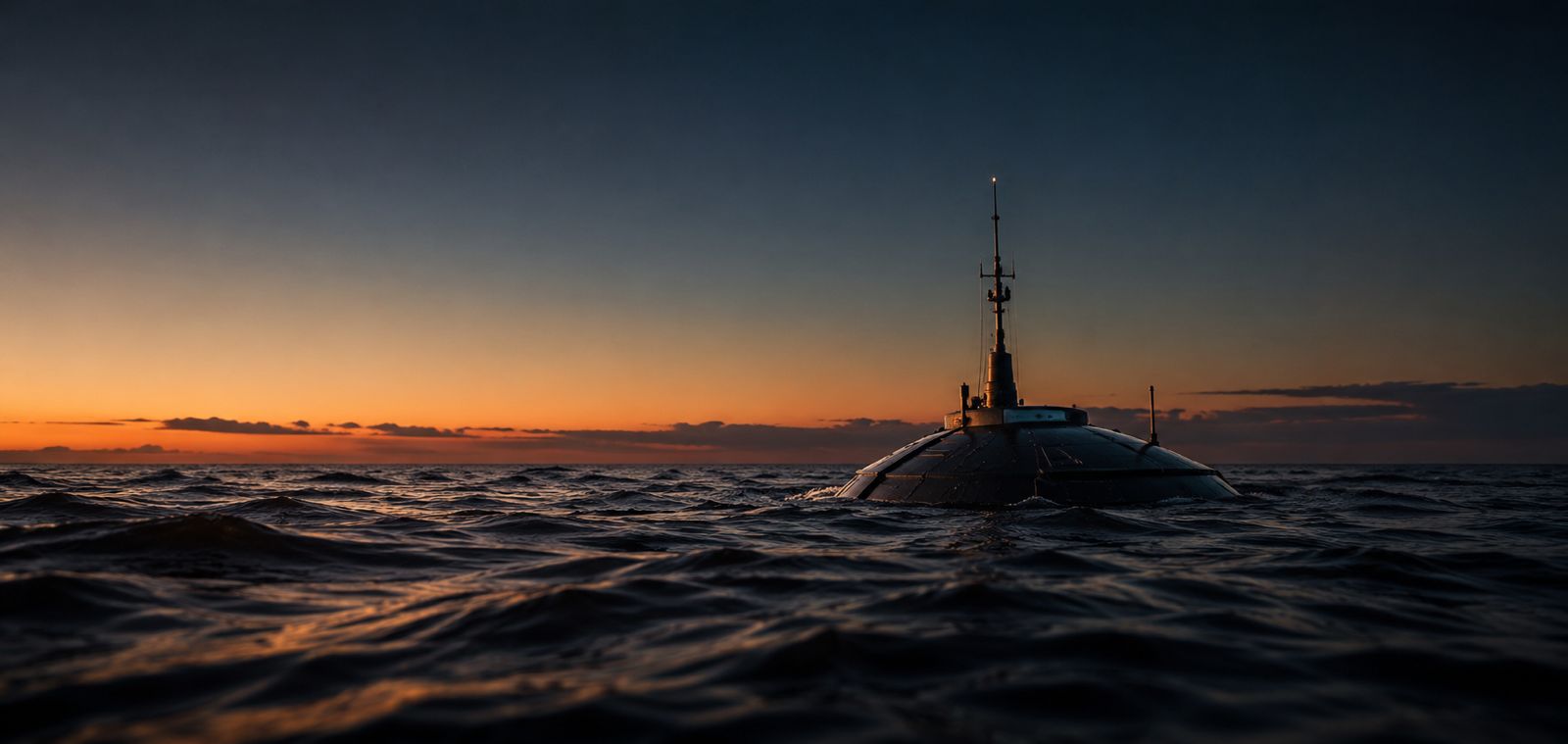
Into this gap comes an idea that sounds like science fiction and is, increasingly, very much not: Floating AI servers. Autonomous, wave-powered compute nodes deployed far offshore, beyond the grid, beyond land-use friction, beyond the regulatory timelines that slow everything else down.
What a floating AI server actually is
The most concrete version of this technology right now comes from an Oregon-based startup called Panthalassa, named, fittingly, after the ancient superocean that surrounded the supercontinent Pangea.
Their platform, the Ocean-3, is an 85-metre steel structure that sits mostly below the ocean surface. It generates electricity the way a wave would suggest: as the node rises and falls with ocean motion, water inside the structure is forced upward through an internal tube, driving a turbine. That turbine powers AI chips contained inside a hermetically sealed, seawater-cooled module.
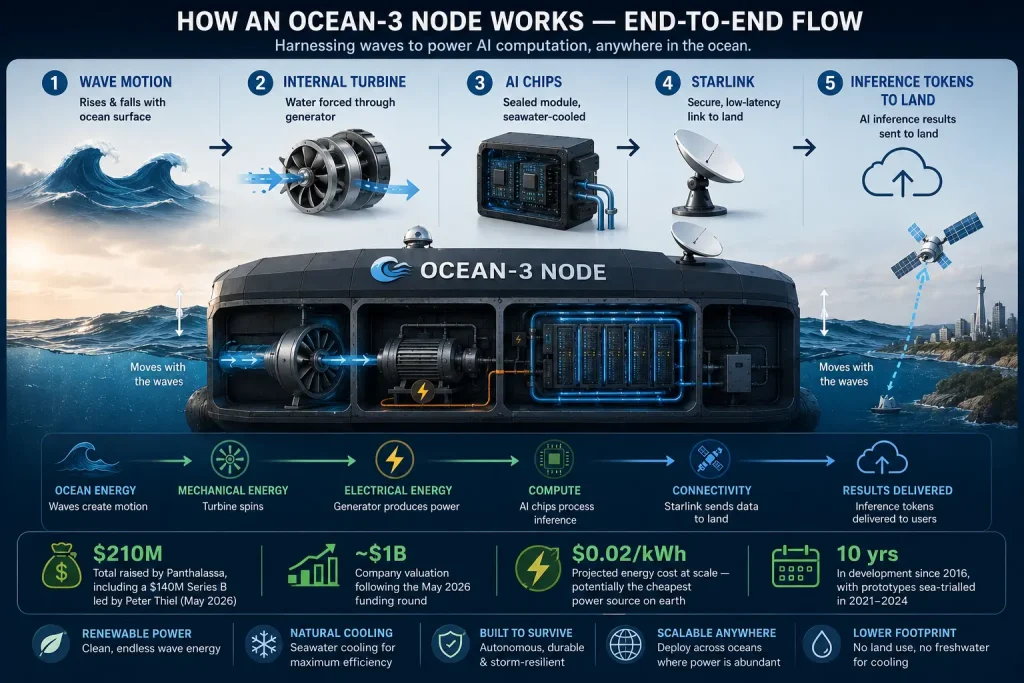
No anchor. No cable to shore. No engine. The structure navigates to its location using the hydrodynamic shape of its hull alone, towed out horizontally, then flipped upright at sea. User queries arrive via SpaceX Starlink satellite. Responses leave the same way.
In essence: it generates power from the ocean, runs AI on that power, and talks to the rest of the world through space.
The engineering behind the elegance
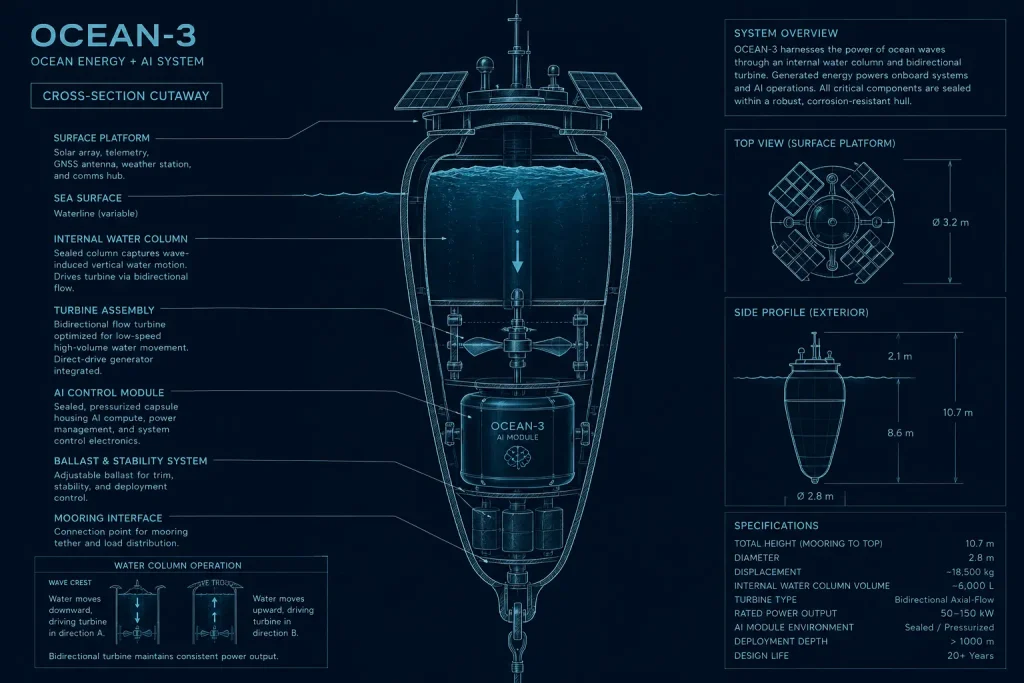
What makes the Ocean-3 design interesting isn’t novelty for its own sake. It’s a deliberate engineering discipline. Most ocean energy projects failed because they introduced too many moving parts, like hinges, flaps, gearboxes, that corrode, biofoul, and break in salt water. Panthalassa stripped all of that out.
The result is a structure with no gearboxes, no flaps, no hinges. It recirculates the same water internally. It’s built from plate steel, abundant, familiar, and manufacturable at scale. When Panthalassa says they’re ready to build factories and deploy fleets, this is why the design is optimised for mass production, not bespoke engineering.
“The waves are like a battery for sunlight, and we can be capturing from it 24/7.”— Garth Sheldon-Coulson, Co-Founder & CEO, Panthalassa
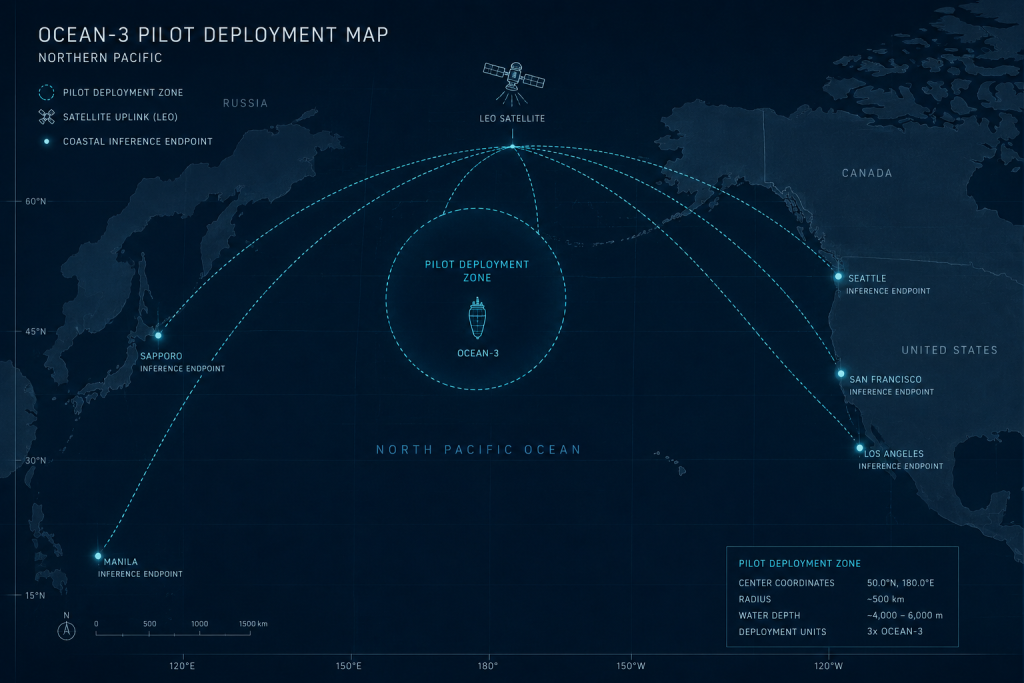
Multiple Ocean-3 nodes deployed together function as a single distributed floating data center. Panthalassa plans to deploy the pilot series in the northern Pacific later this year, with commercial deployments targeted for 2027.
Who actually uses this and how
The immediate use case is AI inference, running trained models against user queries. This is different from training, which requires enormous, coordinated clusters. Inference is more modular and well-suited to a distributed fleet of nodes that each operate independently.
For AI companies, floating servers solve two simultaneous problems: they don’t require grid access, and they bypass the permitting timelines that can add years to a traditional data centre build. Panthalassa has already secured backing from AI companies looking for exactly this: a faster and cleaner path to compute capacity.
For the broader infrastructure ecosystem, the implications extend further. If this works at scale, it changes the land-use calculus for data centres entirely. A floating node uses no local power, occupies no land, and competes with no agricultural, residential, or commercial interest.
What most coverage is missing
The headlines tend to focus on the spectacle, a floating data centre! Wave-powered AI! Peter Thiel!, which is understandable, because the visual is genuinely striking. But the deeper story is quieter and more structural.
The real shift happening here is a decoupling of compute from geography. For decades, where you put a server was constrained by where you could get cheap land, reliable power, and fast fibre. Cloud computing loosened the first constraint. Satellite internet is loosening the third. Wave energy, if it works at scale, dismantles the second.
“There are three sources of energy on the planet with tens of terawatts of new capacity potential: solar, nuclear, and the open ocean.” — Garth Sheldon-Coulson
This matters because AI’s energy demands are not a short-term constraint that will resolve itself as models get more efficient. Efficiency gains tend to get consumed by capability gains. More powerful models train on more data, serve more users, and run more complex reasoning. The demand curve keeps rising. And terrestrial grids, built for a pre-AI world, were never designed to absorb it.
Floating servers don’t solve this completely. But they point toward an architecture where compute is co-located with generation, where AI inference happens wherever the energy is abundant, not wherever the land is cheap.
That’s a fundamentally different way of thinking about infrastructure.
Where it gets hard
The ocean is not a controlled environment. And Panthalassa’s biggest challenge has nothing to do with funding or technology, it’s physics.
CHALLENGES & RISKS
Marine environments degrade metal and electronics aggressively. Every exposed component faces daily corrosion stress.
The nodes must survive hurricanes and severe weather without human intervention nearby. Prototypes have never faced a major storm at scale.
Starlink introduces latency that may not suit all AI workloads, particularly real-time or low-latency inference tasks.
Repairing a broken generator hundreds of miles offshore has no precedent at this scale. Costs and logistics are undefined territory.
Marine organisms attach to submerged surfaces over time, degrading performance and increasing drag, a daily reality for ocean equipment.
Operating in international waters raises unresolved questions about jurisdiction, environmental impact assessment, and liability.
Panthalassa’s design philosophy, removing moving parts and using earth-abundant materials, addresses some of these risks deliberately. But scaling from three prototypes to a commercial fleet is a categorically different challenge. The ocean has ended many promising marine energy ventures that worked perfectly in testing.
Key takeaways
- Floating AI servers are real, and near-term Panthalassa’s Ocean-3 pilot nodes are scheduled for Pacific deployment in 2026, with commercial systems in 2027.
- The platform generates electricity from wave energy, runs AI inference onboard, and transmits results via Starlink, no land connection required at any point.
- Panthalassa has raised $210 million total from Peter Thiel, John Doerr, Marc Benioff, Max Levchin, and others, now valued at nearly $1 billion.
- The deeper shift in computing is decoupling from geography. If wave energy scales, AI infrastructure can go wherever energy is abundant, not wherever land is available.
- Real engineering risks remain: corrosion, storm exposure, satellite latency, and remote maintenance are unsolved at commercial scale. The ocean is not a controlled environment.
Conclusion
There’s a useful way to think about why this idea has attracted the specific investors it has. Peter Thiel, John Doerr and Marc Benioff are not people who back incremental improvements to existing systems. They tend to fund ideas that assume the existing system is the problem.
The terrestrial grid, in the context of AI, is increasingly the problem. It’s slow to expand, geographically uneven, politically contested, and already under strain. Floating servers don’t argue with that situation. They route around it.
Whether Panthalassa’s nodes survive five years of open-ocean conditions, whether the latency is acceptable, whether the maintenance economics work, whether the regulatory vacuum stays benign, none of that is settled.
The honest answer is that we don’t know yet.
But here’s what is clear: the energy constraint behind AI is structural, not temporary. And the people building the next layer of infrastructure are no longer assuming it gets solved on land.
The ocean was always there. It just took a computer crisis to make it interesting.
