


There’s a moment, usually brief, where you glance at something, and your brain quietly fills in the gaps. You see a person across a room and you already know things, their mood, whether they’re approachable, what the context of the situation might be. You’re not reading data. You’re interpreting.
That’s not augmented reality. That’s cognition.
What if your technology could do the same?
The Gap Between Seeing and Understanding
Augmented reality (AR), as most people know it, is a layering act. It puts digital objects on top of the physical world, a navigation arrow hovering over a street, a product floating in your living room before you buy it, a surgeon’s vital overlay during a procedure. It adds. It doesn’t interpret.
Cogmented Reality, a convergence of cognitive AI and augmented spatial computing, takes that a step further. It describes a class of experiences where the digital layer doesn’t just overlay reality; it reasons about it. The system understands context, anticipates intent, and responds with intelligence, not just information.
That sounds like a subtle distinction. It isn’t.
In 2026, the groundwork for this shift is already being laid. Spatial computing is accelerating at a rate few anticipated. Apple is testing four smart glasses designs. Snap has inked a multi-year chip deal with Qualcomm. Meta released Ray-Ban Display models at consumer-friendly pricing. Google’s Android XR platform is being described as what Android did for smartphones, happening now for spatial computing.
Something is consolidating. And what’s consolidating isn’t just hardware.
The Architecture of Cogmented Reality
At its foundation, Cogmented Reality relies on three converging layers:
1. Spatial Awareness: The environment must be understood before it can be augmented meaningfully. This is where advances in LiDAR, radar, and photon-sensing chips come in. Modern spatial systems don’t just see a room; they understand depth, texture, surface, and physical relationships in real time. SLAM (Simultaneous Localisation and Mapping) algorithms allow devices to build and update a live map of the environment without any prior configuration.
2. Cognitive AI Integration: This is the defining layer. Large language models and multimodal AI systems are trained not just to process images but to interpret them. An AI watching you approach a whiteboard doesn’t just see pixels. It can understand the context: a meeting, a brainstorm, perhaps a problem you’re stuck on. It can proactively surface information, suggest connections, or flag something in your peripheral field before you think to look.
3. Persistent, Contextual Interface: Unlike today’s AR, where content disappears when you look away, Cogmented Reality aims for persistence. Your digital workspace “remembers” where things were. Collaborative spatial rooms let multiple participants share context across distance. Multimodal inputs like gaze, gesture, voice, and touch become first-class rather than bolted on.
Current AR is a heads-up display. Cogmented Reality is a co-pilot.
Where This Is Already Taking Shape

The clearest current analogue is in enterprise and industrial settings. A technician wearing smart glasses on a factory floor doesn’t just see an AR overlay of a machine schematic. With cognitive integration, the system recognises which machine they’re looking at, what stage of a maintenance cycle it’s in, and surfaces only the relevant diagnostic information, without the technician typing a single query.
In healthcare, cognitive spatial layers are being tested for real-time surgical guidance, where the system interprets an operating field and highlights anatomical structures that deviate from baseline, a form of contextual intelligence that passive AR overlays can’t offer.
For developers and creators, 2026 platforms like Android XR are emerging as software-first ecosystems. Apps float as volumetric windows, anchored to physical space. Collaborative sessions let multiple people inhabit a shared spatial environment, each seeing persistent objects that update live.
Even consumer hardware is gesturing at this future. Meta’s Ray-Ban Display models, released in March 2026 at $499, represent the first widely accessible AI-on-face device at consumer pricing. Snap’s Qualcomm-powered Spectacles and Warby Parker’s Android XR collaboration signal that fashion and function are beginning to align.
The pattern is consistent; the smarter the spatial layer, the less the user needs to consciously interact with technology at all.
This Is a New Interface Paradigm, Not a New Feature
Most people are framing the current spatial computing wave as an upgrade to screens. A bigger monitor, but in 3D. A better phone, but on your face.
What Cogmented Reality represents is a fundamental restructuring of how humans interface with information. The screen, the window we’ve been looking through for fifty years, was always a container. It separated the world of information from the world of experience.
Cogmented Reality dissolves that container. Information doesn’t live behind a screen you turn to. It lives in the space around you, invoked not by clicks but by context, attention, and intent. The AI layer isn’t a search engine you query. It’s an ambient intelligence that reads the situation alongside you.
This changes something deep. The goal of good interface design has always been to make technology disappear, to get out of the way of the task. Cogmented Reality is the architecture that makes that disappearance finally possible at scale.
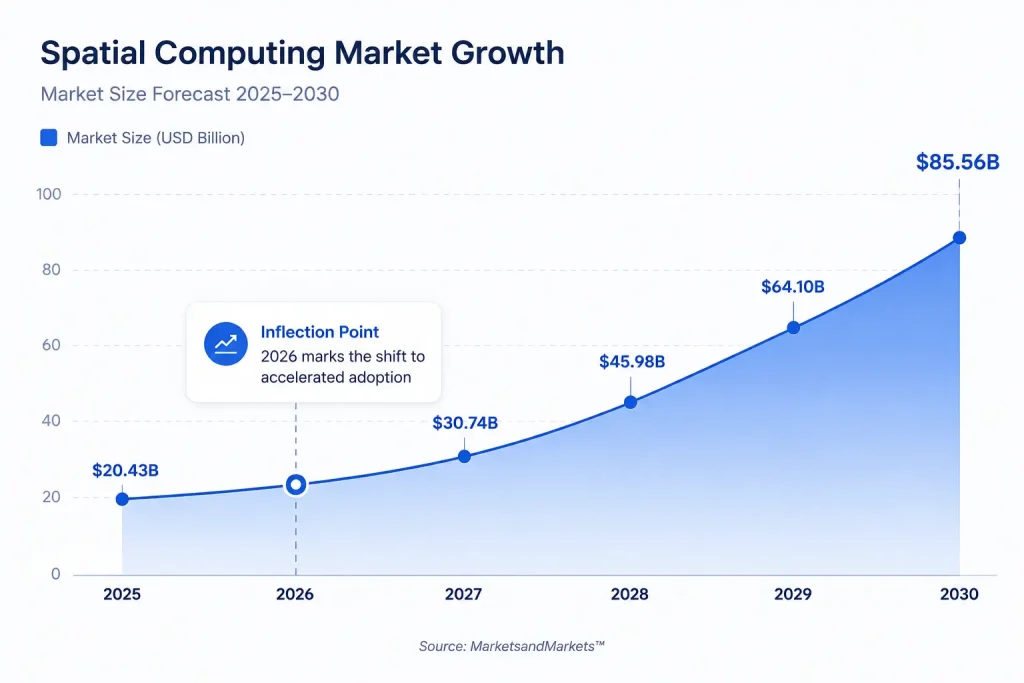
GlobalData predicts that spatial computing adoption accelerates substantially across 2026, with the market projected to grow from $20.43 billion in 2025 to $85.56 billion by 2030, a 33% compound annual growth rate. That isn’t a niche trajectory.
Limitations and Honest Challenges
Hardware still constrains vision. The smartest AI can’t help if the glasses are heavy, battery life is measured in hours, or the field-of-view is too narrow to feel natural. Despite 2026’s consumer momentum, the gap between the lab demo and the daily-wear experience remains real.
Privacy is structurally unresolved. A system that interprets your environment in real time is, by definition, surveilling it. Who owns the spatial data your device maps? What happens when your AI co-pilot is cloud-dependent? These are not hypothetical questions; they are active legal and regulatory battlegrounds.
The cognitive load paradox. Ambient intelligence risks ambient distraction. An AI that proactively surfaces information needs extremely refined judgment about when to speak and when to stay quiet. Getting that calibration wrong doesn’t create a helpful assistant. It creates an exhausting noise.
Ecosystem fragmentation. Android XR, Apple’s Vision OS, Meta’s Horizon platform, Snap’s standalone glasses, these are not interoperable. Developers building for spatial computing face the same fragmentation problem that mobile developers faced in 2009, arguably harder.
Adoption friction is real. Even Meta cut 10% of its Reality Labs workforce in early 2026, signalling that even the most funded players are recalibrating timelines. The hardware race is heating up, but consumer willingness to change daily habits remains the hardest variable.
An AI that proactively surfaces information needs extremely refined judgment about when to speak and when to stay quiet. Getting that calibration wrong doesn’t create a helpful assistant; it creates exhausting noise.
Key Takeaways
- Cogmented Reality is the convergence of cognitive AI and spatial augmented computing, and a system that interprets your environment rather than just overlaying it.
- 2026 marks a platform inflexion point, Android XR, Apple smart glasses prototypes, Meta Ray-Ban Display, and Snap Spectacles all arriving in close sequence.
- The spatial computing market is on track to reach $85.56 billion by 2030 at a 33%+ CAGR.
- The real shift isn’t better AR, it’s a new interface paradigm where AI ambient intelligence replaces the screen as the primary information layer.
- Key unresolved challenges: privacy, battery life, ecosystem fragmentation, hardware weight, and cognitive load calibration.
- The companies that win this wave won’t just build better hardware. They’ll build spatial operating systems that lock in developer ecosystems, the way iOS and Android did.
Conclusion
Every major computing shift has had a moment where it stopped being interesting and started being inevitable. The PC felt like a gadget until spreadsheets arrived. The smartphone felt like a luxury until the app store opened. The cloud felt abstract until every piece of software quietly moved there.
Cogmented Reality is approaching that inflexion. Not because the hardware is perfect, it isn’t. Not because every privacy question is answered, it isn’t. But because the AI layer has matured enough to make spatial computing genuinely intelligent, and the hardware ecosystem has finally fragmented into competition rather than a monopoly.
The real question isn’t whether this technology will reshape how we interact with information. It’s whether the systems we build will enhance human cognition or quietly offload it. That’s the question worth carrying forward.
