
Nobody argues about whether a camera is real art anymore. That debate lasted decades and ended quietly; the photographs won.
The same argument is happening now with digital art. And it’s moving much faster.
The difference is that this time, the tool writes back. It suggests. It interprets. It creates things the human behind the prompt didn’t fully imagine and occasionally, things they wouldn’t have imagined at all. That’s a genuinely new situation, and it’s raising questions that the art world is still figuring out how to hold.
What Is Digital Art Really?
Digital art is creative work produced or significantly shaped through digital technology. It spans a vast spectrum: from a painter using a stylus on a tablet to an artist training a custom machine learning model on thousands of reference images. From pixel illustration to 3D sculpture, motion graphics to generative code that produces unique visuals on mint.
What’s changed isn’t the definition. It’s the scale and the stakes. In 2026, digital art is a serious industry, a maturing market, and a cultural flashpoint, and AI has become its most disruptive and contested ingredient.
The Ecosystem Behind the Image
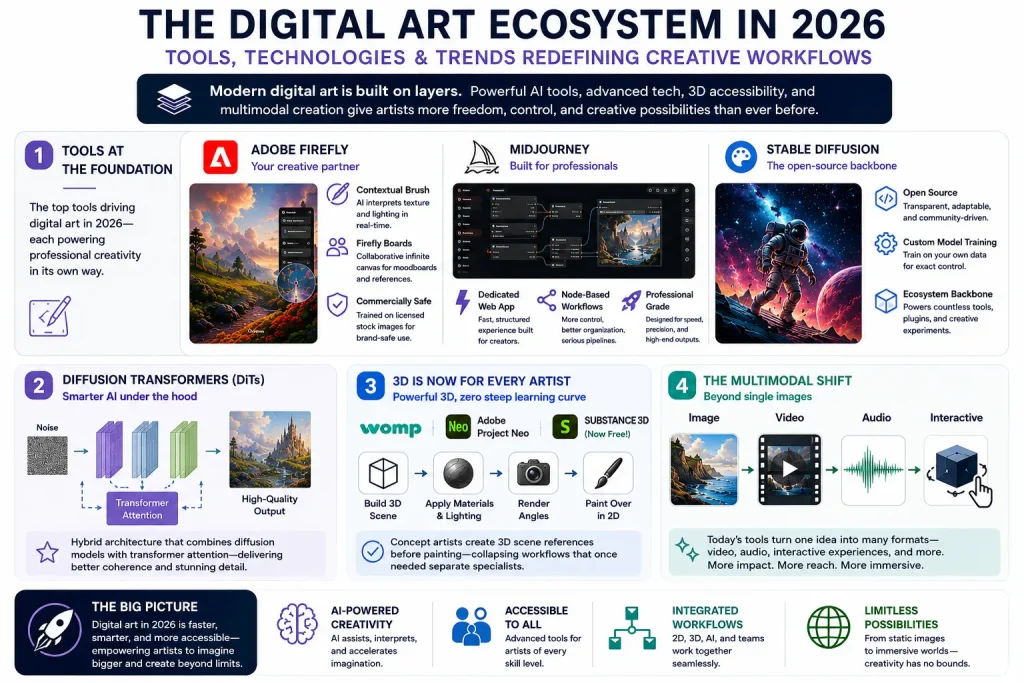
Modern digital art is built on layers. At the foundation are the tools, and the tool landscape in 2026 looks very different from even three years ago.
Adobe Firefly has matured into a serious creative partner. Its Contextual Brush lets artists paint loosely while the AI interprets texture and lighting in real-time. Adobe has also launched Firefly Boards, a collaborative infinite canvas for pooling references, remixing compositions, and building moodboards in real-time with teams. Crucially, Adobe’s model is trained exclusively on licensed stock images, making it the more commercially defensible option.
Midjourney has moved entirely off Discord into a dedicated node-based web app, faster, more structured, and built for professional creative workflows. Stable Diffusion continues to evolve as the open-source backbone of the ecosystem, powering custom model training for artists who want granular control over outputs.
Diffusion Transformers (DiTs), hybrid architectures combining diffusion-based image synthesis with transformer attention mechanisms, now sit under the hood of most leading tools, producing outputs with significantly better coherence than earlier models.
And 3D is no longer a specialist skill. Browser-based tools like Womp and Adobe Project Neo have brought sophisticated 3D techniques to 2D artists at all skill levels. Substance 3D is now free. The result: concept artists routinely build 3D scene references before painting over them, collapsing workflows that used to require separate specialists.
Then there’s the multimodal shift. Single-image output is increasingly treated as a missed opportunity. Today’s advanced tools extend images into video, audio, and interactive formats, turning a digital painting into a motion piece or a generated visual into an immersive soundscape.
What People Are Actually Making
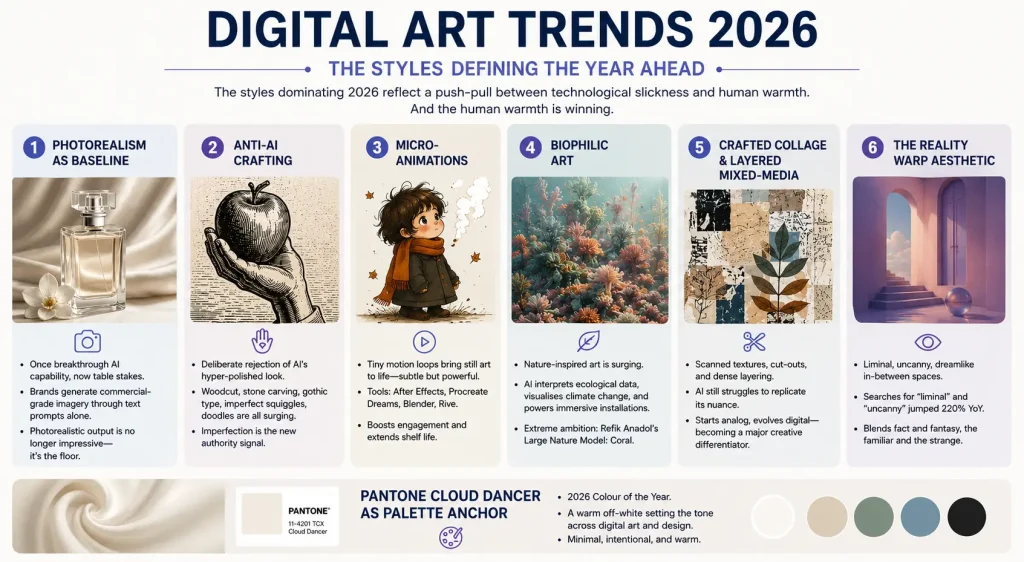
The styles dominating 2026 reflect a push-pull between technological slickness and human warmth. And the human warmth is winning.
Photorealism as baseline: What once required breakthrough AI capability is now table stakes. Brands generate commercial-grade product imagery through text prompts alone. Photorealistic output is no longer impressive, it’s the floor.
Anti-AI Crafting: The most significant counter-movement of 2026 has a name. Creative directors at Landor call it Anti-AI Crafting, the deliberate rejection of AI’s hyper-polished aesthetic in favour of work that feels unmistakably made by human hands. Woodcut illustration, stone carving, gothic typography, imperfect squiggles, and doodle-style characters are all surging. Apple’s own marketing chose a manually operated camera circling a hand-blown glass apple, no CGI, no simulation. That choice was intentional. In a digital world saturated with frictionless synthetics, imperfection is the new authority signal.
Micro-animations: One of 2026’s quietest and most effective trends. These are tiny motion loops, a character’s eyes blinking, smoke drifting, cloth shifting in a breeze, added to otherwise still illustrations. Built with After Effects, Procreate Dreams, Blender, and Rive, they bring a living quality to digital art without crossing into full animation. For publishers, studios, and social creators, micro-motion stretches shelf life and boosts discoverability. It fits feeds and interfaces where restraint reads as premium.
Biophilic art: Nature-inspired digital work is surging, as artists using AI to interpret ecological data, visualise climate change, and create large-scale immersive installations. Refik Anadol’s Large Nature Model: Coral, built from millions of coral reef photographs, represents the extreme ambition of this direction.
Crafted collage and layered mixed-media: Scanned textures, cut-outs, dense visual stacking, the kind of work that AI still genuinely struggles to replicate. Because AI image generators can’t yet authentically capture the nuances of a layered, mixed-media style, this approach has become a creative differentiator. Compositions that begin with scans and cut-outs but emerge into something dynamic digitally are gaining significant traction.
The Reality Warp aesthetic: Canva’s research, sourced from over a billion monthly designs, identifies this as the defining aesthetic of 2026. Liminal spaces, in-between zones, the uncanny and the dreamlike. Searches for terms like “liminal” and “uncanny” jumped 220% year over year. It’s design that blends fact and fantasy, the recognisable and the strange.
Pantone Cloud Dancer as palette anchor: The 2026 Colour of the Year, a warm off-white, is setting the tone for visual palettes across art and design. Minimal, intentional, and warm, it’s influencing everything from digital illustration to branding work.
The Deeper Shift Most People Are Missing
Here’s what the conversation about AI art tends to miss: the technology isn’t really about making images faster. It’s reshaping what it means to have a creative identity.
When anyone can generate a photorealistic image with a sentence, taste becomes the new superpower. The Economist named “slop“, mass-produced, low-quality AI content, its word of the year. That’s the ceiling being set for indiscriminate AI use. The creators who will set themselves apart are those who give real thought to how they’re adopting the technology; those for whom AI is a multiplier of imagination, not a replacement for it.
Simultaneously, the legal landscape has just been clarified. In March 2026, the U.S. Supreme Court let stand the Thaler v. Perlmutter ruling: AI-generated content with no substantial human creative input cannot be copyrighted. The court’s language was explicit: “human authorship is a bedrock requirement of copyright.” For digital artists using AI as a tool, this is protective. For purely automated outputs, it opens serious commercial and IP questions.
And another quiet shift: NFTs have stopped being speculative and started being infrastructure. In 2026, they function as a standard verification method, proof of ownership and provenance, rather than a gamble. SuperRare opened a physical brick-and-mortar gallery in 2025. Galleries that thrive are those building immersive, community-centred experiences around digital work. The old elitist model is fading.
The creative is safe. The automated pipeline isn’t.
The Artist Economy Is Being Rebuilt
Something else is quietly happening alongside the technology story: the economics of being a digital artist are being restructured from the ground up.
Online platforms have eliminated traditional gatekeepers. Digital artists can now reach global audiences instantly, sell commission-free, and build direct collector relationships that would have required gallery representation a decade ago. Social media is no longer optional for those building sustainable careers; long-form, behind-the-scenes content is growing as audiences seek depth and authenticity over quick consumption.
At the same time, subscription fatigue is a genuine pressure point. Rising software costs are pushing creative professionals toward alternatives: free tools like Blender and the newly free Substance 3D, Affinity’s capable alternatives to Photoshop and Illustrator, and open-source workflows. The future is trending toward fewer monthly bills and more genuine tool choice.
The artists gaining traction aren’t necessarily those with the best technical outputs. They’re the ones building communities, sharing process, and making work that feels honest and alive.
Where It Gets Complicated
No honest look at digital art in 2026 skips the friction. There’s real tension here.
The NFT market has restructured, not recovered: Christie’s closed its digital art department in late 2025. NFT Paris cancelled its fair. The speculative frenzy is gone. What remains are smaller, more deliberate, utility-driven NFTs that offer event access, artist relationships, or exclusive content. The art still matters; the hype loop doesn’t.
Copyright is murky in the middle: The Thaler ruling protects human creators, but the line between AI-assisted and AI-generated is genuinely contested. Owning an NFT still doesn’t automatically confer copyright to the underlying work, a widespread misunderstanding that creates confusion for collectors and creators alike.
Oversaturation is real: Low barriers to AI image generation have flooded platforms. Discovery has become harder. A quality signal is harder to establish. The artists gaining traction are those with strong conceptual frameworks, not just compelling outputs.
Training data ethics: Questions about what models are trained on, and whether artists consented, remain unresolved in most jurisdictions. This isn’t going away.
The tool subscription problem: Rising costs across creative software are creating genuine access friction, particularly for students, emerging artists, and hobbyists. The industry is pushing back, and free and open-source tools are gaining serious ground.
Key Takeaways
- Digital art in 2026 spans everything from tablet illustration to AI-generated generative NFTs and micro-animated book covers; the medium is the umbrella, not the definition.
- AI tools (Firefly, Midjourney, Stable Diffusion) have moved from experimental to embedded in professional creative workflows, with Firefly Boards now enabling real-time team collaboration.
- The dominant counter-movement of 2026 is Anti-AI Crafting, a deliberate embrace of imperfection, handmade textures, and visible human authorship as a differentiator.
- Micro-animations are one of 2026’s quietest and most effective trends: tiny motion loops that make still art feel alive without becoming full animation.
- 3D tools have democratised, browser-based apps like Womp and Adobe Project Neo bring sophisticated techniques to 2D artists at all skill levels.
- Pantone Cloud Dancer (warm off-white) is anchoring 2026’s dominant colour palette across digital art and design.
- The March 2026 Thaler v. Perlmutter Supreme Court ruling confirmed: purely AI-generated work cannot be copyrighted. Human creative input is legally required.
- Taste is the new creative superpower. AI has solved the speed problem; it has amplified the need for human discernment, imagination, and emotional intelligence.
- The NFT market has moved from speculation to utility, value concentrates in works with genuine community, access, or experiential benefits.
- The artist economy is being rebuilt: direct collector relationships, commission-free platforms, and subscription fatigue are reshaping who succeeds and how.
What Actually Changes
Every major technology that enters the creative process gets accused of killing art. Photography. Digital editing. 3D modeling. None of them did. They all changed what artists needed to be good at.
AI is doing the same, with one genuinely novel twist. It doesn’t just change the technique. It challenges the concept of originality itself. When a tool can produce anything, choosing what to make and why becomes the artistic act.
What 2026 is quietly teaching the creative world is this: authenticity, taste, and human presence are not soft values. They are strategic advantages. The brands, artists, and studios winning right now are not the ones generating the most. They’re the ones making work that makes people stop, feel something, and remember why they connected with it.
The question worth sitting with isn’t whether AI-assisted digital art is real art. It’s whether the human behind it is bringing something irreplaceable to the work.
