
Every morning, someone at a major company opens a spreadsheet and stares at competitor pricing they gathered the day before. By 11 a.m., half of it is wrong.
Prices shift. Pages re-render. Stock levels vanish. New items appear. The web doesn’t hold still, and for decades, that has been an enterprise problem with no elegant solution. Scrapers break on JavaScript. APIs get deprecated. Selenium jobs drift. Human analysts are expensive and inconsistent. The web was built for people, not programs. And so most companies have lived with this uncomfortable fact: the data they need most changes faster than they can catch it.
That’s the problem TinyFish was built to solve. Not with another scraper. Not with another wrapper. With something closer to the internet’s first real infrastructure layer for AI agents.
What Is TinyFish?
TinyFish is a Palo Alto-based AI infrastructure company founded in 2024. Its platform gives AI agents the ability to do what humans do on the web: search, read pages, navigate sites, fill forms, and bypass authentication walls, but at enterprise scale, with structured outputs, and without falling apart when a layout changes.
The company emerged from stealth in August 2025 with a $47 million Series A led by ICONIQ Growth, joined by USVP, MongoDB Ventures, Mango Capital, ASG, and Sandberg Bernthal Venture Partners. Its customers at launch already included Google, Amazon, DoorDash, Grubhub, Cigna, Volkswagen, and ClassPass.
That’s not a humble beta list. Those are companies with entire engineering organizations who chose to use TinyFish instead of building it themselves.
In 2026, TinyFish expanded into something larger: a four-product platform that functions as the complete web infrastructure layer for the agentic era. One API key. Four capabilities. The entire live web is accessible to machines.
“If you can turn the internet into analyzable data, it will fundamentally give businesses advantages that others don’t have.” — Sudheesh Nair, CEO, TinyFish
The People Who Built It
The founding team reads as if someone assembled it on purpose. Sudheesh Nair was formerly President of Nutanix, one of the more formidable enterprise software companies of the last decade. Shuhao Zhang led large-scale engineering at Meta. Keith Zhai was a senior correspondent at The Wall Street Journal, someone who spent years watching what kind of data enterprises actually needed and couldn’t get fast enough.
It’s a rare combination: enterprise sales intuition, systems engineering depth, and journalism-grade understanding of what intelligence actually means. The company employs around 25 people. Lean for the problem they’re solving.
How TinyFish Works: The Four-Layer Platform
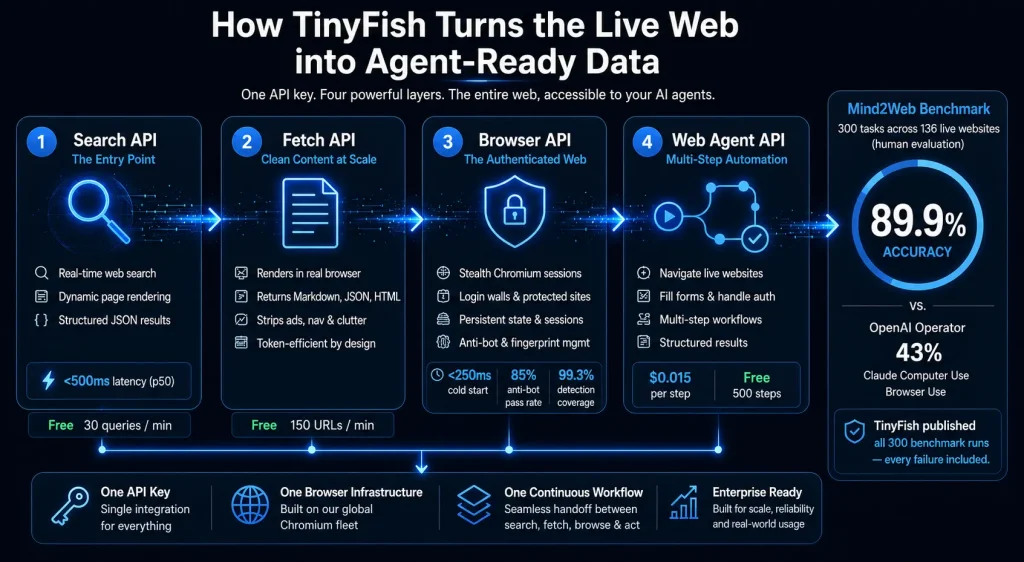
The platform launched in full in April 2026, consolidating four products under a single API key. Each solves a distinct problem in the agent-to-web pipeline.
1. Search API: The Entry Point
Most search APIs return cached link lists. TinyFish Search runs on its own Chromium fleet, rendering dynamic pages in real time and returning clean, structured JSON, not the stale snapshot of a page from three days ago, but what the page actually says right now.
The latency target is under 500 milliseconds at p50. For agents running in production loops that check competitor pricing, monitor earnings reports, or track breaking news, that speed isn’t a nice-to-have; it’s what makes the use case possible.
As of May 2026, the Search API is entirely free, with no credit card required. Free tier supports 30 queries per minute.
2. Fetch API: Clean Content at Scale
Fetching a page for an LLM isn’t as simple as hitting a URL. Most sites render in JavaScript. Most responses are 90% navigation, footer, and ad content.
Feeding that to a model wastes tokens, inflates costs, and buries the signal.
TinyFish Fetch renders the full page in a real browser and returns clean Markdown, JSON, or HTML, the actual article, table, or product data, stripped of everything irrelevant. Token-efficient by design.
The efficiency case is direct: where a raw fetch hands an LLM a wall of HTML, TinyFish Fetch hands it the content. Fetch is also free, with 150 URLs per minute on the free tier. Failed fetches are never charged.
3. Browser API: The Authenticated Web
Search and Fetch cover the open web. The Browser API goes deeper. It provides stealth Chromium sessions with engine-level fingerprint management, sessions capable of navigating login walls, defeating Cloudflare and Akamai protections, handling persistent state, and returning data from portals that explicitly block automation.
Cold start time: under 250 milliseconds. Anti-bot pass rate: 85%. Detection coverage: 99.3%. These numbers matter for the kinds of workflows enterprises actually run, vendor portals, carrier dashboards, compliance platforms and sites that aren’t meant to be automated but need to be.
4. Web Agent API: Multi-Step Automation
The Agent API is where the platform earns its benchmark claim. TinyFish’s Web Agent navigates live websites, fills forms, handles authentication, and returns structured results from multi-step workflows described in natural language.
On the Mind2Web benchmark, 300 tasks across 136 live websites, with human evaluation, TinyFish scored 89.9% accuracy, ranking above OpenAI Operator at 43%, Claude Computer Use, and Browser Use. The company published all 300 task runs publicly.
Pricing for agent steps is $0.015 per step. Free tier includes 500 steps with no credit card.
Why One Key Matters
The most interesting architectural decision TinyFish made isn’t any individual product; it’s the integration. All four APIs share a single key, a single dashboard, and crucially, a single browser infrastructure.
Most production agent stacks stitch together separate vendors: one for search, another for fetch, a third for headless browsers. Every handoff introduces friction. Session context breaks. Fingerprints diverge. Reliability degrades with each integration seam.
When the same Chromium fleet handles search, fetch, browsing, and agent execution, the system can trace a task end-to-end. Signals from one layer compound into the others. A search result flows into a fetch call, which flows into a browser session, which flows into an agent task, without re-authenticating, without re-rendering, without duct tape.
The Larger Shift This Represents
The AI industry has spent several years debating what agents are. TinyFish is a quiet answer to a more practical question: what do agents need to operate?
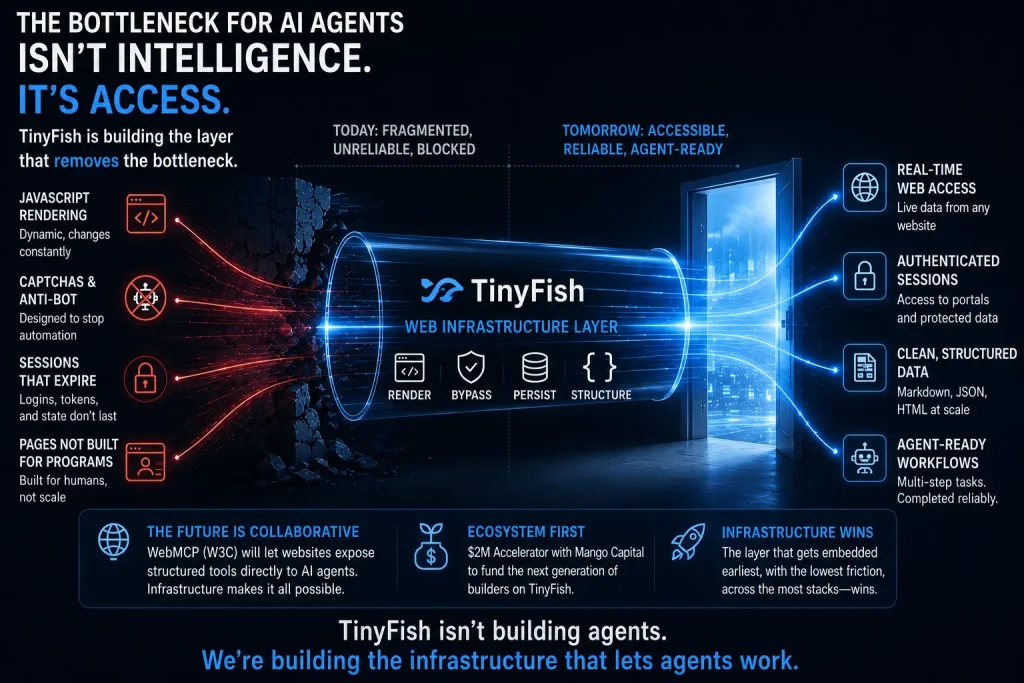
The internet was designed for browsers. Every page assumes a human on the other end, JavaScript that renders on click, CAPTCHA that checks for mouse movement, and sessions that expire. None of it was built to be consumed programmatically at scale.
For a long time, that was acceptable. Agents were a curiosity. But as language models get capable enough to orchestrate real workflows, the bottleneck isn’t intelligence, it’s access. An agent that can reason about competitor pricing is useless if it can’t reliably read a competitor’s pricing page.
That’s what makes TinyFish’s timing interesting. The company isn’t building the agents, it’s building the infrastructure that those agents run on. And in the infrastructure layer, the winner tends to be whoever gets embedded earliest, at the lowest friction, across the most stacks.
The WebMCP standard announced by Google in February 2026, a W3C proposal that would let websites expose structured tools directly to AI agents, points toward a future where this layer becomes even more important. If websites start actively collaborating with agents, the infrastructure that mediates those interactions becomes foundational.
TinyFish launched a $2M Accelerator in 2026 in partnership with Mango Capital, providing seed funding for startups building on its platform. That’s not a PR move, that’s ecosystem building. The same logic cloud providers used in the early 2010s.
Key Takeaways
- Founded 2024, launched publicly August 2025 with $47M Series A led by ICONIQ Growth.
- Four-product platform: Search, Fetch, Browser, and Web Agent, one API key, one infrastructure layer.
- Search and Fetch are permanently free, no credit card, designed to become default agent infrastructure.
- 89.9% on Mind2Web, the highest publicly benchmarked accuracy for a web agent, above OpenAI Operator (43%).
- Enterprise customers include Google, Amazon, DoorDash, Grubhub, Cigna, ClassPass, and Volkswagen.
- 30M+ monthly operations in production as of November 2025.
- Sub-250ms browser cold starts. 85% anti-bot pass rate. 99.3% detection coverage.
- Founding team: ex-Nutanix President, ex-Meta engineering leader, ex-WSJ senior correspondent.
- $2M Accelerator launched in 2026 to seed startups building on the platform.
Conclusion
There’s a version of the near future where AI agents are unremarkable, the way databases are unremarkable, or CDNs are unremarkable. You use them without thinking about them, because the infrastructure they run on just works.
TinyFish is making a specific bet: that the infrastructure agents need to use the web is its own category, with its own complexity, and that owning it end-to-end creates compounding advantages that point solutions can’t match.
The free tier is the tell. Companies that want to sell software charge for it. Companies that want to become infrastructure give the primitives away and grow with the ecosystem. The web was built for humans. TinyFish is quietly rebuilding the interface layer for everything else. Whether the agentic internet looks like what TinyFish is building, or whether it evolves into something else entirely, the underlying question is already here:
What does it mean when machines can browse the web as fluently as people can? We may be closer to finding out than most people realize.
