
About ten years ago, software engineering went through a quiet civil war, monolithic applications on one side, microservices on the other. The monolith lost.
That same war is now playing out in AI.
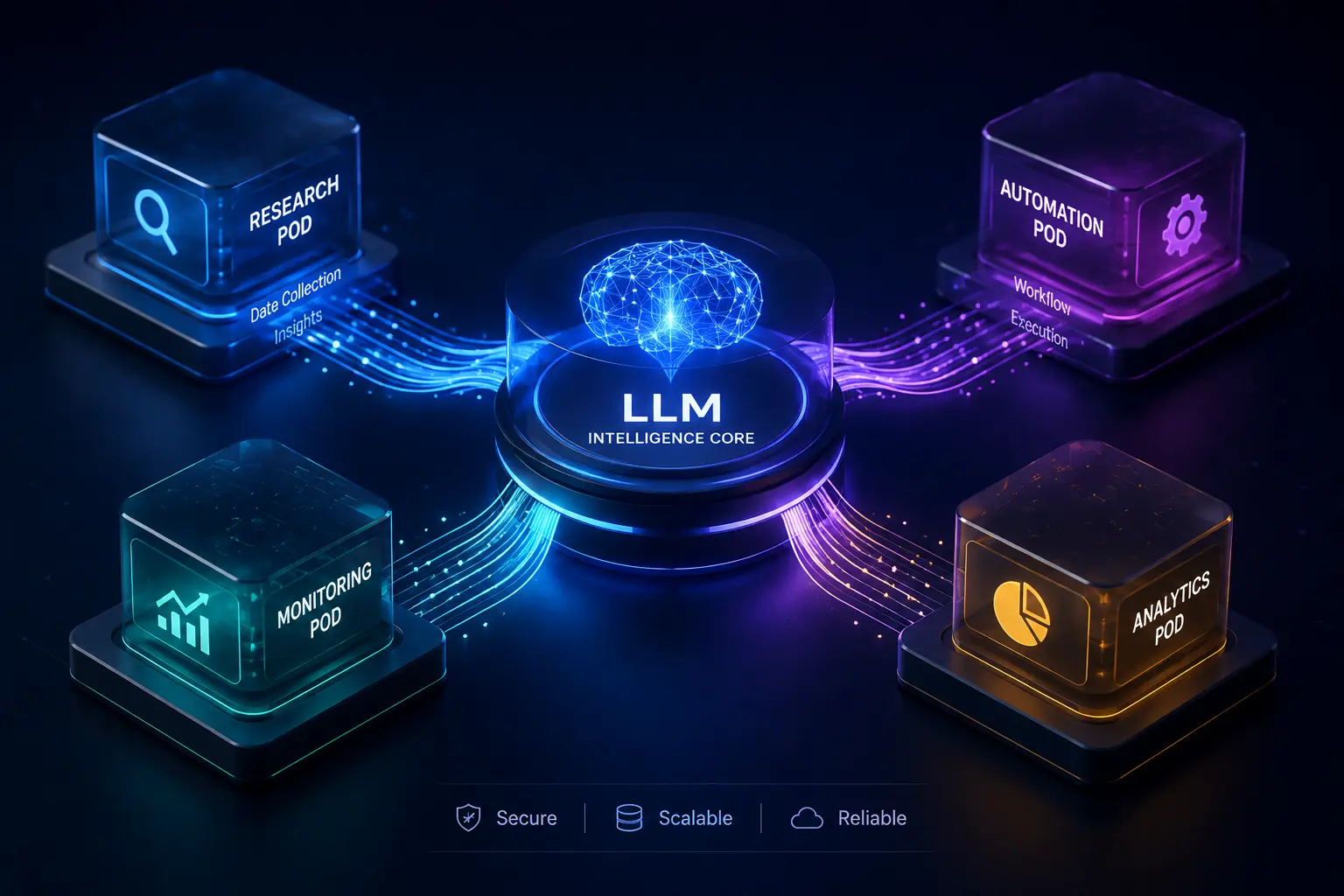
The all-in-one assistant is the new monolith. AI pods, specialised execution units sharing a central intelligence layer, are the microservices equivalent. And the engineers building them are the same ones who lived through the first transition. They remember how it ended.
What an AI Pod Actually Is
An AI pod is an autonomous execution unit built around a specific operational role. It has its own tools, its own memory, its own data connections, and its own scope. What it doesn’t have, what it doesn’t need, is its own full language model.
That’s the key distinction people often miss. A pod isn’t a miniature version of a general AI assistant. It’s closer to a specialist: a trained professional who knows their domain deeply, handles routine decisions independently, and reaches for the phone only when something genuinely requires higher-level reasoning.
At NVIDIA and ServiceNow’s expanded collaboration announced at ServiceNow Knowledge 2026, Jensen Huang described the next phase of enterprise AI as specialised autonomous AI agents, not broader, more capable assistants, but agents with targeted capabilities across specific enterprise workflows. That framing captures exactly what an AI pod is: targeted, not general.
Some examples of how pods map to real organisational functions:
- DevOps Pod: A triage agent detects a bug, routes context to a coding agent, which passes output to a security agent, which hands off to an infrastructure agent for deployment. Each step is a pod. Each pod is replaceable without rebuilding the others.
- Finance Pod: Reconciles transactions, surfaces anomalies, and flags items for human review. Handles the routine 90% autonomously. Escalates the edge cases.
- Legal Pod: Analyzes contracts against policy templates, tracks regulatory changes, generates compliance summaries. Calls the shared LLM when interpretation is genuinely ambiguous.
- Content Pod: A researcher agent gathers source material. A writer agent drafts. An editor agent refines. Each is a pod; together they form a workflow, no human in the loop for standard outputs.
The Shared LLM Layer: Where the Economics Live
If pods are the execution layer, the shared LLM intelligence layer is where reasoning happens. And understanding why sharing matters requires a quick look at how inference actually works under the hood.
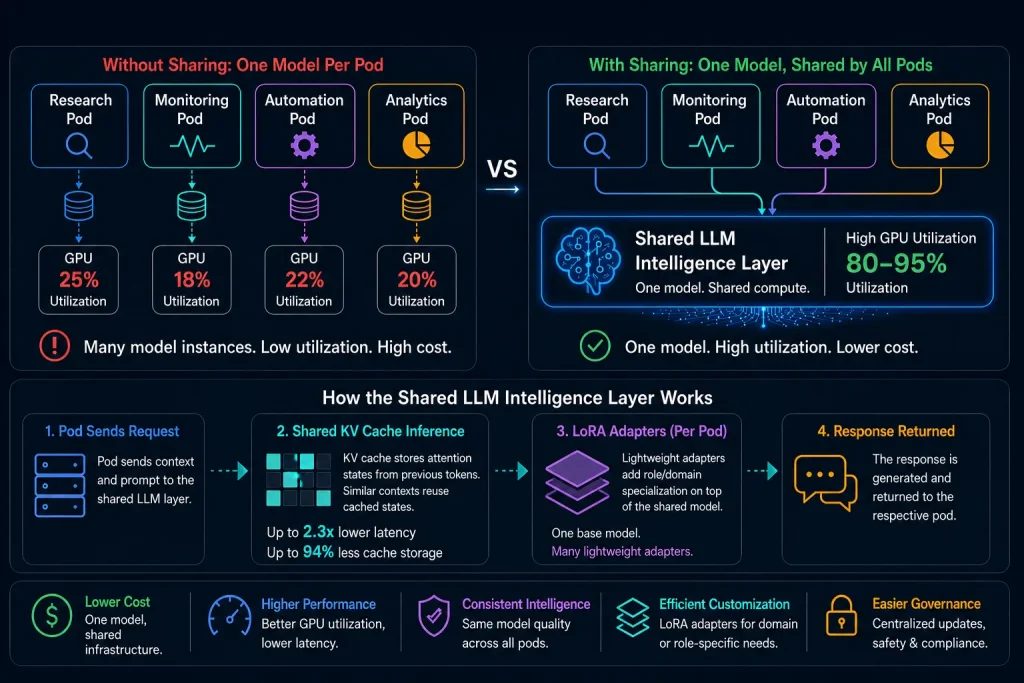
Running a large language model is GPU-intensive. Every request consumes memory. Every concurrent request competes for the same hardware. When organisations gave each team their own model instance in the early days of enterprise AI, the result was a fleet of GPU-hungry deployments, most of which sat idle most of the time.
The breakthrough is shared KV cache inference. A KV cache stores the computed attention states from previous tokens, so the model doesn’t recalculate from scratch on every request. In a shared architecture, pods that send similar context to the same LLM can reuse those cached states. Research from 2026 on systems like TokenDance shows shared KV cache architectures reduce end-to-end latency by up to 2.3x and cut cache storage by 94% compared to isolated serving, by treating communication patterns between agents as a first-class optimisation target.
There’s also the LoRA approach, Low-Rank Adaptation. Instead of fine-tuning a full model for each pod’s domain, LoRA trains lightweight adapter layers on top of a shared base model. The base model is one. The adapters are many. A monitoring pod, a legal pod, and a research pod can each have role-specific fine-tuning while running on the same underlying weights, dramatically reducing compute and memory overhead.
This is the infrastructure insight that changes the economics. Not one model per team. One model, many specialised adapters, all sharing compute through a centralised serving layer.
How the Layers Connect: From Request to Action
The interaction between a pod and the shared LLM follows a clean pattern, though calling it ‘clean’ understates how much engineering is behind keeping it reliable at scale.
A pod receives a task from a scheduler, a trigger, an event stream, or another pod. It gathers relevant context from its environment: the data it has access to, the current state of whatever it’s monitoring or operating on. Then it makes a structured call to the intelligence layer, not ‘tell me what to do’ but a precise, context-rich request: here is what I’m looking at, here is the decision I need help with, here is the format I need the answer in.
The LLM reasons. The pod acts on the result. What keeps this from becoming a coordination nightmare is the emergence of open protocols that standardise how pods talk to the intelligence layer and to each other. MCP (Model Context Protocol), developed by Anthropic, gives pods a universal connector to tools, data sources, and the LLM, described by BCG as ‘USB-C for AI.’ A2A (Agent-to-Agent Protocol), introduced by Google with support from Salesforce, SAP, and Atlassian, handles the peer layer, pods routing outputs to other pods in multi-step workflows.
Together, they solved what an engineering headache was, before standard protocols, each pod-to-LLM connection required custom integration. With open standards, the same pod can connect to different LLMs, different tool providers, and different orchestration layers without rebuilding the integration from scratch each time.
How Teams Are Actually Building With This
The frameworks have matured quickly. LangGraph handles complex stateful workflows, pods that need to remember what happened three steps ago and branch accordingly. CrewAI is built for role-based automation, where each crew member is a pod with a defined responsibility. CrewAI’s Flows run over 12 million executions per day across industries, including finance, federal government, and field operations. AutoGen (Microsoft) handles conversational multi-agent setups where pods need to negotiate intermediate outputs with each other. What does a real build look like?
The Agentic DevOps Pipeline
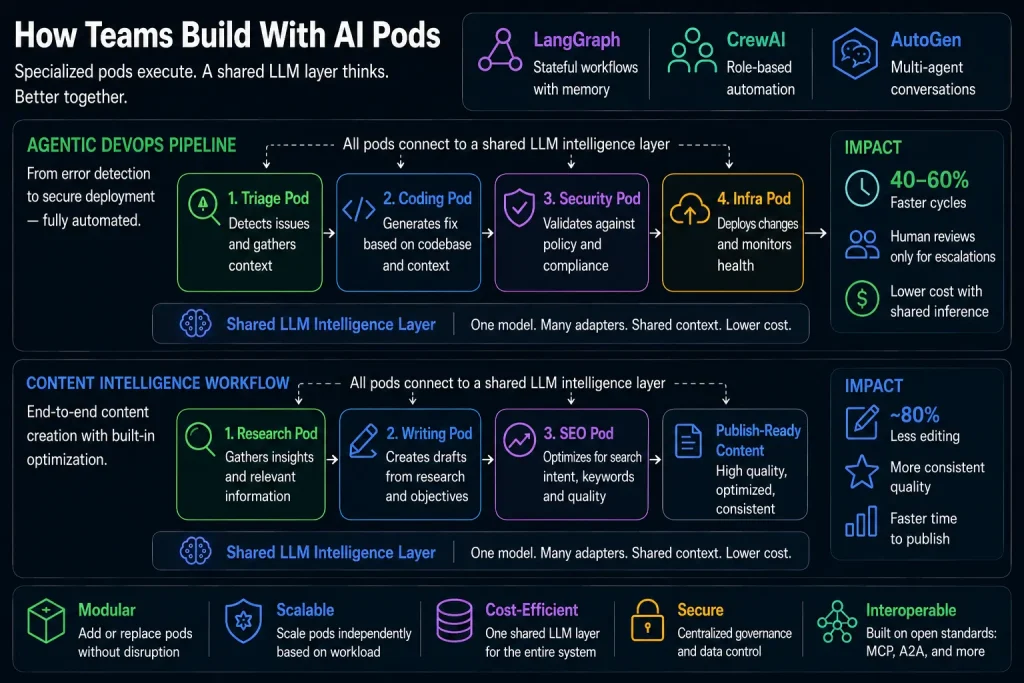
One of the clearest examples comes from DevOps, where the pod pattern has become almost standard among engineering teams that have moved past AI pilots into production. A Triage Pod monitors error logs and detects anomalies. When a bug surfaces, it doesn’t alert a human; it packages the context and passes it to a Coding Pod running a specialised adapter for the team’s codebase. The Coding Pod generates a fix proposal. That goes to a Security Pod that checks the proposed change against compliance policy. If it passes, the Infrastructure Pod deploys it.
Four pods. One shared LLM. A workflow that took a human engineer thirty minutes of context-switching now takes minutes, with a human reviewing only the cases that the security pod flags for escalation. Enterprise teams report 40–60% faster operational cycles after deploying agentic architectures like this.
The Content Intelligence Workflow
A media company’s content team deploys three pods to a single CrewAI flow: a Research Pod that pulls current data and competitor coverage, a Writing Pod that drafts from the research output, and an SEO Pod that optimises the result against search intent before publishing. The shared LLM handles the language-intensive steps, such as synthesis, drafting, and semantic analysis, while each pod maintains its own toolchain for the domain-specific actions.
What would have required three people working in sequence now runs as an autonomous pipeline with a human editor reviewing the final output. The editing load drops by roughly 80% on standard content formats, with quality improving because the SEO pod applies consistent criteria that human editors apply inconsistently.
You’re Not Deploying Software Anymore
Here’s the reframe that makes this architecture feel different from everything that came before it.
When you deploy a monolithic AI assistant, you’re deploying software. It runs, it responds, you update it, it runs again. The relationship between your organisation and the system is transactional: you send it inputs, it produces outputs.
When you deploy a system of AI pods sharing a centralised intelligence layer, you’re doing something closer to organisational design. You’re defining roles. You’re establishing communication protocols. You’re deciding what decisions each unit is authorised to make independently, what requires collaboration, and what requires human review. You’re setting the governance structure before the agents start running.
At Google Cloud Next 2026, the dominant theme wasn’t model capability. It was continuous agent execution, systems that act, decide, and adapt with minimal human involvement, embedded directly into the infrastructure layer. The competition between cloud providers has shifted from compute pricing to who can best support autonomous agent operations at scale.
That framing matters. An AI assistant you can ignore. An AI organisation’s pods running continuously, making decisions, routing work, flagging exceptions, that requires the same kind of intentional design you’d give to any organisational structure. Including the failure modes.
By 2027, Deloitte projects 50% of enterprises using generative AI will deploy autonomous agents, up from 25% in 2025. The acceleration is real. But what will separate the organisations that benefit from the ones that struggle isn’t the quality of the models; it’s whether they treated the architecture as an organisational decision rather than a technical one.
Key Takeaways
- AI pods are the microservices of intelligence: specialised, independently deployable execution units that share a central LLM rather than each running its own.
- The economics are driven by shared inference: LoRA adapters let pods have domain-specific behavior on a shared base model; shared KV caching cuts latency by 2.3x and storage by 94% in multi-agent serving.
- Gartner projects 40% of enterprise apps will have task-specific agents by end of 2026, up from under 5% in 2025. The adoption curve is steep.
- Open protocols, MCP and A2A are the connective tissue. MCP standardises tool access; A2A standardises pod-to-pod communication. Together, they collapse integration complexity.
- Leading frameworks in production: LangGraph (stateful workflows), CrewAI (12M+ daily executions), AutoGen (conversational multi-agent). Each has different strengths; the choice depends on workflow topology.
- NVIDIA, ServiceNow, Google Cloud, and Microsoft are all structuring their enterprise AI platforms around the specialized agent model, not broader assistants.
- This is an organizational design problem, not just a technical one. Role definitions, governance, escalation paths, and failure modes must be designed before pods go live.
Conclusion
The microservices transition took years to settle, failed migrations, over-engineered systems, teams that distributed everything because distribution felt modern, then spent eighteen months debugging network calls that used to be function calls. The AI pod transition is moving faster, with higher stakes, and the same early exuberance.
The architecture is sound, and the economics work. But the lesson from microservices holds. The technology is the easy part. The hard part is designing the boundaries, what each pod knows, what it’s allowed to decide, where it stops and where a human begins. Organisations that answer those questions before they scale will build systems that compound in value. The ones that deploy first and design later will build systems that compound in complexity.
The question worth sitting with: When you hand a pod the authority to act without asking: to file the ticket, send the message, trigger the deployment, how confident are you that you’ve drawn that boundary in exactly the right place?
