
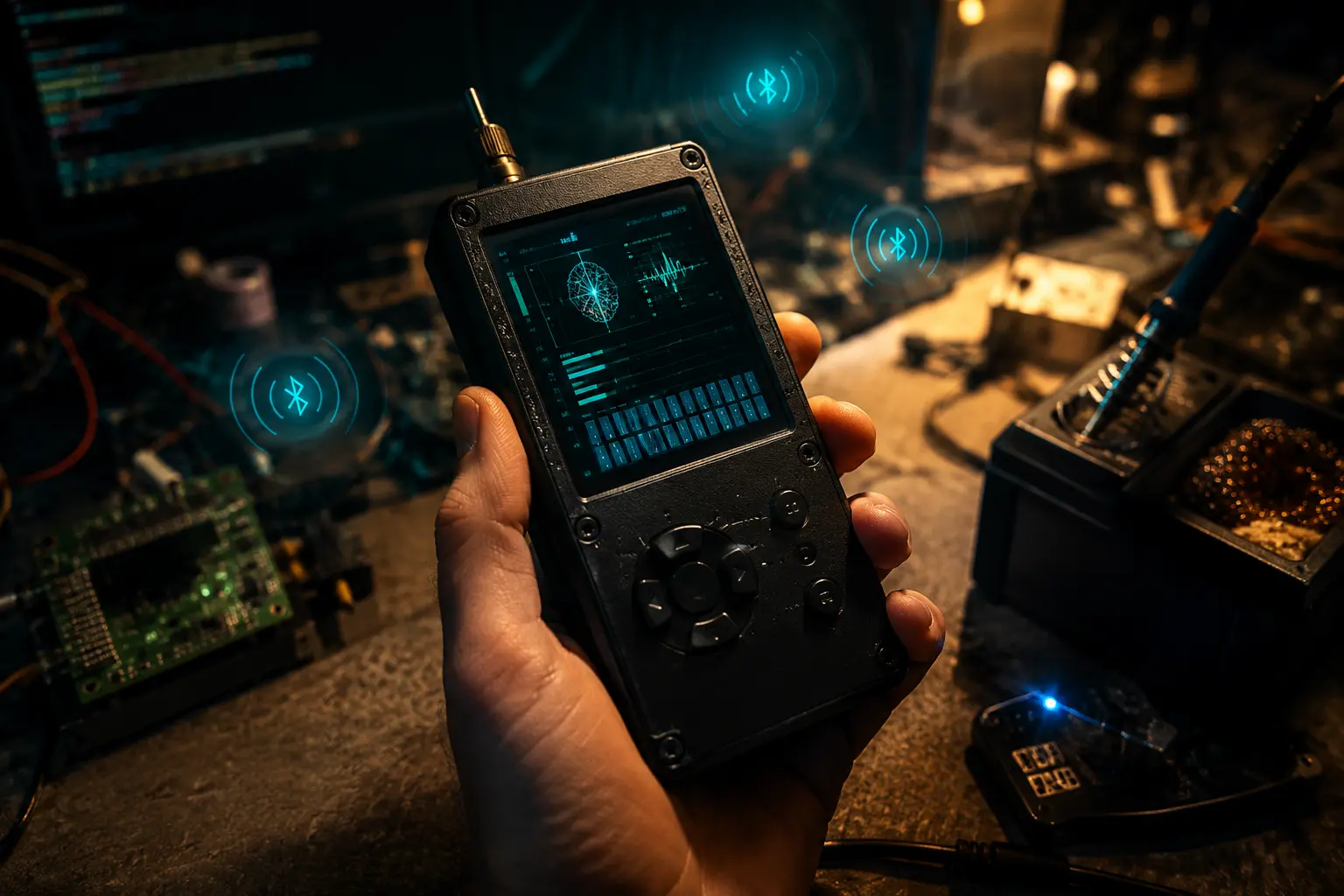

Most gadgets announce features. PolyCast5 keeps building them.
Since early 2026, RoboticWorx has been quietly stacking capabilities onto a pocket-sized open-source remote, the kind of device that doesn’t fit neatly into any product category. It’s not just a remote. It’s not just a security tool. And it’s not just an AI interface. It’s all of those things, running on hardware you can modify yourself.
And as of May 26th, it’s finally going public.
What Is PolyCast5, and Why Is 2026 Different?
The PolyCast5 is a portable, open-source multi-tool remote built by RoboticWorx. At its core, it combines five wireless technologies into a single device: Wi-Fi, Bluetooth, IR, RF, and NFC. The pitch is simple: one tool to interact with almost any electronics around you.
But the pitch undersells it. What’s actually been happening throughout this year is a steady stream of firmware updates, hardware revisions, and new features that have pushed the device well past “clever gadget” territory. We’re talking AI keyboards, offline credential vaults, live packet analysis, and a Claude AI usage monitor, all running on hardware you can hold in your palm.
That sounds like a lot. It is.
The AI Keyboard Nobody Expected

The February update introduced what might be the most unusual feature on any pocket device: an AI that connects to your computer as a standard Bluetooth keyboard and types for you.
The key detail here, and it’s easy to miss, is that your computer sees nothing unusual. As far as the OS is concerned, someone is just typing on a Bluetooth keyboard. Except it’s not a person. It’s an AI model receiving a spoken voice command, generating a script, and executing it at speeds no human could match.
You speak into the built-in microphone. Speech-to-text converts it on-device. The command is sent to an AI reasoning model. The resulting script fires through Bluetooth HID to your computer. The whole chain happens without your computer needing a single app installed.
“As far as your computer is concerned, this is a person typing something on a literal ordinary Bluetooth keyboard. Except it is actually an AI.” — PolyCast5
This update also introduced the AI Packet Analyser, a mode in which PolyCast5 captures 150 live Wi-Fi frames on a selected channel and sends the raw data to an AI reasoning model for deep analysis. Results are displayed on a local web portal that the device hosts itself, with no cloud dependency. No app.
On the hardware side, the new v7 board revision integrated the microphone and cut power consumption enough to push battery life to roughly a week per charge.
Passwords, Commands, and a Firmware Overhaul
Here’s where it gets genuinely interesting for anyone who thinks about security.
The March update turned PolyCast5 into an offline password manager. Say “Password” followed by the service name, and the device locates the right credential and auto-types it over Bluetooth, without ever touching the internet. The AI never sees your password, but it only handles the matching logic. The firmware does the rest.
The same logic applies to custom commands. Say “Custom” followed by a task description, and the device finds the right pre-scripted macro and executes it. Ambiguous inputs get resolved through fuzzy matching, and “My GitHub” will find your specific entry even if you didn’t name it exactly. Security is the real story here. There’s no cloud sync to compromise. No master password to forget. No breach notification to dread. The credential vault lives on the hardware itself, and retrieval happens locally over an encrypted Bluetooth channel.
This update also migrated the entire firmware stack to ESP-IDF v6.0, the newly released development framework from Espressif. For anyone who wants to fork the code and add their own features, this makes the process significantly cleaner. For end users, it means more stability, lower memory usage, and room for future features.
An offline password vault that retrieves credentials by voice, without ever connecting to the internet. That’s not a feature you see in many places.
Launch Date Confirmed, May 26th
The most recent update is the shortest, but the most significant: the Kickstarter campaign for PolyCast5 goes live on May 26, 2026.
Alongside the launch announcement, RoboticWorx shipped another round of hardware improvements, specifically targeting power savings and shaving off a few more milliamps from idle consumption. Website assets were also fully refreshed with clean renders and embedded demos. New documentation and tutorials were added for the AI keyboard and custom build control features.
The update also quietly introduced something interesting for AI power users: a live Claude AI usage monitor. The app displays real-time API metrics and rate limit data directly on the device’s screen. It is a small but genuinely useful tool for developers working against API consumption limits.
Small detail. Surprisingly practical.
On the open-source front: RoboticWorx confirmed that the core firmware will be released publicly immediately after the Kickstarter campaign concludes. That’s a meaningful commitment, it means backers aren’t just buying a product, they’re getting full visibility into what’s running on it.
What Most People Are Missing

Every feature PolyCast5 has shipped in 2026 points at the same underlying idea: the gap between edge hardware and AI capability is closing faster than most people realise.
Offline AI credential management. Live Wi-Fi intelligence. Voice-activated keyboard automation. These aren’t features that should fit on a device this size. And yet, here they are running on an ESP32-C5 chipset you can modify yourself.
The open-source angle matters more than it might seem. When the firmware ships post-Kickstarter, the community gets a working foundation for any number of applications: custom security tools, accessibility devices, developer productivity macros, and network diagnostics. The product is a starting point, not an endpoint.
The firmware going open-source post-campaign isn’t a footnote. It’s the whole point.
The larger shift here is that AI is increasingly running at the hardware layer, not as a cloud service you call, but as a local capability embedded in the device itself. PolyCast5 is a small, clear example of what that looks like in practice.
Key Takeaways
- Four major updates shipped in 2026, each adding meaningful new capability, not just fixing bugs.
- AI keyboard automation works without any software installed on the host computer, purely via Bluetooth HID.
- Offline password manager retrieves credentials by voice without internet connectivity or cloud exposure.
- AI Packet Analyzer captures and interprets raw Wi-Fi frames using a reasoning model, results displayed locally.
- Kickstarter launches May 26, 2026, core firmware goes open-source immediately after the campaign.
- Battery life extended to approximately one week per charge after v7 hardware revision.
Conclusion
PolyCast5 has spent 2026 building toward something, and it’s almost here. Four updates. Continuous hardware revisions. A firmware stack is now sitting on ESP-IDF v6.0 and ready for public inspection.
The Kickstarter moment on May 26th will be the first real test: does the maker community recognise what’s in front of them?
A pocket-sized device that handles passwords, analyses networks, automates keyboards, and monitors AI APIs, all offline, all open, all modifiable.
The more interesting question isn’t whether it funds. It’s what people build with it after the firmware drops.
