
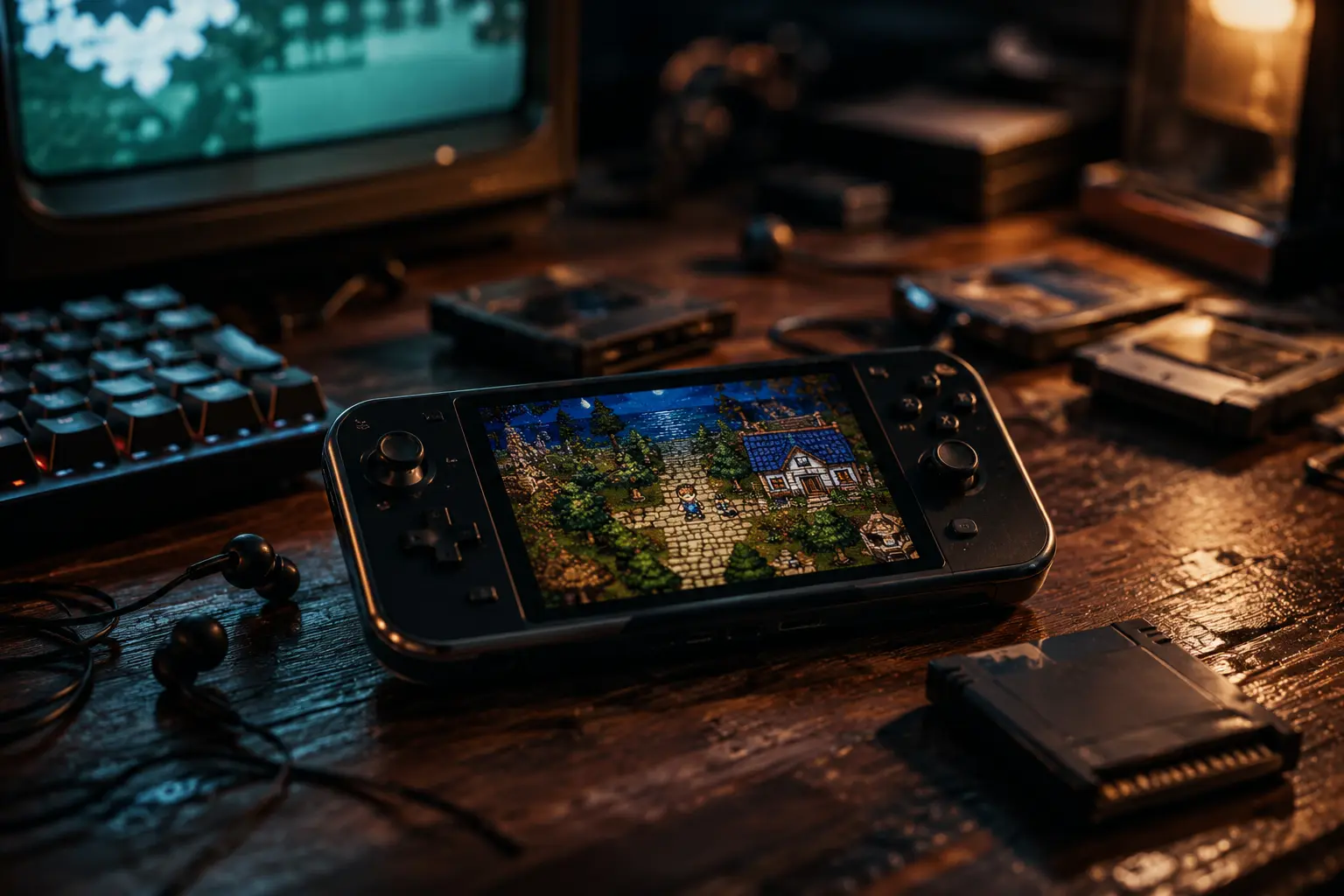

There’s a device in millions of hands right now that most people in mainstream tech have never heard of. It doesn’t run the latest AAA games. It doesn’t need a subscription. It doesn’t stream from the cloud. And yet, people are obsessed with it.
It’s a retro gaming handheld from a company called Anbernic. Compact, affordable, and built to play games that are decades old. The kind of device that shouldn’t matter in 2026. The kind that, somehow, matters more than ever.
What Is Anbernic?
Anbernic is a Chinese consumer electronics brand under Shenzhen Yangliming Electronic Technology Co., Ltd. The brand officially launched its RG (Retro Game) series in November 2017, positioning itself as a maker of open-source handheld gaming consoles. The mission was to bring classic games like NES, SNES, PlayStation, and Game Boy to a portable device that anyone could afford, modify, and own completely.
No cloud dependency. No platform fees. No gated ecosystem. Just a device, your games, and your hands.
What started as a niche product for emulation enthusiasts quickly outgrew its origins. By 2023, the RG35XX series had, in their own words, ignited the retro gaming circle and overwhelmed the market. That’s not marketing copy. Community forums, Reddit threads, and YouTube teardowns confirmed it independently.
Built in Shenzhen, Designed to Last
Anbernic devices come out of Shenzhen, Guangdong, the same ecosystem that produces components for most of the world’s consumer electronics. That geography matters. It means tight supply chains, rapid prototyping, and the ability to launch four to five new models per year at a pace that Western hardware companies struggle to match.
The devices are built around:
- ARM-based SoCs (System-on-Chip), similar in architecture to budget Android phones.
- IPS (In-Plane Switching) and OLED (Organic Light-Emitting Diode) display panels, with full-lamination, were introduced as early as 2020.
- Physical controls such as D-pads, analogue sticks, and shoulder buttons were designed to replicate the feel of original console controllers.
- Aluminum alloy shells on premium models, durable plastic on budget tiers.
The software layer runs either Linux (for deep customization), Android (for app compatibility), or Windows. Anbernic launched their first Windows-based PC handheld in July 2022, a shift that signalled ambitions well beyond simple emulation.
Every step has witnessed Anbernic’s growth, all of which have made our journey, our history, and the records of the retro game console. — Anbernic.
How Emulation Actually Works Here
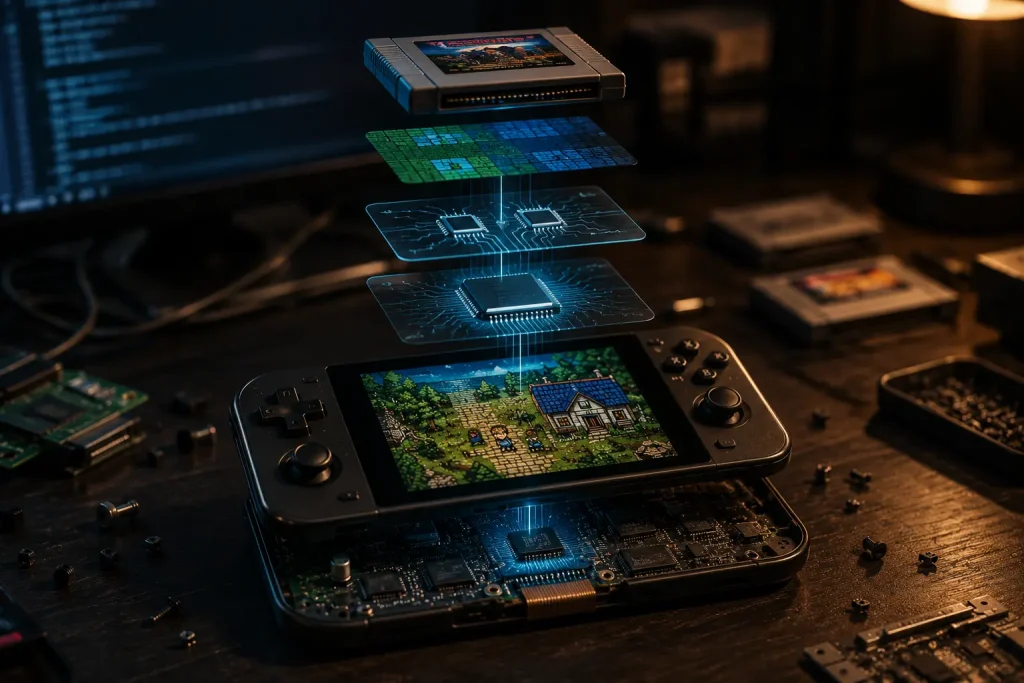
The core function of an Anbernic device is emulation, software that mimics the hardware of older consoles well enough to run their original game code. Think of it less like piracy and more like translation.
Each Anbernic handheld ships with a curated emulation frontend, typically RetroArch or a proprietary UI, that organises games by system. You load a ROM (a digital copy of a game cartridge), the emulator translates original hardware instructions into something the modern chip can process, and the game runs.
The performance ceiling depends on the SoC inside. Entry-level models handle 8-bit and 16-bit systems effortlessly. Mid-range handles PlayStation 1, N64, and Dreamcast. Premium models push into PlayStation 2 and GameCube territory. Decades of gaming history, collapsed into one pocket.
What makes Anbernic compelling beyond specs is its open-source approach. Most models run Linux builds that users can flash with community firmware, ROCKNIX, KNULLI, and GammaOS, unlocking better performance, more emulators, and granular configuration control. The device becomes a platform, not just a product.
What’s New in 2026: Anbernic Gets Experimental
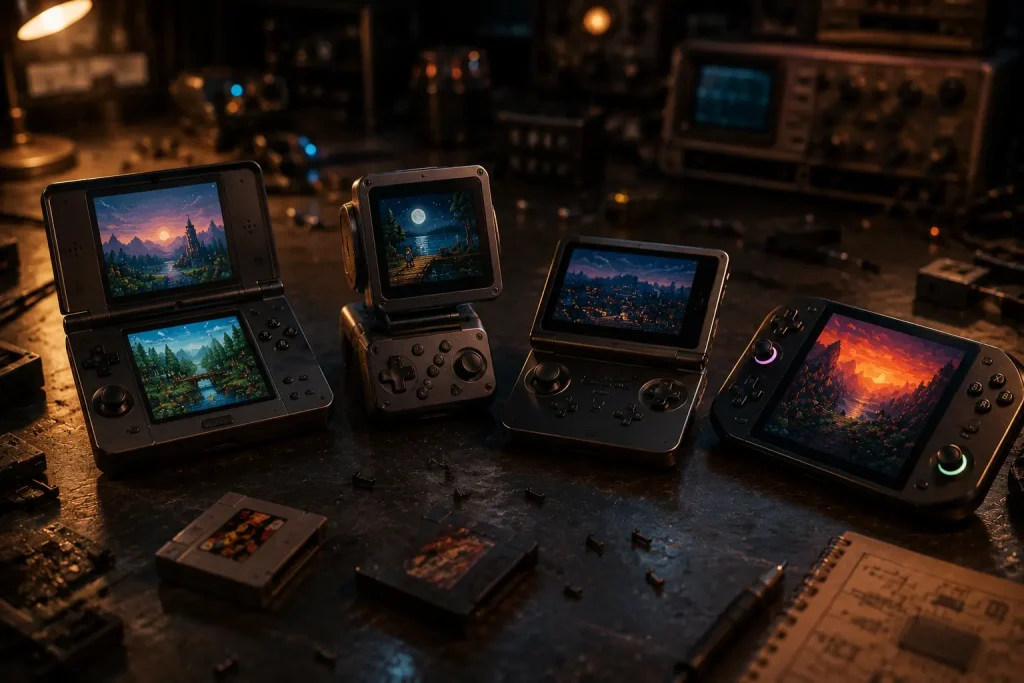
If previous years were about refining the formula, 2026 is about breaking it. Anbernic has released a wave of hardware this year that is, by any measure, unusual, and that’s exactly the point.
RG Vita & RG Vita Pro
Announced in February 2026, the RG Vita series represents Anbernic’s push into premium Android territory. The base model packs a 5.46-inch 720p display with the Unisoc T618 chip and Android 12. The Pro steps it up considerably: a 5.5-inch 1080p bezel-less IPS INCELL touchscreen, powered by the RK3576 64-bit octa-core processor, running a dual-boot Android 14 and Linux configuration.The Pro also ships with WiFi 6, Bluetooth 5.2, Hall-effect joysticks, and a six-axis gyroscope. An OTA firmware update in May 2026 added the Google Play Store, a significant unlock that effectively turns the device into a full Android handheld, not just an emulation machine. The reception was mixed. Community sentiment leaned lukewarm on the value proposition, but the hardware specs themselves are among the strongest Anbernic has shipped.
RG DS
Anbernic’s first dual-screen handheld, the RG DS, is an unapologetic tribute to the Nintendo DS form factor. Two 4-inch IPS displays, both touch-capable with stylus support, fold together in a clamshell design. It runs Android 14 and Linux on a Rockchip RK3568 chip with 3GB RAM.
The RG DS solves a real problem: Nintendo DS emulation on a single-screen device always feels compromised. Playing games designed around the dual-screen layout on a wide single panel m eans either tiny side-by-side windows or constant screen-switching. The RG DS simply removes that friction entirely. Pre-orders started at $94, shipping before December 2025, making it one of the more affordable entries in the dual-screen market.
RG Rotate
The RG Rotate is the oddest device in Anbernic’s 2026 lineup, and arguably the most interesting. It features a 3.5-inch 720×720 square IPS display mounted on a mechanical swivelling hinge, with an aluminium alloy body and replaceable L2/R2 shoulder buttons. It runs Android 12 on the Unisoc T618 chip with 3GB RAM.
Anbernic is pitching it as a multifunctional device: gaming, music player, and a retro clock. Pre-sale launched on May 11, 2026, priced at $82.99 for Polar Black and $99.99 for Aurora Silver. The community response was cautiously intrigued.
RG Slide
Released in 2025 and carrying into 2026, the RG Slide takes design cues from the Sony PSP Go, a sliding screen that lifts to reveal the controls beneath. Specs are solid: Unisoc T820 processor, 8GB RAM, 4.7-inch 120Hz display, 5000mAh battery, and Android 13. The RG Slide also includes Anbernic’s AI assistant features, including real-time translation during gameplay.
RG 557: The Flagship
The RG 557 is Anbernic’s most powerful handheld to date. A 5.48-inch AMOLED screen at 1920×1080, driven by the MediaTek Dimensity 8300 on a 4nm process, with up to 12GB RAM, 256GB storage, WiFi 6E, and a 5500mAh battery delivering up to 8 hours of play. RGB joystick lighting with 16 million colour options rounds out what is, unambiguously, Anbernic’s most ambitious consumer device.
The RG 557 also marks the company’s clearest signal yet that it intends to compete at the high end, not just serve the budget market.
If previous years were about refining the formula, 2026 is about breaking it. Rotating screens. Dual displays. AI assistants. Anbernic is probing every edge of what a handheld can be.
Where Anbernic Is Heading
The 2026 lineup isn’t random experimentation. A direction emerges: Anbernic is building toward a handheld that isn’t just an emulation box, but a genuinely multi-purpose personal device.
The AnbernicAI integration is the clearest signal. Already shipping on the RG 557 and RG Slide, it includes real-time in-game translation, an AI gameplay assistant, and image generation tools. Rough around the edges, but the intention is unmistakable; these devices are trying to become smarter, not just faster. There’s also a premium ambition taking shape. The Dimensity 8300 in the RG 557, AMOLED panels, WiFi 6E, dual-boot OS configurations — these are not the specs of a budget manufacturer playing it safe. Anbernic is climbing the hardware stack, slowly but deliberately, and the form factor experiments aren’t stopping either. Dual screens, rotating displays, sliding keyboards — they’re treating the handheld as an unsolved design problem, not a settled one.A device that plays your old games, translates Japanese text in real-time, and might also tell you the time. That’s a strange product. It might also be exactly what people want.
What This Actually Represents
Anbernic’s rise isn’t really about nostalgia. It’s about ownership.
The dominant model in modern gaming is platform dependency; you don’t own your games, you license access to them. Your library lives on Sony’s servers, or Microsoft’s, or Nintendo’s. When those storefronts close, your access goes with them. Anbernic handhelds, running open-source firmware with locally stored ROMs, represent the opposite philosophy.
You own the hardware. You own the software. You own the experience.
It’s a preservation argument as much as a gaming one. Shenzhen’s hardware ecosystem, which is deep, fast, and vertically integrated, is enabling a new category of companies that can ship high-quality consumer devices at price points that were unthinkable a decade ago. Anbernic is proof that serious hardware doesn’t require a Silicon Valley zip code or a billion-dollar war chest.
Key Takeaways
- Founded in 2017, in Shenzhen, China, releases 4–5 new models per year across budget to flagship tiers.
- Devices run Linux, Android, or Windows; most support community firmware for deep customization.
- 2026 lineup is the most experimental yet: RG DS (dual-screen), RG Rotate (swiveling square display), RG Slide (slider form factor), RG Vita Pro (premium Android), RG 557 (flagship AMOLED, Dimensity 8300).
- AnbernicAI is now shipping across multiple devices with real-time translation, an AI assistant, and image tools.
- The open-source philosophy creates a product development loop with the user community.
- The brand is climbing the hardware stack: WiFi 6E, AMOLED panels, dual-boot OS, octa-core 4nm chips.
- Represents a broader shift toward device ownership in an era of subscription-locked digital platforms.
The Question Worth Sitting With
Anbernic will never be a household name in the way Sony or Nintendo are. That’s probably not the point. What it represents is something quieter and more durable: the idea that the best gaming experience isn’t always the newest one, and that hardware built for ownership rather than dependency can find a devoted, global audience, even without a marketing budget or a celebrity endorsement.
In December 2018, Soulja Boy rebranded an Anbernic device, sold it under his name, and the project collapsed within a month. The actual company, unnamed and uncelebrated, kept building.
Eight years later, they’re shipping rotating screens, dual displays, AI assistants, and flagship-tier chips.
Nobody in Silicon Valley saw that coming. Then again, nobody in Silicon Valley was watching Shenzhen that closely.
