
You’ve probably seen a beautifully designed landing page that made you feel something, then clicked a button, got confused, and left.
Or the opposite: a product that worked flawlessly but looked like it was built in 2009.
Both are failures. But they’re different failures, and they come from mixing up two disciplines that sound interchangeable but aren’t: Visual design and UI/UX design.
What Visual Design Is
Visual design is rooted in traditional graphic design principles, colour theory, typography, composition, and brand identity. A visual designer’s core question is simple:
Does this look right?
Their work lives in logos, brand guidelines, illustration systems, campaign visuals, and the overall aesthetic language of a product. When applied to digital products, visual design shapes how something feels before a user even interacts with it.
Think of a visual designer as the art director of a film, responsible for how every frame looks, the colour grading, and the set design. Their craft is emotional and expressive. It’s not about whether the product works. It’s about whether it resonates.
What UI/UX Design Is
UI/UX is an umbrella that holds two related but distinct disciplines.
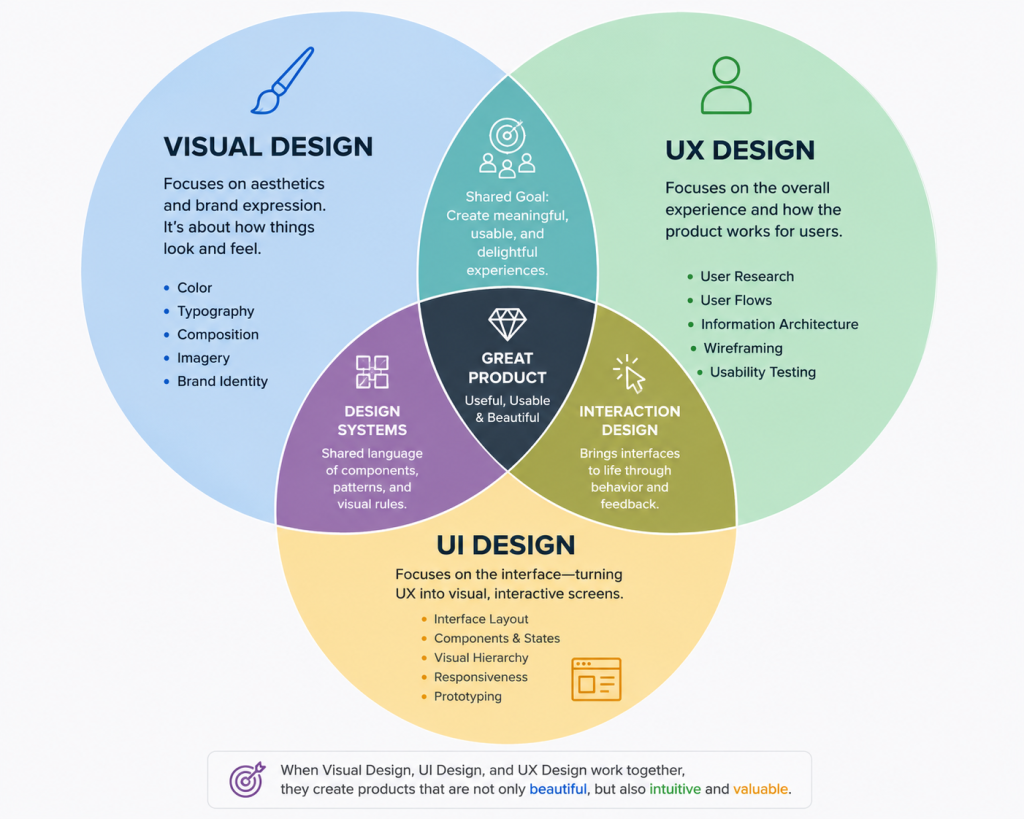
UX (User Experience) is about how a product works. It involves research, user flows, information architecture, and usability testing. UX is largely invisible when done well; nobody praises the navigation on a great app. They just use it without thinking.
UI (User Interface) sits where logic meets aesthetics. A UI designer translates UX thinking into actual screens, deciding how buttons look, how states behave, and how the visual system holds together across the product. It’s the bridge between experience logic and what the user actually sees.
UX is the blueprint. UI is the finished interior.
“UX is about how things work, while UI is about how things look and feel.”
The Real Difference
| Aspect | Visual Design | UI/UX Design |
| Core question | Does this look right? | Does this work for the user? |
| Focus | Aesthetics, brand, emotion | Usability, flows, interaction |
| User research | Rarely | Fundamental |
| Measures success by | Brand perception | Task completion |
The overlap creates confusion, especially in smaller teams where one person covers all three. But the distinction matters: each discipline asks a different question and fails in a distinct, predictable way when ignored.
What’s Changing in 2026
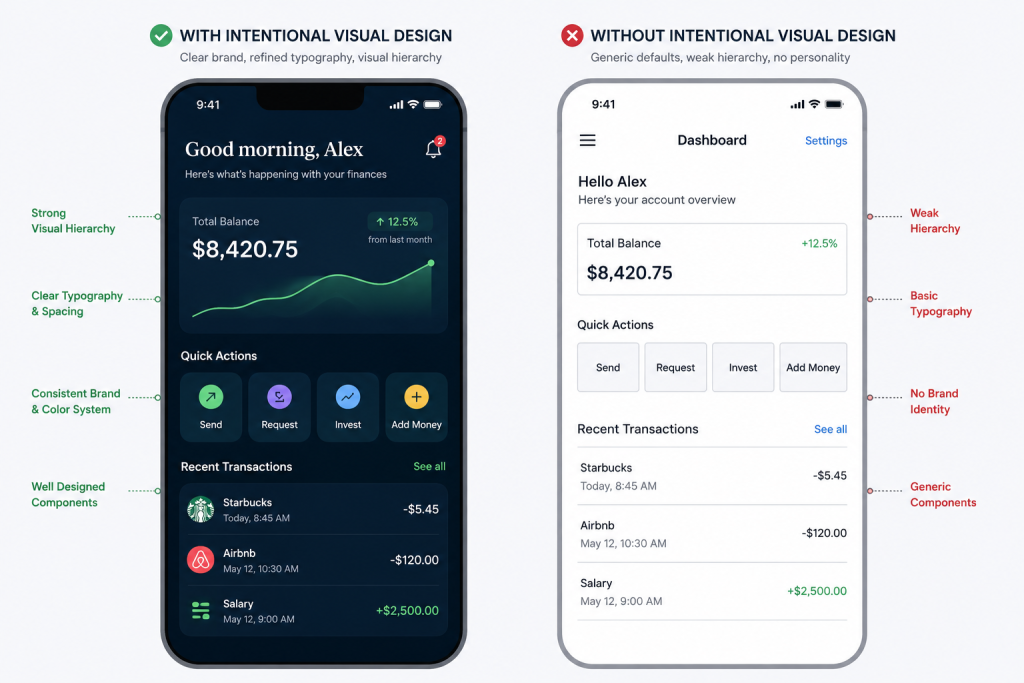
Visual design is recovering its personality. After years of sterile minimalism, design is shifting toward richer, more expressive visual treatments, brands using bold colour, texture, and personality that extreme minimalism had suppressed. Everyone adopted the same restrained palette, and brands lost visual differentiation. Now that’s reversing. Dark mode has also matured from a novelty into a carefully considered system, with palettes built for low-light environments without sacrificing brand identity.
UI/UX in 2026 is defined by one word: intention. Attention is hyper-fragmented, and users are craving simplicity. The most important shift is in how AI is integrated, away from AI as an all-knowing autopilot, toward AI as a thoughtful copilot that’s present, optional, and respectful of context. Interfaces that bombard users with AI suggestions are already feeling dated.
Accessibility has crossed a threshold, too. It’s no longer framed as a feature or a compliance checkbox. Its infrastructure, built into design systems from the start, encompasses vision, motor abilities, cognition, and the environment. Products that skip this are increasingly seen as exclusive, not just incomplete.
The Insight Most People Miss
Visual design without UX is decoration. UX without visual design is a wireframe.
Most products fail not because they’re ugly or confusing in isolation, but because the visual and experience layers were built by people who weren’t talking to each other. A stunning interface that sends users down a broken flow doesn’t feel like a UX problem. It feels like a bad product. And users don’t make that distinction.
“A product must work well before it can be made beautiful. But strong visual design amplifies user engagement and brand perception.”
The designers who thrive in 2026 understand both disciplines well enough to know when to lead and when to hand off.
Key Takeaways
- Visual design asks: Does this look right and feel on-brand?
- UX design asks: Does this work for the person using it?
- UI design bridges both translating logic into actual screens.
- In 2026, the best design is purposeful rather than decorative in both fields.
- The highest-value designers are those who speak both languages fluently.
Conclusion
The line between these disciplines is blurring, but that makes understanding them more important, not less.
A beautiful product that confuses people isn’t good design. A functional product that feels cold and generic isn’t either. The goal has always been both, and the teams that treat visual design and UI/UX as separate conversations tend to build products that feel exactly that way.
The question worth sitting with:
In your last project, did visual and experience design inform each other or did they happen in parallel, hoping for the best?
