
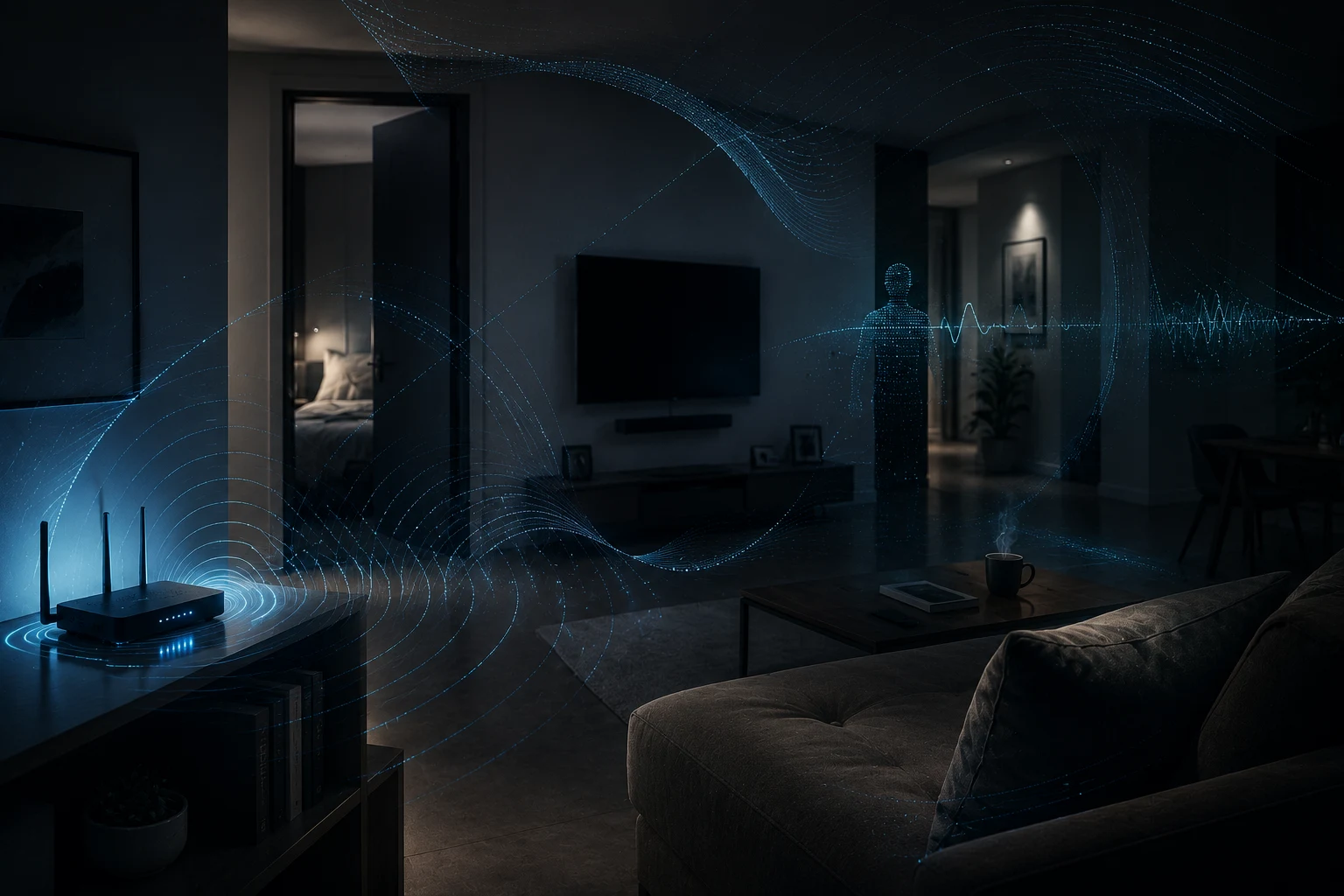

Your router has been lying to you, or rather, it’s been holding back. For years, it sat in the corner doing one job: moving packets. But in 2026, that same device is learning to sense you. Not metaphorically. Physically. It can detect if you’re home, if you’ve fallen, if the room is empty. It doesn’t need a camera. It doesn’t need a microphone. It just needs the radio waves already filling your walls.
That’s Wi-Fi sensing. And this year, it stopped being a research curiosity.
What’s Actually Happening
Wi-Fi sensing uses the same radio signals that connect your devices to the internet, but analyses how those signals change as they bounce through a room. A person walking across a space measurably disturbs the signal. So does breathing, falling, or even sitting still.
This isn’t new science. Researchers have understood the principle for over a decade. What’s new in 2026 is that the infrastructure is catching up to the science.
IEEE 802.11bf, the official Wi-Fi sensing standard, is now crossing from ratification into real commercial deployment. Qualcomm is building sensing directly into Wi-Fi 7 chipsets. Huawei’s AirSensing platform is already live in enterprise buildings. Intel engineers are embedded in the standardisation working groups. The pieces have been assembling quietly, and 2026 is the year the picture becomes clear.
“Wi-Fi is no longer just how we connect. It’s becoming how buildings think.”
How Wi-Fi Sensing Actually Works
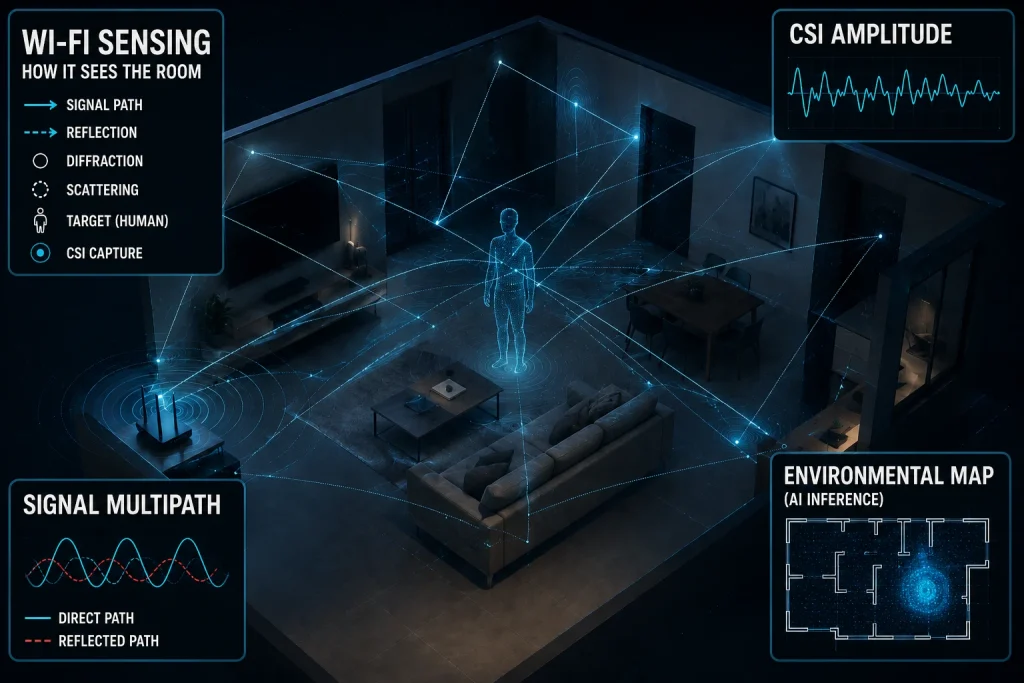
The underlying mechanism is Channel State Information (CSI), a detailed, per-subcarrier snapshot of how a Wi-Fi signal travels from transmitter to receiver. When nothing moves, CSI is relatively stable. When a body enters the space, the multi-path reflections shift. That shift is data.
Early systems could detect gross motion, such as someone walking into a room. What’s changed in 2026 is the resolution:
- Fall detection: identifying the signature pattern of a person falling versus sitting quickly.
- Breathing rate monitoring: sensing micro-movements through walls.
- Occupancy counting: distinguishing one person from three in a space.
- Gesture recognition: interpreting hand movements without cameras.
A major 2026 research paper on 802.11bf multiband passive sensing, combining sub-7 GHz and millimeter-wave signals, reported 95–100% sensing accuracy in controlled indoor scenarios. That’s the kind of number that makes product teams take notice.
But accuracy in a lab and reliability in the real world are different things. This is where AI enters the picture.
AI Is the Real Breakthrough, Not the Antennas
Older Wi-Fi sensing systems had a fragility problem. Move the couch, rearrange the room, add a new appliance, and the model broke. Sensing without context is just noise.
What’s different now is that self-supervised learning and edge AI are making sensing systems adaptive. A 2026 paper, MU-SHOTFi, demonstrated multi-person Wi-Fi sensing using self-supervised learning that can adapt to new environments without labelled training data. That’s a meaningful practical leap.
Qualcomm’s FastConnect ecosystem is building exactly this kind of edge AI intelligence into chipsets that will ship in millions of routers, laptops, and smart home devices. The sensing capability won’t be opt-in infrastructure; it will be embedded in the hardware people already buy.
“The question is no longer whether Wi-Fi can sense humans. It’s how much intelligence existing wireless infrastructure can extract from physical environments — without people realizing it.”
The Market Scale
According to a 2026 market report on the IEEE 802.11bf Sensing Market, the Wi-Fi sensing industry is projected to grow from $2.3B in 2025 to $14.7B by 2034. The primary growth drivers are smart buildings, healthcare monitoring, industrial automation, and automotive sensing.
The major players are not startups. Qualcomm, Intel, Huawei, Cisco, and Aruba are all actively building. At CES 2026, MediaTek signalled that future Wi-Fi systems would prioritise environmental awareness and reliability, not just throughput speed. That’s a meaningful shift in how the industry frames the technology’s core value.
How Small and Medium Businesses Can Actually Use This
This isn’t just enterprise infrastructure. The commercial opportunity for SMBs is surprisingly immediate.
- Retail occupancy analytics: Understand foot traffic, dwell time, and zone density without any cameras. Wi-Fi sensing can map how customers move through a space using existing routers, with no installation overhead.
- Office space optimisation: With hybrid work still defining office planning, accurate room occupancy data, not badge swipes, not booking systems, helps small businesses right-size their real estate.
- Elderly care and assisted living: Fall detection and activity monitoring without intrusive cameras is a compelling value proposition for small care providers who can’t afford dedicated IoT sensor networks.
- Security monitoring: Passive detection of after-hours movement in retail, restaurants, or warehouses through existing Wi-Fi hardware, integrated into existing building management systems.
- Hospitality: Occupancy-based climate control and lighting automation, improving energy efficiency across multiple rooms without per-room sensor installs.
The key enabler is cost structure. Businesses already have Wi-Fi routers. If sensing capability ships as a firmware or software layer, which is exactly where the industry is heading, the incremental cost is close to zero.
The Sensor You Never Agreed To

The industry conversation focuses on capability. What can it detect? How accurate is it? Which chipsets support it? But there’s a more uncomfortable question that’s starting to surface in policy circles.
Wi-Fi sensing is an invisible surveillance infrastructure. Unlike a camera or a microphone, there’s no indicator light. No obvious sensor. A router that’s sensing your presence looks exactly like a router that isn’t. The people being sensed have no way to know, and in most jurisdictions today, no legal protection.
A growing body of 2026 research and policy writing, including the essay When Wi-Fi Starts Watching, is beginning to frame 802.11bf not just as a sensing standard, but as a passive behavioural monitoring layer baked into standard networking hardware.
That’s not a reason to stop the technology. It’s a reason to have the regulatory conversation now, before deployment outpaces policy. The history of tech suggests we rarely do this well.
The larger shift 802.11bf represents is a redefinition of what network infrastructure is. Wi-Fi used to be plumbing, invisible, functional and taken for granted. In 2026, it’s becoming environmental intelligence: a system that doesn’t just connect devices, but perceives and interprets the physical world in real time.
“Wi-Fi sensing doesn’t look like surveillance. That’s the point — and the problem.”
Key Takeaways
- IEEE 802.11bf is transitioning from standard to commercial product, and occupancy detection, fall monitoring, and gesture sensing are all active deployment areas in 2026.
- AI is the real unlock; self-supervised learning is making sensing systems adaptive to real-world environments, not just controlled lab conditions.
- Major chipmakers are all-in: Qualcomm, Intel, Huawei, and MediaTek are building sensing into hardware that will ship at scale.
- The market is large, projected to reach $14.7B by 2034, driven by healthcare, smart buildings, industrial use, and automotive.
- SMBs have a practical near-term opportunity for occupancy analytics, fall detection, and passive security through existing Wi-Fi infrastructure.
- Privacy regulation has not kept pace; invisible passive sensing without disclosure or consent is a growing policy concern that 2026 has not yet resolved.
Conclusion
Every few years, a technology crosses the threshold from experimental to infrastructural. It stops being something you choose and becomes something you’re surrounded by. Wi-Fi sensing is approaching that threshold.
The capabilities are real. The commercial momentum is real. And the hardware it depends on is already in your home, your office, your hotel room, your doctor’s waiting area. What’s less clear is whether we’ve thought carefully enough about what it means to fill the world with sensing infrastructure that nobody can see, turn off, or meaningfully consent to.
The router in the corner isn’t just moving packets anymore. The question is what we’re comfortable letting it learn.
