
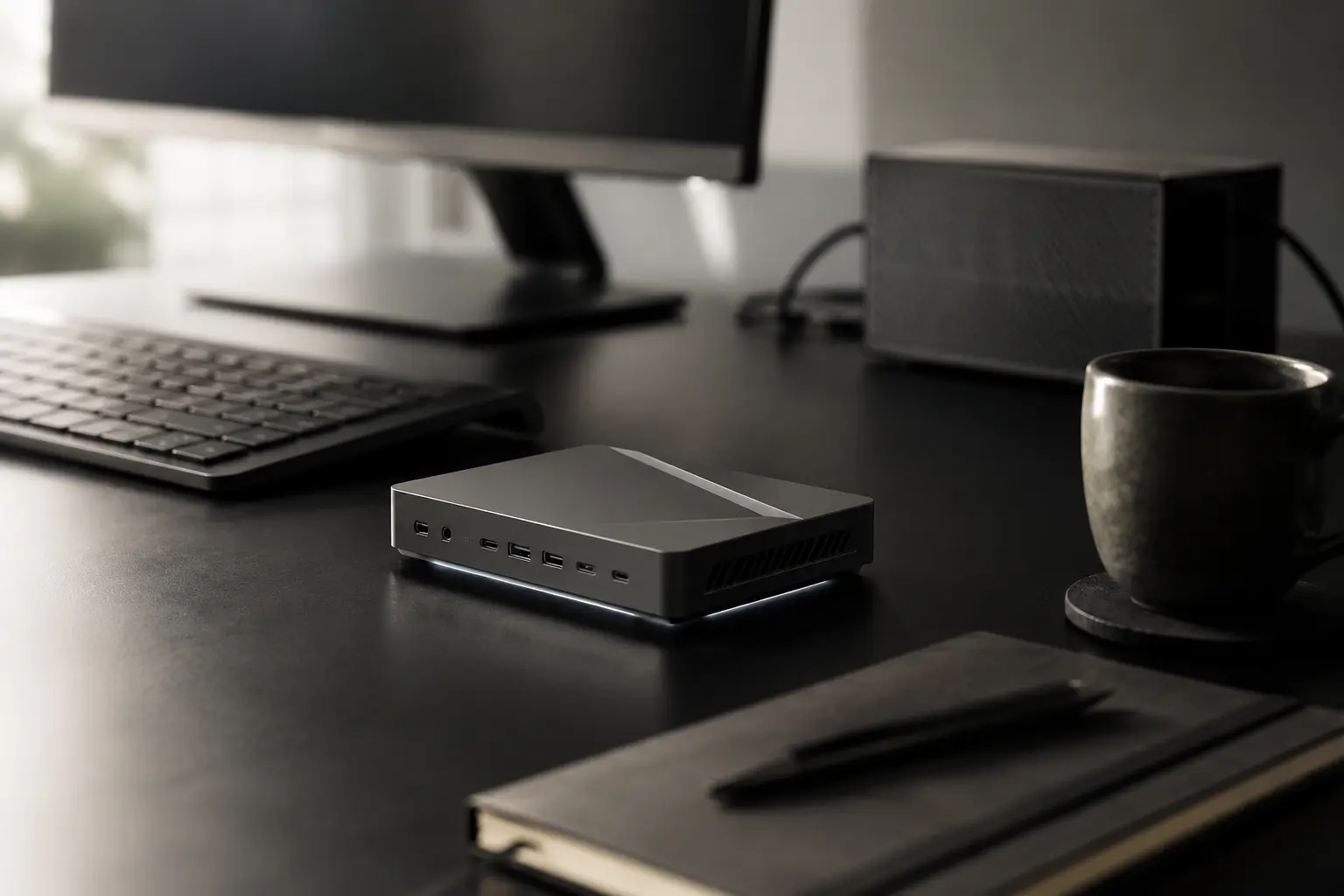

It looks like a thick SSD. It weighs less than a water bottle. And yet, it can drive a 4K display, run local AI workloads, and — if you add the right accessory — push frames at RTX 5060 Ti speeds.That’s the Khadas Mind 2. And the question it keeps asking is both obvious and quietly radical: why does a powerful computer need to be big?Most people have never seriously challenged that assumption. Desktops are towers. Workstations are heavy. Even laptops — designed for portability — still commit you to a single rigid form. The Mind 2 doesn’t accept any of that.
What Is the Khadas Mind 2?
The Khadas Mind 2 is a modular mini PC — a category that sounds niche until you understand what modular actually means here. It’s not just a small desktop. It’s a compute core designed to expand, attach, and transform depending on what you need it to be.Launched in 2024 and refined through 2025 and into 2026, the Mind 2 is built around Intel’s Core Ultra Meteor Lake platform. It measures 146 × 105 × 20 mm — roughly the footprint of a paperback book, but only 20mm thick — and weighs 435 grams. It’s the kind of device that makes you pick it up just to confirm it’s actually a computer.Khadas, the Hong Kong-based hardware company known for pushing SBC (single-board computer) design boundaries, has been refining this ecosystem since the original Mind launched. By 2026, the Mind 2 sits inside a mature, expanding ecosystem that includes an eGPU dock packing an RTX 5060 Ti, a portable display-keyboard combo that turns it into a laptop, and upcoming Panther Lake-powered successors.For someone encountering it for the first time, it genuinely reframes what a personal computer can look like.
How It’s Built
The Chassis
The Mind 2’s body is CNC-milled, anodized aluminum — machined from a solid block of metal rather than stamped or molded. The seams are tight, the chamfered edges catch light with a subtle sharpness, and the overall impression is of something built to a standard you don’t usually see at this price point. Reviewers consistently note the build quality as a genuine differentiator from competitors.
The Cooling System
Fitting serious thermal management into a 20mm-thick chassis required creative engineering. Khadas uses a custom system combining a vapor chamber (VC), pure copper heat fins, and a maglev fan — a magnetically levitated fan that spins with less friction and noise. The dual-inlet, single-outlet airflow keeps the CPU below 90°C under full load, well inside Intel’s 110°C spec. Under typical workloads, it’s whisper quiet.
The Mind Link Connector
This is the part that makes the Mind 2 different from every other mini PC on the market.On the bottom edge sits the proprietary Mind Link interface — a magnetic, high-bandwidth connector that carries native PCIe 4.0 x8 bandwidth (up to 128 GT/s). This is what allows the Mind 2 to connect to expansion modules — particularly the eGPU dock — without the bandwidth penalty that cripples most Thunderbolt-based eGPU solutions. The Mind 2S variant supports PCIe 5.0 x8 at twice the throughput.
Specs and Performance
The Mind 2 starts at $799 with the Core Ultra 5 125H, 16GB RAM, and 512GB SSD. Step up to the Core Ultra 7 155H and you get the most capable version — the popular 32GB/1TB configuration sits at ~$1,099, with a 64GB/2TB top tier available. Underneath all of it: Intel Arc integrated graphics, an NPU delivering 34 TOPS for on-device AI, and a rear IO that punches well above its size — Thunderbolt 4, USB4, HDMI 2.1, dual 2.5GbE, Wi-Fi 6, and Bluetooth 5.3.
Where the ecosystem earns its keep is in the expansion. The Mind Graphics 2 dock ($1,349) connects via Mind Link PCIe 4.0 x8 and brings a full desktop RTX 5060 Ti with 16GB GDDR7 — delivering 4–6x the 3D performance of the integrated Arc, plus a 10-port dock and built-in 350W PSU in a single box. The Mind xPlay ($399) adds a display, keyboard, and trackpad, turning
Advantages and Disadvantages
What It Gets Right
- Build quality is genuinely exceptional — CNC aluminum at this size is rare.
- Mind Link solves eGPU bandwidth — PCIe 4.0 x8 native vs. Thunderbolt’s 32 GT/s ceiling.
- Thermal engineering is impressive for 20mm — stays quiet under typical loads.
- Ecosystem depth is growing: eGPU, laptop shell, docks, developer kits.
- Connectivity is unusually rich — dual 2.5GbE alone is a differentiator.
- Linux support is solid — Ubuntu 24.04 runs well.
Where It Falls Short
- Price premium is real. Starting at $799, it’s expensive for a mini PC — and the full ecosystem costs over $2,400.
- RAM is soldered. You can’t upgrade memory after purchase.
- Cooling headroom is limited. Extended sustained workloads can trigger thermal throttling in the thin chassis.
- Mind Graphics 2 is proprietary. Unlike desktop GPUs, you can’t move it to another system.
- Fan noise under heavy load is noticeable — not silent at 100% CPU.
- BIOS updates and driver setup (especially for the eGPU) can require manual patching.
Maintenance and Longevity
The M.2 2230 slot is user-accessible via a tool-free press latch — storage can be swapped post-purchase, but RAM is soldered, so the config you buy is the one you keep. Thermal paste replacement is possible but requires disassembly and isn’t something most users will ever need.
Khadas provides active firmware and driver support, though initial BIOS and NVIDIA driver setup for the eGPU can involve manual steps — reviewers flagged this as a friction point out of the box. Once past that, day-to-day operation is smooth. The Mind 2 ships with a standard 1-year warranty, in line with other premium mini PC makers.
The Larger Shift This Represents
We’ve accepted a strange compromise for decades: the more computing power you want, the less portable your computer becomes.The Mind 2 pushes back on that. Its modular logic argues your compute core should travel with you — CPU, memory, storage always on hand — while the GPU, display, and ports attach contextually. It’s closer in spirit to a smartphone ecosystem than a traditional PC. And with the Mind Pro (Panther Lake) in pre-order at CES 2026, the ecosystem is accelerating fast.That sounds obvious once stated. It wasn’t obvious before someone built it.
Key Takeaways
- It’s a portable compute core, not just a small desktop. At 435g and 20mm thick, the Mind 2 is small enough to carry everywhere — yet capable enough to drive 4K displays, handle local AI workloads, and pair with a desktop RTX 5060 Ti when the work demands it.
- The modular ecosystem is the whole point. Mind Link’s native PCIe 4.0 x8 connection is what separates this from every other eGPU solution on the market — no Thunderbolt bottleneck, no bandwidth penalty. Attach the Graphics 2 dock, the xPlay display, or both, and the device transforms to fit the environment.
- The engineering is genuinely refined for the size. CNC aluminum chassis, vapor chamber cooling, and a maglev fan keep it quiet and premium under typical loads — a level of build quality you don’t usually find in this category.
- The trade-offs are real and worth knowing upfront. RAM is soldered and can’t be upgraded. The ecosystem gets expensive fast — full kit runs ~$2,448. BIOS and eGPU driver setup still skews enthusiast-grade rather than plug-and-play.
- The bigger idea matters more than the specs. The Mind 2 challenges the assumption that serious computing has to be fixed and large. Once you’ve used it across multiple environments, traditional PCs start to feel surprisingly rigid by comparison.
Conclusion
The Khadas Mind 2 isn’t the right computer for everyone. Its premium pricing, soldered memory, and proprietary ecosystem ask for a real commitment. The Mind Graphics 2 dock costs more than a standalone RTX 5060 Ti, and the full ecosystem pushes past $2,400.But for a specific kind of user — someone who moves between environments, cares about desk aesthetics, wants real compute performance without sacrificing portability, and thinks in ecosystems rather than single devices — the Mind 2 makes an argument that’s hard to counter.What’s actually interesting isn’t the specs. It’s the philosophy. In a market crowded with mini PCs that are essentially small towers, the Mind 2 proposes a different question entirely: what if your computer came with you everywhere, and your desk accessories stayed home?Once you’ve used it that way, the older model starts to feel oddly backwards.
| Categories | Mini PC Reviews, Modular Computing, Portable Hardware, AI PCs, Developer Gear |
