

“Cyber attacks are evolving faster than ever, but so is AI. Are your security operations ready for 2026?”
AI-Driven Security Operations: The Future of SOC and Cybersecurity in 2026
Learn how AI-driven SOCs will transform cybersecurity in 2026 with autonomous systems, predictive threat detection, and Human–AI collaboration. Security operations are rapidly evolving toward an AI-first, proactive model. In 2026, the focus is shifting from simply reacting to alerts to anticipating, prioritising, and responding to threats in real time.
Modern Security Operations Centres (SOCs) achieve this through three key pillars: Autonomous Systems, Predictive Threat Detection, and Human–AI Collaboration. Together, these pillars enable faster, smarter, and more effective cybersecurity, ensuring organisations stay ahead of increasingly sophisticated cyber threats.
Now, let’s understand each of these pillars deeply:
Autonomous Systems
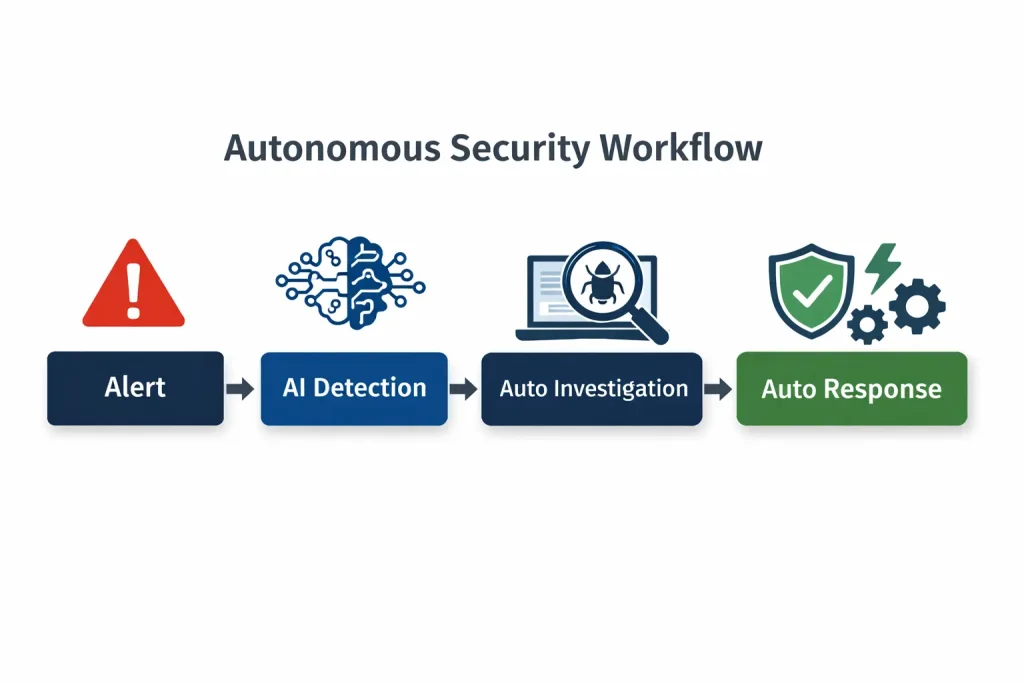
Autonomous systems represent the next step beyond traditional automation, enabling security operations to move from alerts to action without constant human intervention. Autonomous systems take security operations beyond basic automation, helping teams move from simply reacting to alerts to actually taking action, without needing constant human involvement. These systems analyse data across endpoints, networks, and cloud environments in real time, identifying threats and acting instantly. They can isolate compromised devices, block suspicious activity, and initiate response workflows within seconds, reducing the window of attack. By learning from past incidents, they continuously improve accuracy and decision-making. While human oversight remains important for critical decisions, autonomous systems significantly enhance SOC efficiency by handling high-volume tasks at scale.
Predictive Threat Detection
Predictive threat detection shifts cybersecurity from a reactive to a proactive approach. Instead of relying only on known attack patterns, it uses AI and behavioural analytics to identify early signs of suspicious activity. By continuously analysing user behaviour, network traffic, and system anomalies, it can detect potential threats before they fully develop. This allows organisations to respond earlier and prevent attacks rather than just contain them. As cyber threats become faster and more sophisticated, predictive detection helps security teams stay ahead of attackers. In 2026, it will become a core capability in modern, AI-driven SOCs.
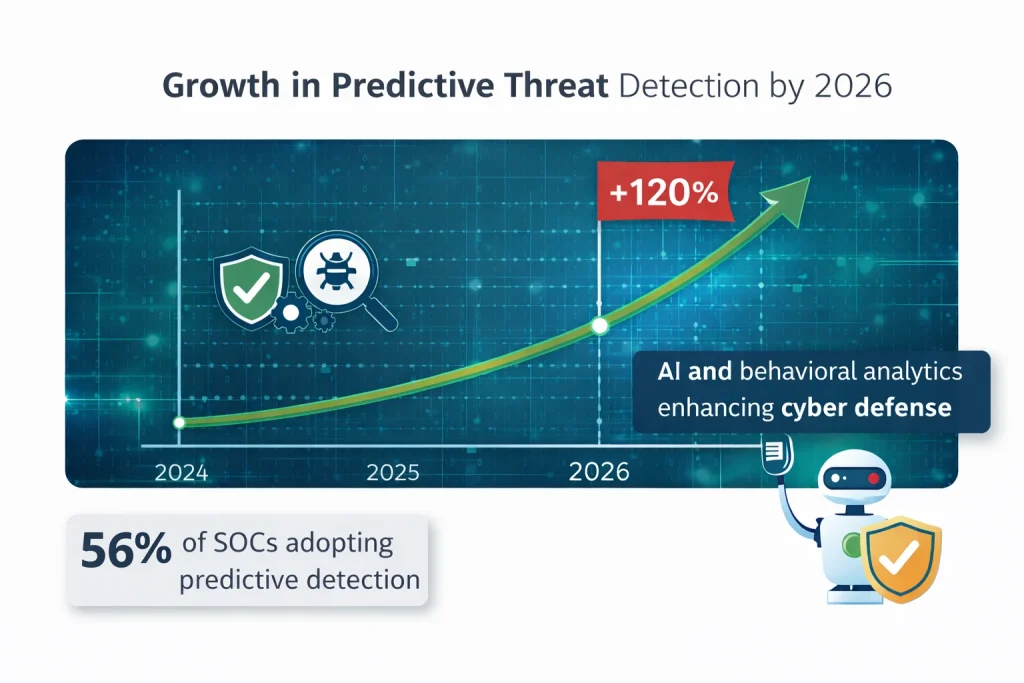
The graph illustrates the rapid growth of predictive threat detection adoption from 2024 to 2026. The upward trend highlights how organisations are increasingly shifting toward AI-driven and proactive security strategies. The marked growth (such as the +120% increase) reflects the rising importance of detecting threats early rather than reacting after damage occurs. The statistic showing that over half of SOCs are adopting predictive detection indicates that it is quickly becoming an industry standard. Visual elements like AI and security icons emphasise the role of intelligent systems in modern cyber defence. Overall, the image reinforces that predictive threat detection is a key driver of the future of cybersecurity.
Human–AI Collaboration
In today’s cybersecurity landscape, Human–AI collaboration is key to fast, effective threat management. AI excels at processing massive datasets, detecting anomalies, and generating insights in real time, giving analysts speed and scale that humans alone cannot match. Human experts add critical judgment, context, and strategic oversight. They validate AI-identified risks, prioritise incidents, and make complex decisions where business context matters. By combining AI’s rapid analysis with human intuition, organisations reduce cognitive overload and focus on the most impactful threats. The future Security Operations Centre (SOC) is a partnership, not a competition. AI identifies patterns, humans strategise, and together they secure the digital landscape efficiently.
Key Highlights from the Infographic:
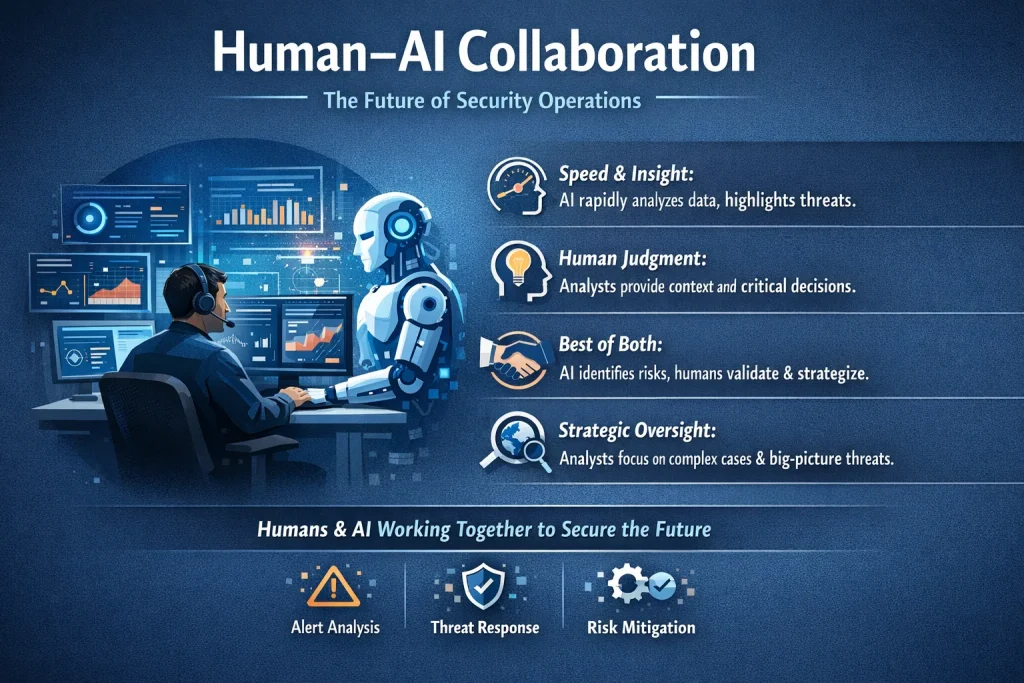
Speed & Insight: AI rapidly analyses data and highlights potential threats.
Human Judgment: Analysts provide context, evaluate risks, and make strategic decisions.
Best of Both: AI-driven alerts combined with human validation ensures effective response.
Strategic Oversight: Humans focus on complex cases and overarching security strategies.
Outcomes: Alert Analysis, Threat Response, and Risk Mitigation are optimised through collaboration.
Conclusion
AI-driven SOCs are redefining how organisations prevent, detect, and respond to cyber threats. By combining autonomous systems, predictive threat detection, and Human–AI collaboration, businesses gain unmatched speed, insight, and strategic oversight.
As cybersecurity continues to evolve, is your SOC ready to harness AI for proactive defence in 2026?
