
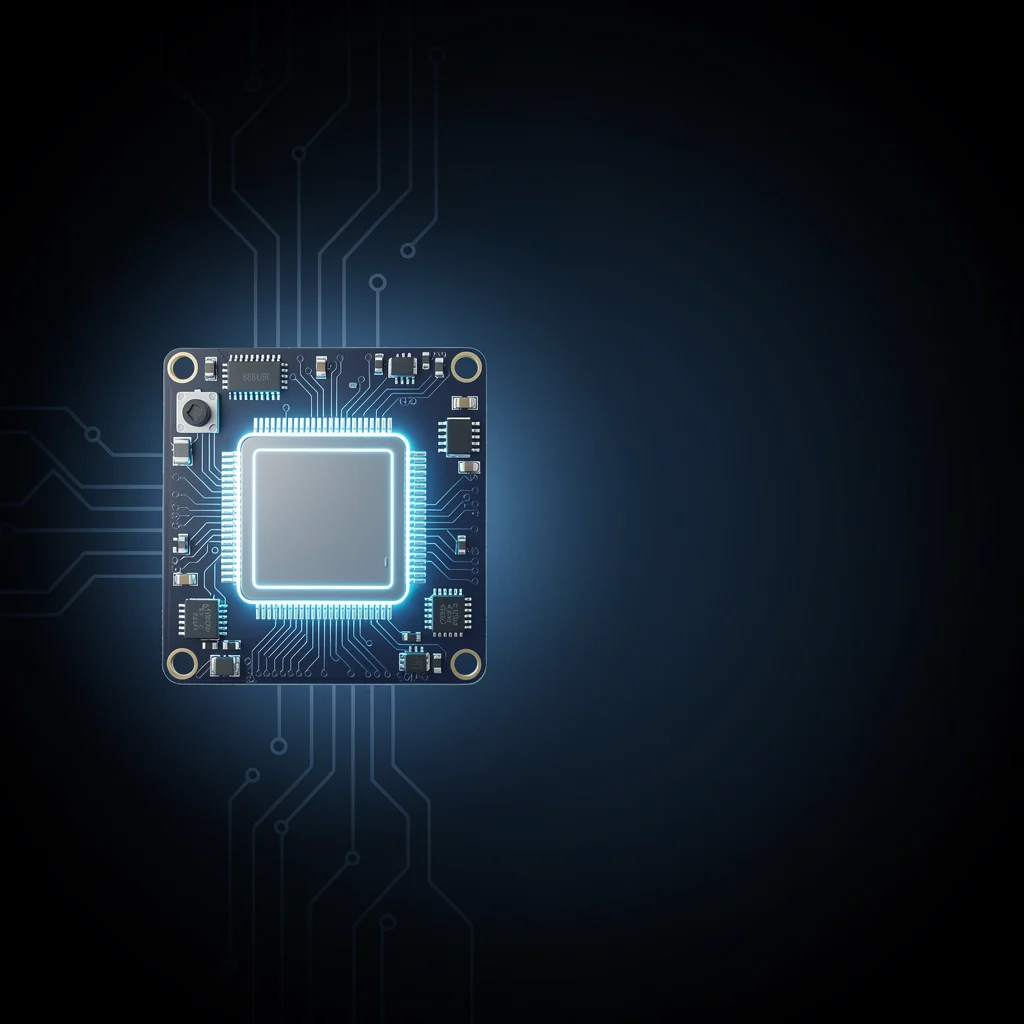

A sensor once simply collected data. Today, that same sensor can understand it and act on it. This shift is quiet. But it’s changing what it means to be an engineer.
Embedded systems are no longer “just hardware”
For decades, embedded systems were built to follow instructions, sense inputs, process signals, and produce outputs. That was the boundary. But that boundary is dissolving.
As AI moves closer to hardware, embedded systems are no longer just reactive.
They’re becoming intelligent systems that can learn, predict, and decide. Machine learning is moving directly onto the device, changing what ECE engineers need to know and changing the future scope of ECE as a discipline.
Traditionally, embedded devices offloaded the heavy thinking to external servers, the cloud.
Now, intelligence is moving onto the device itself. This is what we call Edge AI: data processed locally, decisions made in real time, with dramatically lower latency and no cloud dependency.
It doesn’t sound dramatic.
But it changes where intelligence lives and who builds it.
Hardware is being redesigned for AI
We’re entering a phase where hardware is no longer general-purpose. It’s becoming specialised for AI workloads, something traditional CPUs were never designed to handle efficiently.
Terms like NPUs (Neural Processing Units), AI Accelerators, and Edge SoCs are no longer just conference buzzwords. These are purpose-built chips optimised to run intelligence at the edge, with low power and high throughput.
Open architectures like RISC-V are accelerating this shift, giving engineers more customisation control over silicon without depending on proprietary designs.
Terms like NPUs (Neural Processing Units), AI Accelerators, and Edge SoCs are no longer just conference buzzwords. These are purpose-built chips optimised to run intelligence at the edge, with low power and high throughput.
Open architectures like RISC-V are accelerating this shift, giving engineers more customisation control over silicon without depending on proprietary designs.
“The real competition is no longer just software innovation, it’s how efficiently hardware can run intelligence.“
TinyML: AI that fits inside small devices
AI is no longer exclusive to powerful machines.
With TinyML, machine learning models can run on microcontrollers, wearables, and sensor devices with severe memory and power constraints.
Even low-power hardware can now detect patterns, recognize voice or gestures, and predict failures, enabling predictive maintenance even on low-power industrial sensors.
TinyML also powers IoT (Internet of Things) devices, enabling intelligence at the sensor level without any cloud dependency.
With TinyML, machine learning models can run on microcontrollers, wearables, and sensor devices with severe memory and power constraints.
Even low-power hardware can now detect patterns, recognize voice or gestures, and predict failures, enabling predictive maintenance even on low-power industrial sensors.
TinyML also powers IoT (Internet of Things) devices, enabling intelligence at the sensor level without any cloud dependency.
“AI is no longer limited by size; it’s becoming everywhere.”
Security is moving into silicon
As devices become smarter, they become more exposed.
Traditional software-layer security isn’t sufficient for always-on, distributed edge devices. So the industry is embedding security directly into hardware: secure boot mechanisms, hardware-level encryption, and trusted execution environments.
For ECE students, this opens a powerful and underexplored intersection, hardware, security, and AI converging in one design.
Traditional software-layer security isn’t sufficient for always-on, distributed edge devices. So the industry is embedding security directly into hardware: secure boot mechanisms, hardware-level encryption, and trusted execution environments.
For ECE students, this opens a powerful and underexplored intersection, hardware, security, and AI converging in one design.
Neuromorphic computing: a glimpse further ahead
Some of the most ambitious research takes inspiration from the human brain itself.
Neuromorphic systems process information like neurons, consuming extremely low power while operating in real time.
The technology is still maturing, but its direction is clear: not faster machines, but smarter, more efficient ones.
Neuromorphic systems process information like neurons, consuming extremely low power while operating in real time.
The technology is still maturing, but its direction is clear: not faster machines, but smarter, more efficient ones.
What ECE students should focus on
Core foundations
- Embedded C / C++
- Microcontrollers (ARM, ESP32)
- Electronics and system design
AI + edge integration
- Python for ML basics
- TensorFlow Lite
- TinyML concepts and deployment
Hardware awareness
- Basics of VLSI
- ASIC design fundamentals
- NPUs, RISC-V, and accelerators
Tools that matter
- MATLAB / Simulink
- Embedded dev environments
- AI model optimization tools
Emerging areas
- Hardware security
- Edge AI + IoT deployment
- Neuromorphic computing
Key takeaways
- Embedded systems are evolving into intelligent, autonomous systems.
- Machine learning is moving from cloud infrastructure to edge devices.
- Hardware is being purpose-built for AI, including open architectures like RISC-V.
- TinyML enables AI in IoT and power-constrained environments.
- Predictive maintenance and real-time inference are core edge AI use cases.
- Security is becoming a hardware-level concern, not just software.
- ECE students are uniquely positioned at the hardware-AI intersection.
Closing thought
The future engineer may not fit neatly into a single category. Not purely hardware, not purely software. But someone who understands how intelligence is built from silicon to system.
For years, software sat at the center of innovation.
Now, software is moving closer to hardware.
And hardware is becoming capable of intelligence. This convergence is where the next wave of engineering will grow, and for ECE students exploring career options in 2026, embedded AI represents one of the fastest-growing opportunity areas in the field.
Are we still learning to build systems, or are we learning to build intelligence itself?
