

Nobody reads the Terms of Service. But somebody has to write them, and that somebody is now legally responsible for every word that isn’t there.
The moment a user downloads your software, a legal relationship begins. They didn’t read the agreement. You might not have read it either; maybe you copied a template, added your company name, and moved on. That used to be fine. In 2026, it isn’t.
Regulators across three continents are actively enforcing software compliance laws. Fines are real. App store removals are real. Class action suits over inaccessible interfaces are real. The legal layer of software development has become load-bearing, yet most developers still treat it like wallpaper.
Introduction
Building software used to have a clean separation of concerns: engineers wrote code, lawyers reviewed contracts, and the two worlds rarely collided until something went wrong. That separation is dissolving.
In 2026, a converging set of regulations, spanning data privacy, artificial intelligence, accessibility, intellectual property, and sector-specific compliance, has made legal awareness a prerequisite for shipping software, not a post-launch concern. Whether you’re a solo developer launching your first app or a team building enterprise software, the legal obligations are the same. The stakes just scale with your user base.
This article walks through every major legal dimension that matters when you’re building a software application in 2026 — written for people who build things, not just people who review them.
1. Data Privacy: The Law That Follows Your Users
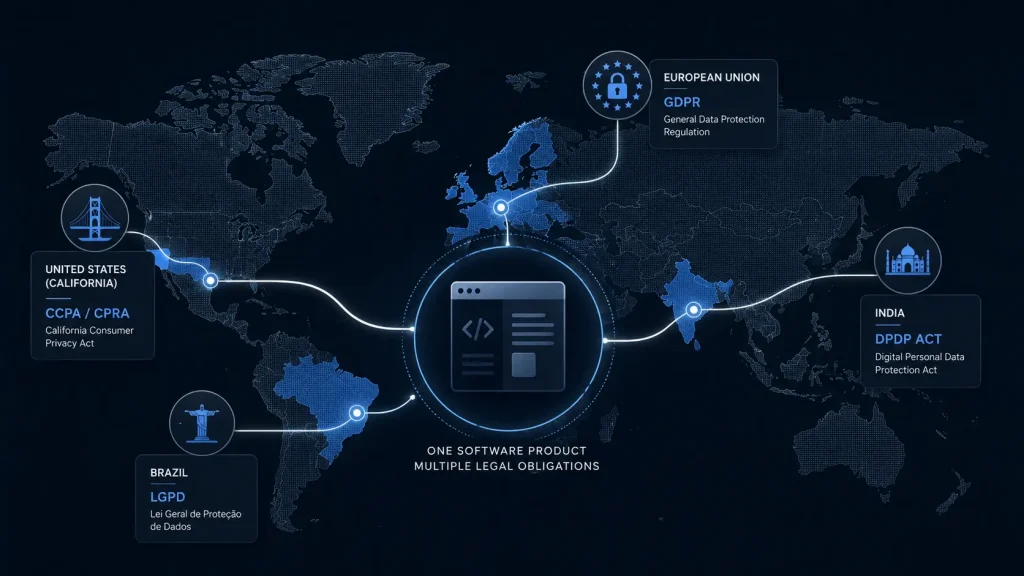
Here’s the rule that catches most developers off guard: data privacy laws follow users, not servers.
Where your company is incorporated doesn’t matter. If your software processes the personal data of European Union residents, the General Data Protection Regulation (GDPR) applies. California users bring the California Consumer Privacy Act and California Privacy Rights Act (CCPA/CPRA) into scope. Indian users trigger the Digital Personal Data Protection Act (DPDP Act). Brazilian users activate the Lei Geral de Proteção de Dados (LGPD). Build globally, and you’re likely operating under all of them at once.
In 2026, regulators aren’t waiting for complaints; they’re auditing. GDPR fines have surpassed €7.1 billion cumulatively, and a single data access request costs an average of $1,524 to process manually. These aren’t edge cases. They’re what happens when software ships without thinking about the data it touches.
What your software needs is a lawful basis for every data point collected, with deletion and data export functionality built into the product from the start. Privacy by design isn’t a feature to add later. Under GDPR Articles 25 and 32, safeguards such as encryption and access controls are legal expectations, not optional extras.
2. Terms of Service, EULA, and Privacy Policy: The Legal Trinity
Every software application needs three documents. Not one. Not a combined blob of legalese. Three distinct agreements, each doing a specific legal job.
Terms of Service set the rules of the relationship: what users can and can’t do, what gets an account terminated, who owns platform content, and how disputes are resolved. Without explicit ToS language, you have no enforceable standing when someone violates your rules.
End-User License Agreement (EULA) governs the software license itself, the terms under which a user may install and use your application. It restricts reverse engineering, redistribution, and resale. Distributing through Apple or Google?
Both platforms mandate one, and Apple publishes the minimum required terms you must include.
Privacy Policy is legally required in virtually every jurisdiction. It must accurately reflect what data you collect, why, how it’s stored, and how users can exercise their rights. A policy that doesn’t match your actual practices isn’t just incomplete, it’s evidence of misrepresentation.
All three need to be versioned, dated, and presented at onboarding, not buried in a footer nobody clicks.
3. The EU AI Act: What Software Developers Need to Know Now
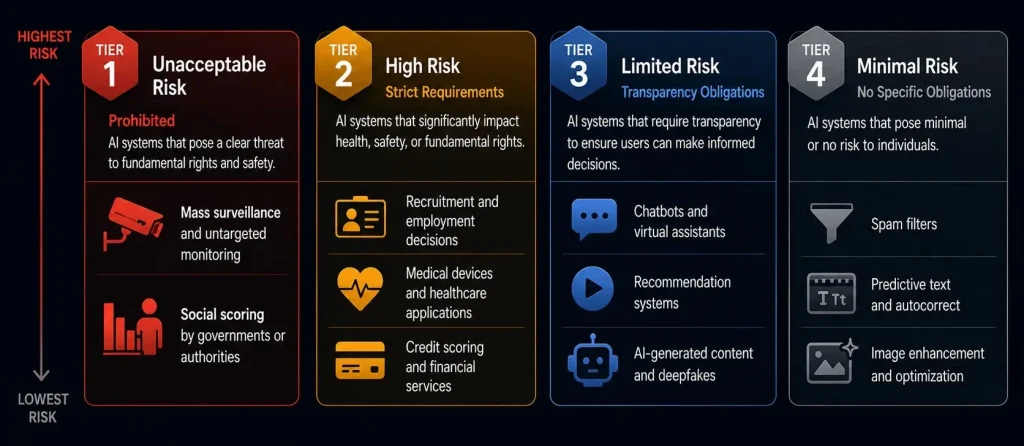
The EU AI Act becomes fully applicable on August 2, 2026. If your software uses machine learning, recommendation engines, automated decision-making, or integrates foundation models like GPT-4, Claude, or Gemini, this law applies to you.
It runs on a risk-tier system. Some practices are already banned since February 2025: social scoring, real-time biometric surveillance, and subliminal manipulation. These aren’t obscure edge cases. Several are recognisable patterns in consumer software.
High-risk applications like the software used in hiring, credit, healthcare, or education now require conformity assessments, quality management systems, and CE markings before EU deployment. The gap is stark: audits show most AI-powered apps sitting at roughly 15% readiness for these requirements.
Lower-risk software isn’t off the hook. Chatbots and AI interfaces must disclose their AI nature to users; draft transparency guidelines were dropped in May 2026. That same month, the EU banned software generating non-consensual intimate imagery, a category now carrying explicit criminal and civil liability.
Fairness is no longer just an ethical aspiration. Under the AI Act’s intersection with GDPR, it’s a legal standard.
4. Intellectual Property: What You Own, What You Don’t
Two questions every developer should answer before shipping: Who owns what this software creates? And are you sure you legally own what you built it with?
Your software’s IP assets, such as source code, branding, design, and written content, are protected from the moment they’re created. Your ToS and EULA need to establish that ownership explicitly and define what rights users have to reproduce or share any of it.
The harder question is user-generated content. If your app lets users create, upload, or share anything, you need a clear licensing clause: who owns it, what license you have to display and distribute it, and what rights the user retains. Leaving this undefined is litigation waiting to happen.
AI-generated content adds another layer; ownership of AI output remains legally unsettled in most jurisdictions. Don’t assume. Build contracts that address it explicitly, because courts haven’t finished deciding it for you.
On open source licensing, most developers treat this as a formality. It isn’t. Integrating GPL-licensed code into a commercial proprietary product without understanding the terms can expose you to serious IP claims. Tools like FOSSA or Snyk can audit your entire dependency tree automatically, but only if someone actually runs them.
5. App Store Rules and Sector-Specific Laws
Distributing through Apple or Google means operating under a third legal layer that exists independently of government regulation and can remove your app at any time.
Both platforms require accurate privacy nutrition labels: structured disclosures of what data your app collects, why, and whether it’s linked to user identity. Inaccurate labels are grounds for removal. Apple also makes clear that you are solely responsible for your app’s content, compliance, and support obligations.
Beyond the platforms, sector-specific laws add obligations that general privacy frameworks don’t cover:
- Healthcare: HIPAA’s 2026 Security Rule updates made encryption mandatory and require MFA for all users accessing protected health information.
- Finance: PCI-DSS for payments, SEC rules for fintech, and DORA for EU financial entities.
- Children’s software: COPPA prohibits collecting data from under-13s without verifiable parental consent. The May 2026 Digital Omnibus package further strengthened children’s protections across EU platforms.
6. Accessibility: No Longer Optional
The European Accessibility Act (EAA) came into force in June 2025, requiring digital products and services targeting EU consumers to meet accessibility standards for users with disabilities. In the US, ADA (Americans with Disabilities Act) claims against software interfaces continue to be actively litigated. Accessibility is no longer a UX consideration that lives on a product roadmap. It’s a compliance requirement with legal consequences for non-compliance.
Practically, this means your software needs to meet WCAG 2.1 Level AA standards at a minimum, keyboard navigability, screen reader compatibility, sufficient colour contrast, text alternatives for visual content, and captions for media. These aren’t difficult to implement early. They’re expensive to retrofit.
7. What a Legally Compliant Development Workflow Looks Like
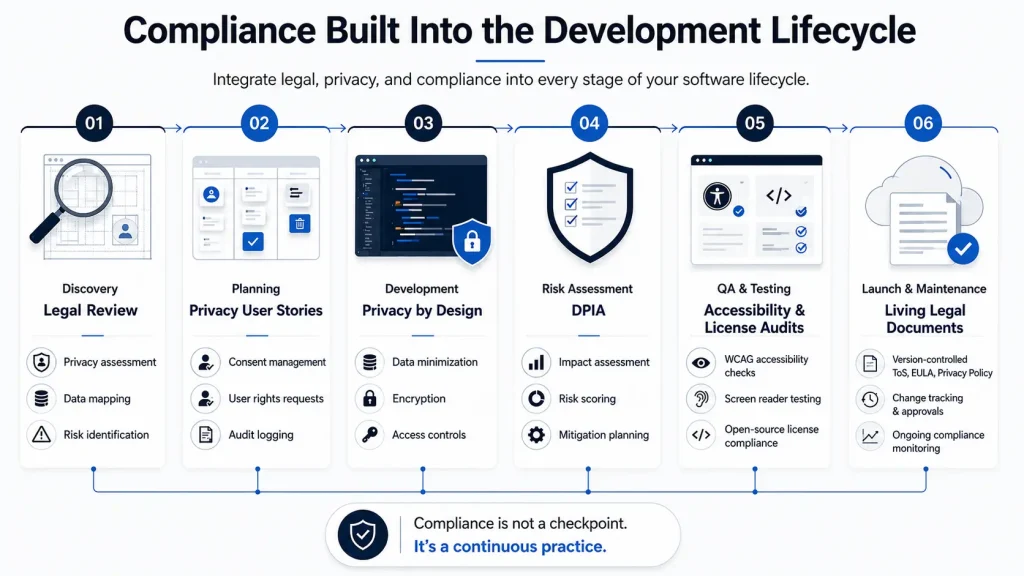
Compliance isn’t a launch checklist. It’s a development practice. Here’s how teams that get this right integrate the legal layer from the start:
- Legal considerations start during product discovery. Before building features that collect personal data, process sensitive information, or make automated decisions, teams assess the potential legal and compliance implications.
- Privacy requirements are treated as real product features. Consent flows, data deletion requests, and audit logging are planned and prioritized alongside core functionality instead of being pushed to the end of the roadmap.
- Data Protection Impact Assessments (DPIAs) are carried out before high-risk data processing begins. While GDPR requires them in certain situations, they are a valuable risk-management practice for any software product.
- Open-source dependencies are regularly reviewed to identify licensing conflicts and compliance risks before each release.
- Accessibility testing is built into the quality assurance process. Rather than conducting occasional audits, teams continuously evaluate accessibility alongside functionality and performance.
- Legal documents remain living assets. Terms of Service (ToS), End-User License Agreements (EULAs), and Privacy Policies are updated as products evolve and are presented to users whenever significant changes are made.
8. What This Shift Actually Represents
For most of tech history, the arrangement was simple: build fast, let users accept everything, deal with consequences later. Enforcement lagged so far behind technology that legal risk stayed theoretical.
That arrangement is over.
The GDPR, EU AI Act, EAA, and DPDP Act represent something deeper than compliance burden. They’re the formal recognition that software shapes lives, how people access credit, find jobs, receive healthcare, and understand the world. Regulators are now treating software the way they treat pharmaceuticals; the burden of safety belongs to the builder.
For developers, this is both a constraint and a competitive moat. Software that ships with clear legal architecture, documented consent flows, auditable data practices, and honest agreements earns trust that competitors cutting corners can’t easily replicate. Enterprise procurement now screens for compliance posture before a contract gets signed.
The developers who understand this aren’t slowed down by legal requirements. They’re building on a foundation that holds.
Key Takeaways
- Privacy laws don’t stop at borders. If your software serves users globally, regulations like GDPR, CCPA, DPDP Act, and LGPD may all apply at the same time.
- Every app needs a solid legal foundation. Make sure you have clear Terms of Service, an EULA, and a Privacy Policy that accurately reflect how your software works.
- AI compliance is now a business requirement. The EU AI Act introduces strict rules for high-risk AI systems, making documentation, transparency, and risk management essential.
- Compliance goes beyond government regulations. Apple App Store and Google Play policies can impact your software just as much as laws, and violations can lead to app removal.
- Build compliance from day one. From open-source licensing and accessibility standards to industry rules like HIPAA and PCI-DSS, addressing legal requirements early is far easier and far less expensive than fixing issues after launch.
Conclusion
There’s a quiet assumption embedded in how most software gets built: that the legal side is someone else’s job. The lawyer’s job. The compliance team’s job. The problem to deal with after you’ve shipped something worth protecting.
That assumption is now expensive. The regulations don’t wait for product-market fit. The accessibility obligations don’t pause while you’re iterating. The data privacy requirements kick in the moment the first user signs up.
The good news is that most of this is solvable with early intention. A privacy policy written honestly, an EULA that actually reflects your software’s terms, an architecture designed around data minimisation, and a dependency tree someone actually audited. None of these is a heroic act. They’re the work of teams that take the full scope of what they’re building seriously.
Your software is making promises to every user who installs it. The question worth sitting with is:
Do your legal documents actually reflect the promises your software keeps?
