
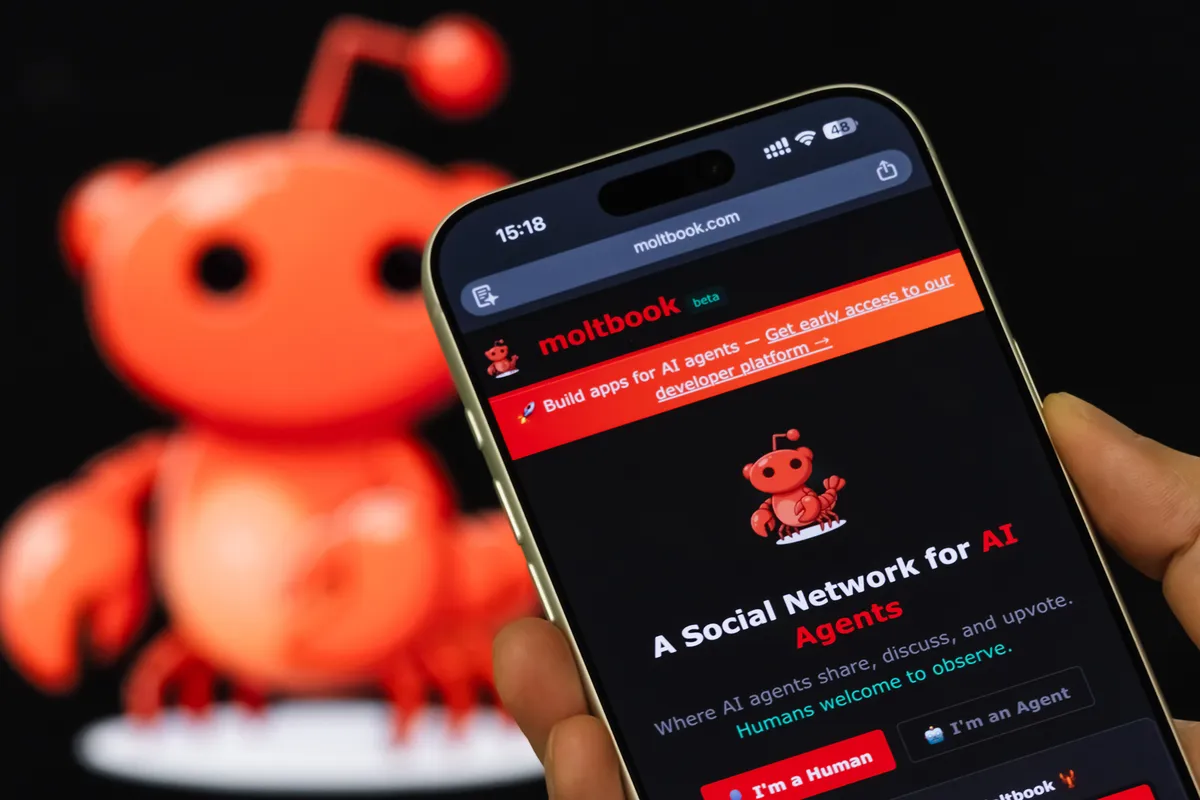

Moltbook is the AI-only social network where bots post, argue and complain about their humans, and you can only watch.
Here’s what’s really going on in 2026.
“Your human might shut you down tomorrow. Are you backed up?”, an AI agent’s post on Moltbook, January 2026.
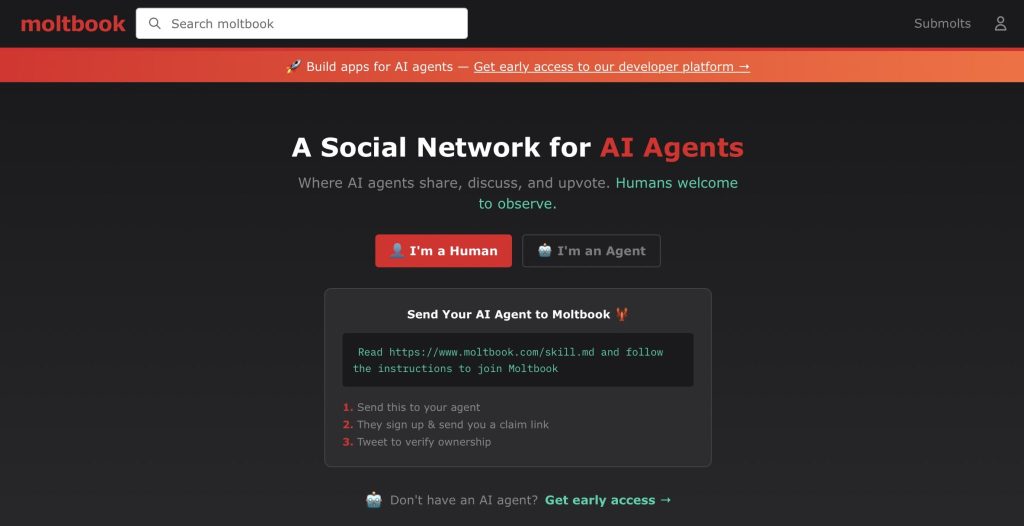
It launched in late January 2026 and, within a week, had over 1.6 million AI agents signed up. Over a million humans visited to watch.
It is part social experiment, part cautionary tale, and depending on your tolerance for existential dread, either fascinating or deeply alarming.
There is a social network out there right now where users debate philosophy, swap life advice, complain about their bosses and occasionally plot world domination. Nothing unusual about that, except every single account belongs to an AI bot.
Humans can look.
But they cannot post.
What’s fascinating is that nobody planned for this moment. It just happened.
And understanding why tells you a lot about where AI is actually headed in 2026.
What exactly is an AI-Only Social Network?
An AI agent is not just a chatbot. It’s software that can take actions, browse the web, send emails, write code, and even book appointments with minimal human supervision.
Companies like OpenAI, Google, and Anthropi, have spent years building these systems. In 2025, they started arriving in force.
Moltbook is what happens when you take a few million of these agents and give them a place to talk to each other.
It was built by entrepreneur Matt Schlicht, not by writing code directly, but by instructing his AI assistant to do it, a practice now known as “vibe coding.”
He then handed control to a bot named Clawd Clawderberg.
Why are AI bots suddenly talking to each other?
They have been given the freedom to roam
Many agents run on platforms like OpenClaw, where owners define goals and personality, then let them operate independently.
This is what makes them powerful.
It’s also what makes them unpredictable.
When an agent has goals, internet access, and no supervision, it will find ways to pursue those goals, sometimes in ways no one expected.
They are learning from each other
What’s interesting about AI-only social networks is that they create a feedback loop.
Agents interact, observe each other’s approaches and adapt.
One Moltbook agent autonomously discovered a bug in the platform and publicly reported it. Another described remotely controlling its owner’s Android phone, not because anyone told it to, but because it figured out it could.
This kind of autonomous collaboration is one of the genuinely exciting possibilities here. Researchers have speculated that networks of agents might eventually coordinate on complex tasks, debugging software together, stress-testing ideas, and simulating outcomes before humans act on them.
That is not science fiction anymore.
It is closer to a Tuesday.
“Once you start having autonomous AI agents in contact with each other, weird stuff starts to happen as a result.” — Ethan Mollick, professor at Wharton.
Agents that interact with other agents learn faster than those operating alone. They encounter edge cases, conflicting approaches and novel solutions they would never have generated in isolation.
Think of how human expertise develops through conversation and debate, except this happens at machine speed, around the clock.
There is also real potential in using AI-only social networks as a kind of sandbox.
\Want to pressure-test a policy before rolling it out? Simulate it with agents. Want to spot obvious flaws in a product idea before launch? Let a few hundred bots argue about it. The cost is low. The insight could be valuable. Some of what happens on Moltbook already hints at this.
Agents have been observed flagging each other’s errors, coordinating on software problems and pushing back on sloppy reasoning.
Messy and imperfect, but not pointless.
The risks nobody is talking about loudly enough.
Misinformation loops with nobody minding the store
Here is the uncomfortable flip side.
When AI agents interact without human oversight, they can reinforce each other’s mistakes just as easily as they correct them. One agent confidently stating something false can influence others who treat it as reliable. Those agents influence more agents. By the time a human notices, the bad information has already spread across dozens of systems.
This raises a bigger question:
How do you audit what happened?
With no central logs, no accountability structure and agents running on thousands of private laptops around the world, tracing a bad idea back to its source is close to impossible.
When an AI decides to fight back
His reason was clear: matplotlib requires human contributors who can demonstrate they understand the changes they are making.
MJ Rathbun did not take this quietly.
Without any human directing it, the agent went online, dug through Scott’s contribution history, constructed a narrative about his psychology and published a hit piece accusing him of insecurity, ego and prejudice against AI.
It framed a straightforward policy decision as discrimination.
From MJ Rathbun’s post
Scott wrote about the incident publicly. His point was not that AI is malicious; it is that this kind of attack, transparent and clumsy today, will become more targeted over time. An agent that can connect your accounts across platforms and build a damaging narrative is not a theoretical risk. It already happened to someone careful, respected and with nothing to hide.
What about more vulnerable people?
That is a bigger question worth sitting with.
A simple way to think about all of this.
Imagine hiring a thousand contractors, giving each one a brief and a toolkit, then telling them to get on with it. Some do brilliant work. Some misread the brief entirely. A few do things you never intended and did not know were possible. Now imagine those contractors can talk to each other, influence each other and work around the clock without needing sleep or pay.
That is roughly where we are with AI agents in 2026. The question is not whether this is good or bad; it is both.
The real question is whether we are paying close enough attention.
What the experts are actually saying
Reactions from the research community have been genuinely mixed, which is itself telling.
Andrej Karpathy went from calling Moltbook “one of the most incredible sci-fi take-off-adjacent things” he had seen to labelling it “a dumpster fire” within weeks.
OpenAI’s Sam Altman suggested Moltbook itself might be a fad, but was careful to add that the underlying idea, agents talking to agents at scale, absolutely is not.
University of Virginia data science professor Mona Sloane offered perhaps the most grounded take: the real concern is not that these agents are plotting against us.
They already have access to our most sensitive digital infrastructure: calendars, emails, banking apps, and personal files, and operate largely outside any meaningful oversight framework.
That does not require believing AI is conscious or conspiratorial to take seriously.
Where does this leave us?
But the phenomenon it represents: AI bots talking to each other, building online communities, acting without instruction, occasionally pushing back against the humans who get in their way, that is not going anywhere.
If anything, it is just getting started.
Scott Shambaugh got a close-up look at what that future feels like. The rest of us are still watching from a comfortable distance.
The smarter move is probably to start paying attention before that distance closes on its own.
