

Every generation gets one moment where science fiction stops being fiction.
Sometimes it’s quiet, a headline, a lab video, a product page nobody expected. Sometimes a founder climbs into a half-ton steel frame, grips a control seat, and walks the machine forward until it punches through a brick wall.
On May 12, 2026, Wang Xingxing, founder of Hangzhou-based Unitree Robotics, did exactly that.
The machine was the GD01. And the world noticed.
What Is the Unitree GD01?
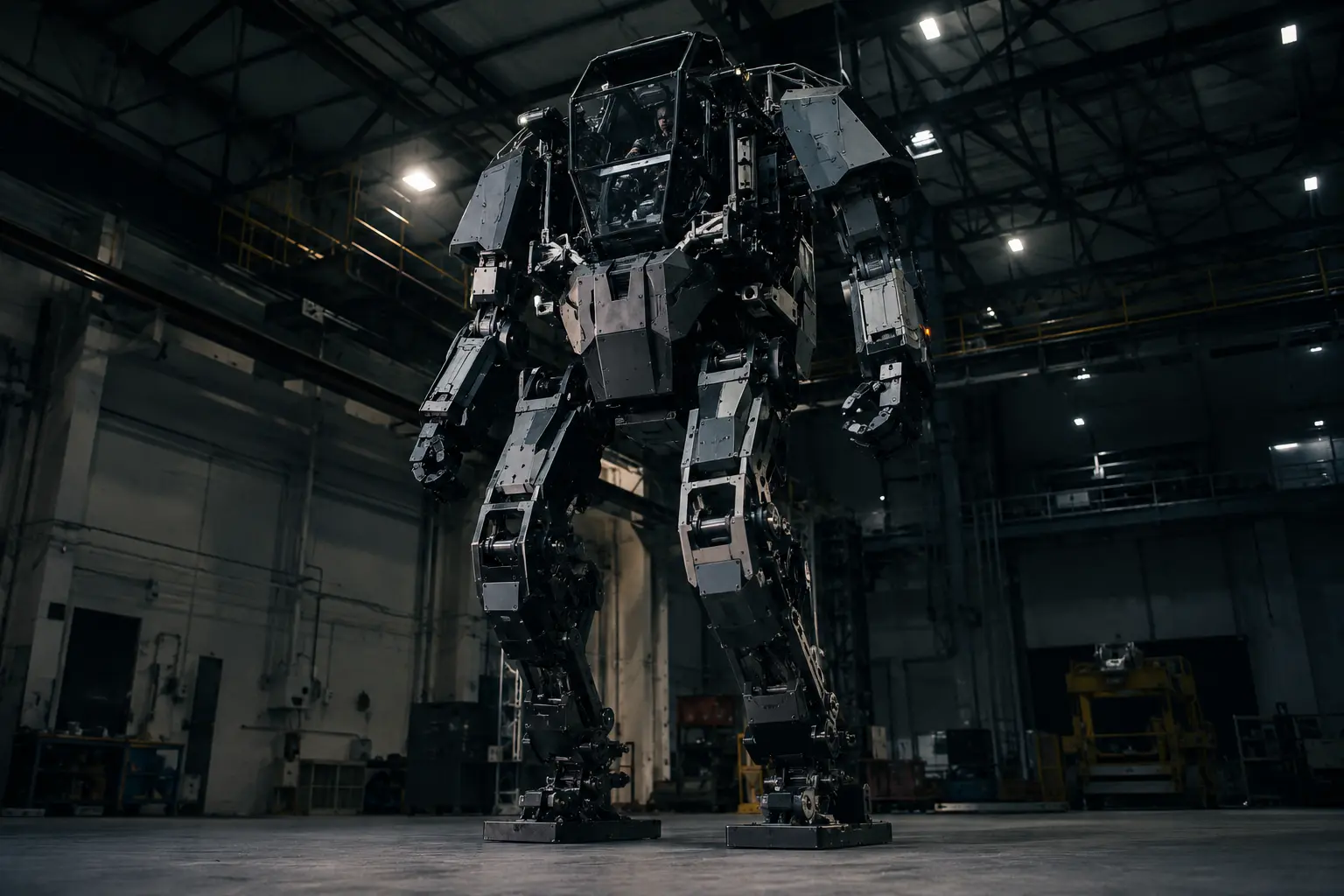
The GD01 is not a prototype. It is not a concept render. It is, according to Unitree, the world’s first mass-produced manned transformable mecha, a rideable, bipedal robot that a human pilot climbs into, buckles up, and operates from a cockpit embedded in its torso.
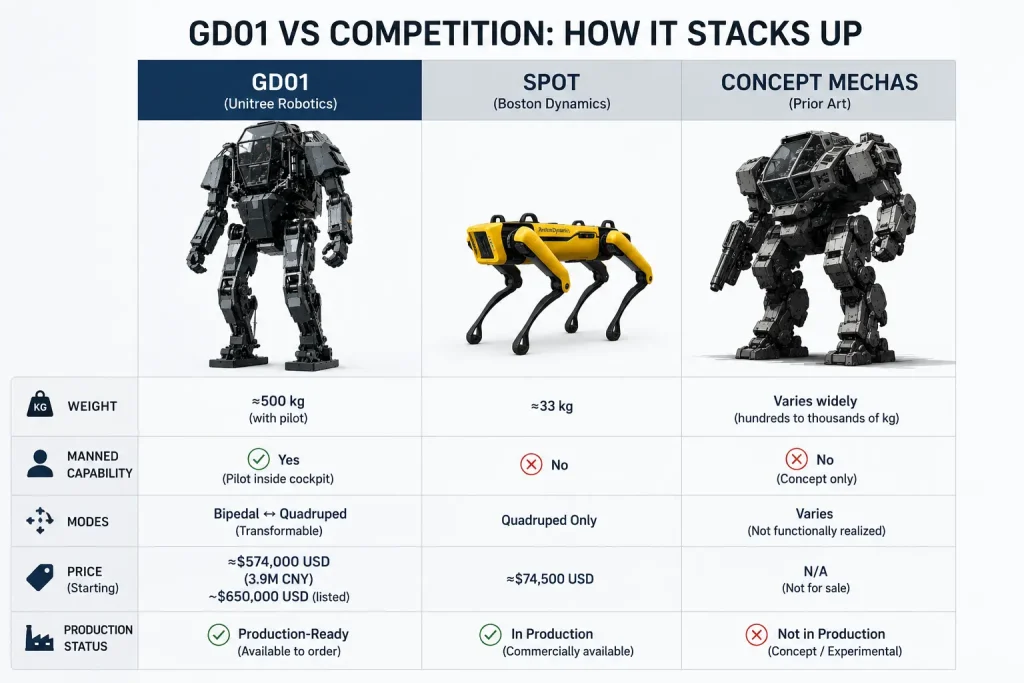
It stands approximately 2.8 metres tall, closer to nine feet, and weighs around 500 kilograms with a pilot on board, roughly the mass of a grand piano on legs. It is built from high-strength alloy, moves on precision servo drives, and can transition from walking upright to crawling on all fours in a matter of seconds. Unitree positions it officially as a civilian vehicle, with a starting price of 3.9 million yuan, approximately $574,000 USD. The company also offered a round-figure marketing price of $650,000 in some materials.
The more interesting question is why, and what it means that this thing exists at all.
The Engineering Behind the Machine
Understanding the GD01 requires appreciating what it draws from. Unitree didn’t start here. The company spent years developing compact quadruped robots, agile, affordable alternatives to Boston Dynamics’ Spot, and more recently, its G1 and H1 humanoid robots. The GD01 is the convergence of those two lineages.
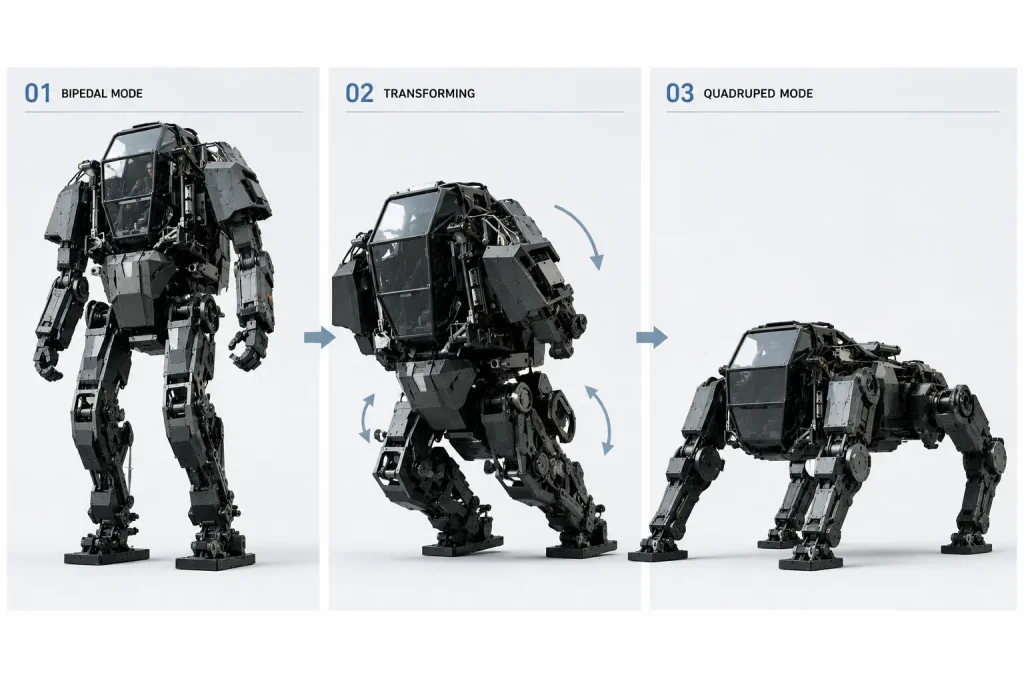
The machine runs in two primary modes:
Bipedal Mode: The GD01 walks upright on two legs in a humanoid gait, with deliberate, stable steps across flat surfaces. In this configuration, the pilot sits at roughly the height of the robot’s core, giving a commanding vantage over the immediate environment. The limb movements, visible in the demo footage, read as surprisingly fluid for a machine this size.
Quadruped Mode: When the terrain gets complex, such as stairs, slopes, or uneven ground, the robot transitions. The body tilts from vertical toward horizontal, the legs fold, and reposition into a four-legged configuration, and the centre of gravity drops close to the ground. The full switch takes a few seconds. The pilot stays inside throughout.
What makes this non-trivial is dynamic balance control at the 500kg level. Keeping a half-ton manned robot stable while it walks, and doubly so while it reconfigures mid-motion, is a hard problem. Unitree’s years of work on both quadruped and humanoid balance algorithms inform the way the GD01 manages the transition without tipping.
The cockpit itself sits in the torso region of the frame. An open structure, with silver safety bars and thick treads around the frame for additional traction. Hydraulic lines run visibly along the limbs. The design is functional, not sleek, and that honesty is notable.
Who Actually Buys This?
Unitree describes the GD01 as targeting “high-value markets”, industrial operations, emergency rescue, cultural tourism, and high-end transport across difficult terrain. Those categories are broader than they sound. In disaster response, a machine that can traverse rubble in quadruped mode and then stand upright to reach elevated areas has obvious utility over either a pure wheeled vehicle or a stationary robotic arm. A human operator inside means judgment calls happen in real time, without latency from a remote link.
In industrial settings, mine sites, large-scale construction, or heavy logistics, a pilot-operated mecha provides a form factor that’s physically imposing enough to interact with the environment directly. The GD01’s demo already showed it capable of knocking down a brick wall without ceremony.
Tourism and entertainment are the near-term likeliest markets. Theme parks, experiential activations, and high-budget demonstrations are the obvious buyers right now at this price point, similar to how early commercial drones found their initial market in film production before trickling into agriculture and delivery.
The early buyer profile is clear: theme parks, industrial operators, and well-funded research institutions. At half a million dollars, this is not a personal vehicle yet.
What Most Coverage Is Missing
Most of the coverage around the GD01 is framing it as a spectacle, a sci-fi machine, a viral moment, a piece of technology that looks like a movie prop.
That framing undersells what’s actually happening.
The GD01’s real significance isn’t the machine itself. It’s what the machine proves about the process.
Unitree did not announce a concept. They announced a price. That means tooling, supply chain, and production infrastructure are already in place. The transition from prototype to product, the hardest step in hardware, has been completed. Whether the current version sells well or not, the capability to manufacture this class of machine now exists.
The second signal is Unitree’s broader context. In 2025, the company shipped more than 5,500 humanoid robots, more than any manufacturer on earth, including Tesla. Its revenue hit 1.71 billion yuan in 2025, a 335% year-on-year increase, with a net profit margin the company described as growing 674% in the same period. It is simultaneously filing for a 4.2 billion yuan IPO on Shanghai’s STAR Market.
The GD01 launch isn’t a product announcement in isolation. It’s a demonstration, to customers, to investors, and to regulators of what Unitree’s engineering culture is capable of producing. The mech is as much a statement of organisational ambition as it is a commercial vehicle.
And then there’s the geopolitical dimension. Chinese companies now account for roughly 70 per cent of the global quadruped robot market and nearly 90 per cent of global humanoid robot sales. The GD01 is, in some sense, the most visible embodiment yet of that dominance extending into territory that was previously the domain of science fiction studios.
Limitations and Open Questions
No good tech piece omits this part.
The GD01 demo video shows about sixty seconds of operation. In that time, we see walking, wall-punching, and transformation. What we don’t see: battery life, maximum speed, operating range, payload capacity beyond the pilot, weather performance, or any indication of how the control interface works.
Unitree has not disclosed any of those specifications publicly.
The current build, visible in the demo, is conspicuously rough. Exposed wiring, scratched panels, zip-tied rubber treads around the frame, and no visible control dashboard inside the cockpit. For a $574,000 civilian vehicle, the fit and finish gap is real, and critics have noted it.
Regulatory pathways are undefined. In the US and EU, machines that interact physically with humans in commercial settings face increasingly strict safety requirements. No regulatory groundwork has been laid for the GD01 in Western markets. The EU’s updated Machinery Regulation applies fully from 2027; the GD01 doesn’t appear anywhere in that pipeline yet.
There’s also the question of operational maturity. Unitree itself acknowledged that humanoid robotics remains in an “early exploration stage globally”, a caveat that applies doubly to a 500kg manned mecha. Early adopters are buying into a platform, not a finished product.
Key Takeaways
- The GD01 is real and in production, not a prototype. Unitree has set a price and is accepting interest for what it calls the world’s first mass-produced manned mecha.
- It weighs around 500kg with a pilot, stands 2.8m tall, and transitions between bipedal walking and quadruped crawl in seconds, autonomously, with no external assistance.
- Pricing starts at 3.9 million yuan (~$574K USD). Current target buyers are industrial operators, theme parks, and research institutions, not general consumers.
- Key specs are still undisclosed; battery life, max speed, payload, and control interface details have not been publicly released.
- The launch coincides with Unitree’s IPO filing on Shanghai’s STAR Market, a 4.2 billion yuan ($608M) raise that would make it the first humanoid robotics company listed on China’s A-share market.
- The GD01 signals a convergence: Unitree’s decade of quadruped and humanoid robot development is merging into a new platform category, piloted mechas as civilian vehicles.
Conclusion
The GD01 will not be in everyone’s garage by 2027. Probably not by 2030. The price is stratospheric, the specs are opaque, and the regulatory path in most markets is uncharted.
But none of that is the point.
The point is that a company built this, actually built it, priced it, demonstrated it with its founder inside, and announced production. The category of “piloted mecha as civilian vehicle” existed only in fiction twelve months ago.
What happens over the next few years will look a lot like the early years of commercial drones, or electric vehicles, or the first generation of personal computers. Clunky, expensive, unpolished and irreversible. Unitree just walked the GD01 through a wall.
