


Most people have never thought about what happens to their phone when the internet dies. Not a slow connection. Not a bad signal. Complete silence. No WhatsApp. No Signal. No Twitter. Just a glass rectangle with no way to reach anyone.
Governments know this. It’s why internet shutdowns have become a standard political tool. Uganda shut down the internet before its 2021 elections. Iran does it regularly. Myanmar did it during the coup. More than 180 documented shutdowns occurred globally in 2023 alone.
Jack Dorsey noticed this, too. And in early July 2025, he spent a weekend building something to address it.
What Is BitChat?
BitChat is a decentralized, open-source messaging app that works entirely without the internet. No Wi-Fi. No cellular data. No servers. No accounts. No phone number required.
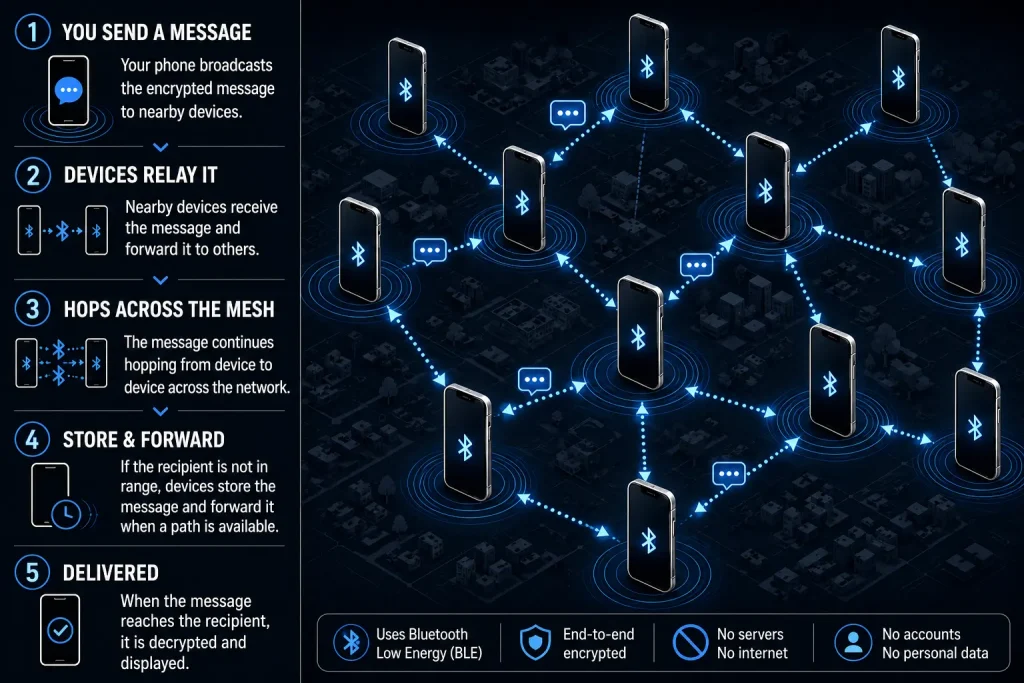
Instead, it uses Bluetooth Low Energy (BLE) mesh networking to pass encrypted messages directly between nearby devices. Your phone connects to phones around it, which connect to phones around them, and so on, until messages reach their destination. In effect, the users become the infrastructure.
Dorsey described it, somewhat casually, as a “weekend experiment” to learn about Bluetooth mesh networks, relays, store-and-forward models, and message encryption. He posted about it on X (formerly Twitter) on July 6, 2025, dropped an “ugly whitepaper,” and released the code on GitHub. By July 28, 2025, BitChat was live on the App Store, free, open source, and available on iPhone, iPad, Mac, and Android.
“Your phones become the network. Messages hop between devices like a relay race where everyone runs and no one sits down.“
How BitChat Actually Works
Bluetooth Mesh Architecture
Traditional messaging apps route data through centralised servers; think of it as every message making a round trip to a data centre before arriving. BitChat flips this entirely.
Each device acts simultaneously as a client and a relay node. When you send a message, it broadcasts over Bluetooth to nearby devices (within roughly 30 meters). Each of those devices forwards it onward through the mesh until it finds its recipient. The network is self-organising, no configuration needed, no central authority assigning roles.
Message Encryption & Privacy
Messages in BitChat are end-to-end encrypted using AES-256 encryption, one of the strongest standards available. Private messages, group channel messages, and public broadcasts are each encrypted differently. Crucially, messages exist only in device memory; they’re ephemeral by design, disappearing once read rather than sitting on a server indefinitely.
There is no account creation. No email. No phone number. No identity attached to your conversation. And the app’s Panic Mode feature lets users wipe all BitChat data with a triple tap, a detail that speaks directly to users operating under authoritarian risk.
Store-and-Forward Model
One elegant piece of the protocol: store-and-forward messaging. If the recipient isn’t currently reachable, nearby nodes temporarily hold the message and deliver it when a path opens. Large messages are chunked into 500-byte packets for Bluetooth transmission, and plans exist to integrate Wi-Fi for higher-bandwidth scenarios like file sharing.
“No account. No phone number. No server. The only thing BitChat needs to work is other people nearby with the app installed.“
Where BitChat Is Actually Being Used
Uganda: A Political Pressure Test
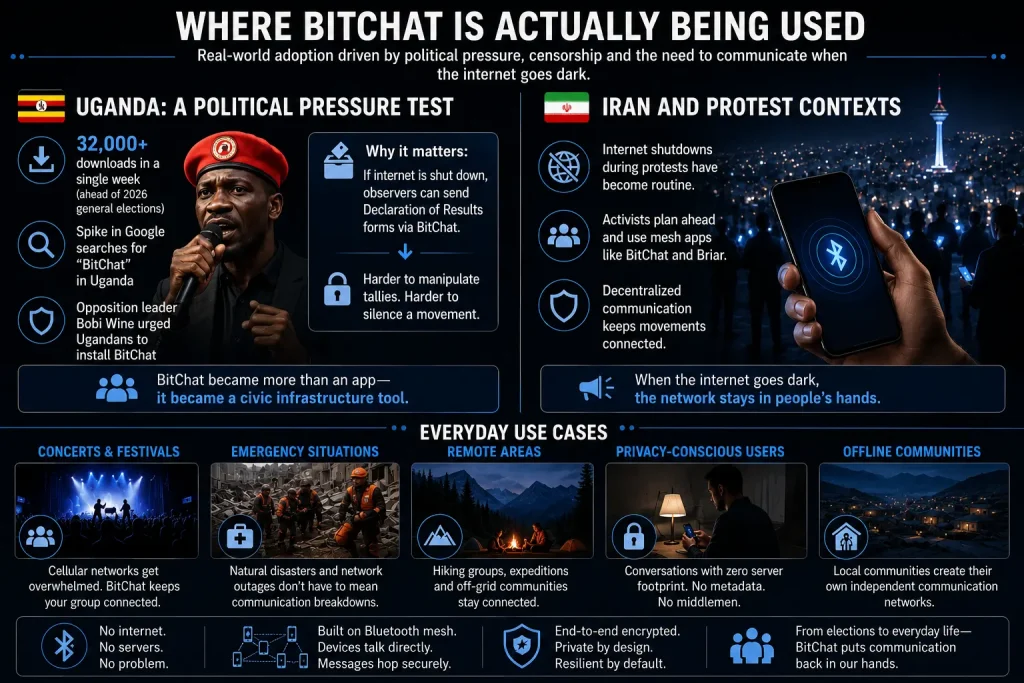
The most striking real-world deployment of BitChat has been political, not technical. Ahead of Uganda’s 2026 general elections, downloads of the app surged by over 32,000 in a single week, according to Chrome-Stats data. Google Trends showed a corresponding spike in Ugandan searches for “BitChat”, the kind of sudden interest that doesn’t come from curiosity. It comes from fear.
Opposition leader Bobi Wine publicly urged Ugandans to install BitChat, citing the government’s history of internet blackouts during elections. His argument was practical: if opposition observers at polling stations could transmit Declaration of Results forms via BitChat when the internet went down, the manipulation of tallies would become significantly harder.
BitChat had found a purpose its creator may not have fully anticipated, not as a convenience app, but as a civic infrastructure tool.
Iran and Protest Contexts
Similar uptake patterns appeared in Iran, where government-imposed internet blackouts during protests have become predictable enough that activists now plan around them. BitChat, along with older mesh apps like Briar, has become part of an informal toolkit for communication resilience in politically volatile environments.
Everyday Use Cases
Beyond crisis scenarios, BitChat has obvious utility for:
- Concerts and festivals: where cellular networks get overwhelmed
- Emergency situations: natural disasters, network outages
- Remote areas: hiking groups, off-grid communities
- Privacy-conscious users: people who simply prefer conversations with zero server footprint
Communication That No One Can Shut Down
BitChat didn’t invent Bluetooth mesh messaging. Apps like Briar, Meshtastic, and Bridgefy have been working in this space for years. What Dorsey brought was something different: mainstream attention.
When one of Silicon Valley’s most recognised founders calls something a “weekend experiment” and it goes viral, it changes the cultural perception of the technology. Suddenly, mesh networking isn’t a niche security researcher’s tool. It’s something people download.
But there’s a deeper current here. BitChat represents a quiet rebellion against the infrastructure assumptions of modern communication. Every major messaging platform today, like Signal, WhatsApp, Telegram, depends on servers controlled by someone. That someone can be pressured, hacked, or legislated.
Mesh networking removes that pressure point entirely. And as internet shutdowns normalise as a geopolitical tactic, the demand for infrastructure-independent communication will only grow.
“BitChat didn’t invent the idea. It popularized the urgency.“
The limitations are real. BitChat’s Bluetooth range is roughly 30 meters, which means dense urban environments work better than rural ones. Security researchers have flagged vulnerabilities in the protocol, and state-level adversaries with direction-finding equipment can potentially locate active mesh nodes. This is not a perfect solution.
But perfect has never been the prerequisite for important.
Key Takeaways
- Origin: BitChat launched July 6, 2025, built by Jack Dorsey as an open-source weekend project under “and Other Stuff,” an open-source collective he financially backs.
- Technology: Uses Bluetooth Low Energy (BLE) mesh networking devices to relay messages peer-to-peer, no internet or cellular required.
- Privacy: AES-256 end-to-end encryption, ephemeral messages, no accounts, no phone numbers, no central servers. Panic Mode wipes everything in three taps.
- Range: Approximately 30 meters per Bluetooth hop, with messages hopping across the mesh to reach recipients.
- Real-world impact: Surged in Uganda ahead of 2026 elections; used in Iran amid government blackouts. Downloads spiked 32,000+ in one week in Uganda alone.
- Open source: Code is publicly available on GitHub. Available free on App Store (iOS/Mac) and Android.
- Limitations: Short Bluetooth range, potential protocol vulnerabilities, limited effectiveness in sparse populations.
Conclusion: The Network That Lives in People
There’s something quietly remarkable about an app that turns a crowd of strangers into a communications network. No contract with a telco. No terms of service with a platform. No single point that a government can switch off.
BitChat is imperfect, limited by physics and protocol, and it will probably never replace WhatsApp for the average user. But that’s not really the point.
The point is that it exists, that it’s free, that it’s open source, and that Ugandan voters are using it to document election results when the internet goes dark. That’s not a weekend experiment anymore.
That’s what infrastructure looks like when people build it for themselves.
