


Every time you open Instagram, stream a show on Netflix, or split a bill on Splitwise, something remarkable is happening behind the screen. Thousands of servers are making decisions in milliseconds. They’re routing your request, checking your identity, querying databases, pulling cached data, and assembling a response, all before you’ve finished blinking.
Nobody told you this was happening. That’s the point.
The best-designed systems are invisible. You only notice architecture when it breaks, when a site goes down on Black Friday, when your bank app freezes during a transfer, when a gaming platform collapses under the weight of a midnight launch. Those moments reveal something critical: writing code is one skill. Designing systems that survive the real world is another.
That second skill has a name. It’s called System Design. And in 2026, it’s become one of the most important disciplines in all of software engineering.
Introduction: Why System Design Suddenly Matters to Everyone
A decade ago, system design was largely the concern of engineers at Google, Amazon, or Netflix, the handful of companies operating at genuinely massive scale. If you were building a startup or working at a mid-size company, you mostly thought about features, not infrastructure.
That calculus has completely shifted.
Today, even early-stage products are expected to handle global users, sustain 99.9% uptime, respond in under 200 milliseconds, and resist constant security threats. Cloud platforms and managed services have lowered the barrier to scale, but they’ve also raised the stakes. Every engineering team now makes architectural decisions that once only concerned the biggest players in tech.
System Design is the field that gives engineers the vocabulary, the frameworks, and the judgment to make those decisions well. It asks: How do you build something that doesn’t just work today, but holds together when ten million people show up tomorrow?
This guide breaks down the full landscape, from foundational concepts to the patterns reshaping architecture in 2026, in a way that’s clear enough for a first-time reader and sharp enough to actually be useful.
The Anatomy of a Modern System
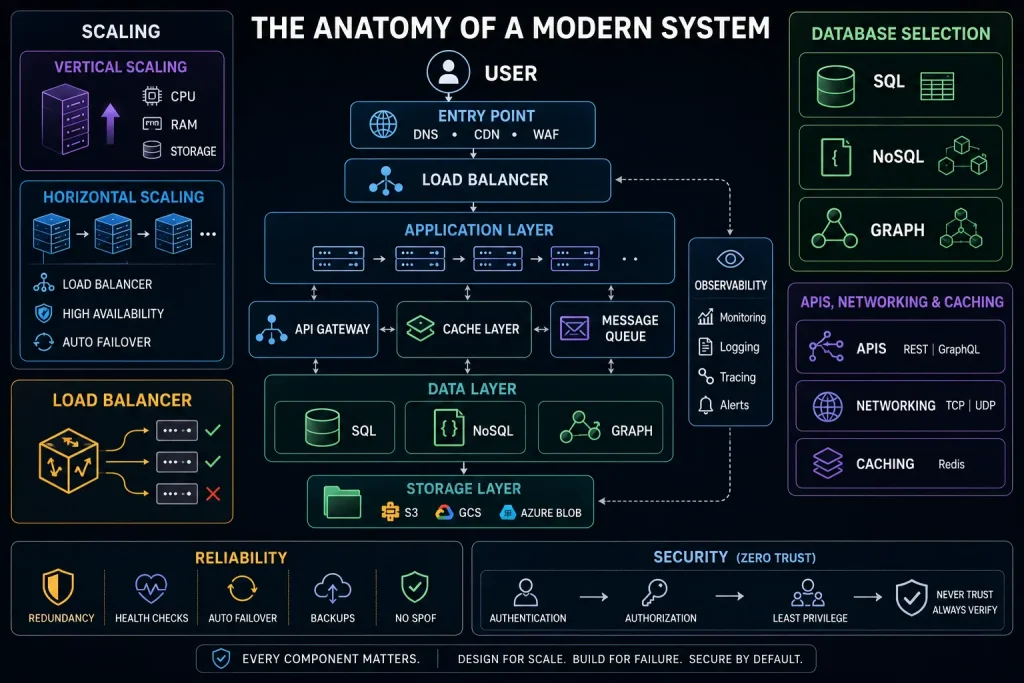
What a System Actually Looks Like
When engineers talk about a “system,” they mean the entire collection of components that work together to serve a user’s request, not just the application code, but everything. Application servers, databases, APIs, networking layers, caching mechanisms, and security controls all need to work in concert. A failure in any one layer cascades outward. Think of it like a city’s infrastructure, roads, traffic signals, utilities, and emergency services. The same interdependence applies in software.
Scaling: Vertical vs. Horizontal
The defining challenge of system design is scaling, making a system handle more load without breaking. Vertical scaling means upgrading a single machine: more CPU, more RAM. Simple, but it has a ceiling. Horizontal scaling means adding more machines and distributing the workload across them, enabling near-limitless growth with natural redundancy. A load balancer sits in front of those servers, routing traffic intelligently, monitoring health, and silently working around failures. Users never notice.
Database Selection: The Decision That Haunts Teams
Few choices carry more long-term weight than database selection. SQL databases like PostgreSQL offer strong consistency and structured relationships. NoSQL databases like MongoDB and Cassandra trade rigid schemas for flexibility at scale. Graph databases like Neo4j are purpose-built for highly connected data, social networks, fraud detection, and recommendation engines. The wrong choice doesn’t just slow things down. It can make certain features architecturally impossible.
APIs, Networking, and Caching
Modern applications communicate through APIs. REST is simple, stateless, and universally supported. GraphQL gives clients precise control over the data they receive, eliminating wasteful over-fetching. Beneath both is the networking layer: TCP for reliable delivery; UDP for speed-sensitive applications like video streams and real-time gaming. Meanwhile, caching tools like Redis serve frequently requested data from memory in microseconds, not just an optimisation at scale, but what makes certain systems possible at all.
Reliability and Security
The question isn’t whether your system will fail; it’s how gracefully it fails. Redundancy, health monitoring, automated failover, and eliminating Single Points of Failure (SPOF) are table stakes, not advanced concepts. Security operates on the same foundational logic. Authentication verifies identity; authorisation verifies permission. In 2026, modern architectures increasingly adopt a Zero Trust model, the assumption that no request, internal or external, is inherently safe. Every call must prove itself, every time.
How Teams Apply System Design in Reality
By 2026, cloud-native will have become the default, not an aspiration. Applications ship as microservices packaged in containers, orchestrated by Kubernetes, deployed via Argo CD, and networked through Istio, with serverless functions handling event-driven workloads at the edges. The toolchain has solidified. These aren’t optional extras anymore; they’re the standard operating environment for serious engineering teams.
Not everything should be microservices, and that realisation is gaining real traction. Companies like Shopify and Basecamp have made public cases for modular monoliths: single deployable applications with clean internal boundaries, simpler to operate, with no network latency between components. Meanwhile, event-driven platforms like Apache Kafka now power the high-throughput pipelines that ride-sharing, fintech, and real-time systems depend on, decoupling producers from consumers and enabling the kind of parallelism that makes dispatching millions of drivers in real time actually possible. Good system design has always been about trade-offs. In 2026, the industry is finally comfortable saying that out loud
System Design as a New Literacy
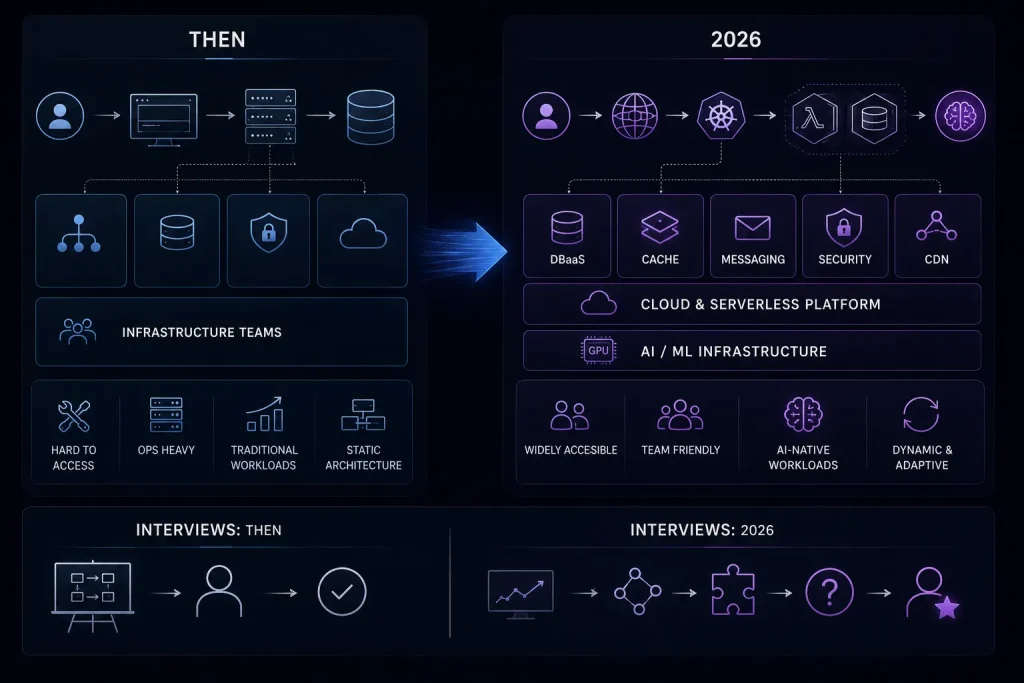
Something fundamental has changed in the past five years, and it’s worth naming clearly.
System design used to be the province of infrastructure teams and staff engineers. Now it’s required knowledge for anyone who wants to build software that matters.
Cloud platforms have democratised the infrastructure. Kubernetes, managed databases, serverless functions, and tools that once required dedicated ops teams are now accessible to a small team on a startup budget. But accessible doesn’t mean simple. The decisions still need to be made. The trade-offs still need to be understood.
At the same time, AI workloads have introduced a new dimension of system design complexity. In 2026, architects aren’t just optimising for user requests; they’re designing for GPU pipelines, model inference latency, training data flows, and the unpredictable cost curves of large language model inference.
The 2026 system isn’t just cloud-native. It’s increasingly AI-native. Intelligence is no longer a feature layer sitting on top of the architecture. It’s becoming the architecture itself.
This shift is also reflected in technical hiring. System design interviews have evolved from whiteboard exercises about boxes and arrows into deep evaluations of architectural judgment. Companies like Meta, Uber, and Netflix now use dynamic, constraint-shifting scenarios designed to test how candidates reason under uncertainty, not just whether they’ve memorised the components.
You can no longer rely on memorised templates. The interviewers are looking for how you think, not what you’ve rehearsed.
Key Takeaways
- System Design is the discipline of building software that is scalable, reliable, secure, and maintainable at real-world scale.
- Horizontal scaling and load balancing are the default strategy for high-traffic systems; vertical scaling has a ceiling.
- Database selection, SQL, NoSQL, or Graph, is one of the most consequential early architectural decisions a team makes.
- APIs (REST and GraphQL) define how services communicate; networking protocols (TCP, UDP) determine how data moves.
- Caching dramatically improves performance but introduces the challenge of cache invalidation.
- Reliability engineering means designing for failure, through redundancy, health checks, and eliminating Single Points of Failure.
- Zero Trust security models assume no request is inherently trusted, requiring authentication and authorization at every layer.
- Cloud-native architecture, microservices, containers, Kubernetes, and serverless are the standard for modern production systems in 2026.
- AI-native design is an emerging paradigm where intelligence shapes the architecture from the ground up, not as an add-on.
- System design interviews now evaluate architectural thinking under dynamic constraints, not template recall.
Conclusion
There’s a certain humility that comes with understanding system design deeply.
You realise that the apps you use every day, the ones that feel seamless, instant, and effortless, are the product of hundreds of carefully considered decisions. Decisions about where data lives, how requests flow, what happens when servers fail, how traffic gets distributed at 3 am when half the fleet is in maintenance.
None of that is accidental. It’s architecture.
The engineers who build systems that last aren’t the ones who write the most clever code. They’re the ones who ask the right questions before writing any code at all. In 2026, as systems grow more distributed, more AI-driven, and more globally interconnected, the ability to think architecturally has become as essential as the ability to code.
The blank page of a system design session, a moment that once intimidated even experienced engineers, is now a canvas. One that rewards curiosity, structured thinking, and the confidence to reason about things you can’t fully see.
The question isn’t whether system design matters. It’s whether you’re building the intuition to do it well.
