
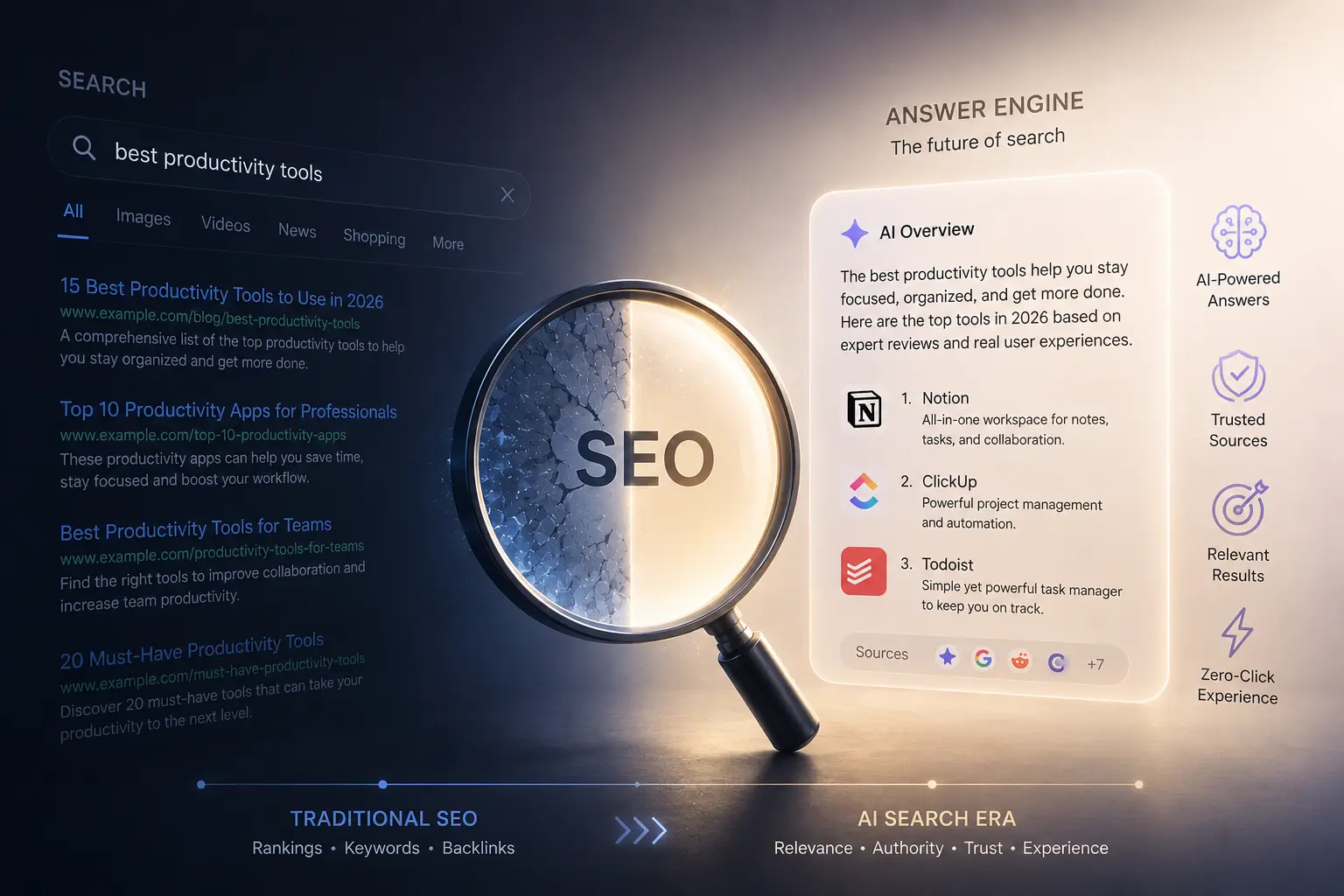

There’s a particular kind of discomfort that comes from being good at something that’s quietly become less relevant. You’re still doing the work. The reports still go out. The rankings still move. But somewhere in the background, the ground shifted and now the thing you optimised for isn’t quite the thing that matters anymore.
That’s where a lot of SEO professionals are in 2026.
Not obsolete. Not irrelevant. But definitely standing at a fork.
The One Shift Everything Else Flows From
Search engines used to be directories. You asked a question, and they showed you a list of places that might have the answer. You clicked. You read. You decided.
That model is dissolving. Google’s AI Overviews, AI Mode, ChatGPT, and Perplexity are no longer pointing users toward answers. They deliver them. Synthesised, confident, immediate. No clicking required.
The result: nearly 60% of Google searches now end without a single click. And AI Overviews appear in 89% of brand-related search results. The #1 organic result, the thing SEO was built around, now sees its click-through rate drop by up to 58% when an AI Overview appears above it.
That’s not a bug. It’s the new architecture. And it changes what the job of ‘doing SEO‘ actually involves.
“Ranking first is no longer winning the game. It’s being considered as a possible source for someone else’s answer.”
What the Old Playbook Got Wrong
Traditional SEO was, at its core, a system of signals. Keywords. Backlinks. Page speed. Meta titles. Schema. You learned the signals, you optimised for them, and you watched the rankings move. It was technical, repeatable, and measurable.
None of that knowledge disappears entirely. But the priority stack has reshuffled.
The skills that once separated good SEOs from average ones- keyword volume analysis, position tracking, and on-page tag optimisation are now table stakes at best, and automation targets at worst.
What doesn’t work anymore:
- Publishing volume as strategy. Mass-producing content to cover every keyword variation is now the fastest way to build a library no AI wants to cite.
- Ranking is the primary metric. Position 1 with a 58% CTR reduction isn’t the win it used to be. Visibility now lives across multiple surfaces.
- Optimizing for Google alone. Users are discovering brands on ChatGPT, Perplexity, Reddit, YouTube, and voice assistants. Single-platform thinking leaves most of the map dark.
- Generic content with no perspective. AI systems are trained to detect the absence of genuine expertise. Thin, safe, corporate-sounding content is the first thing they skip over.
How the New SEO Actually Works
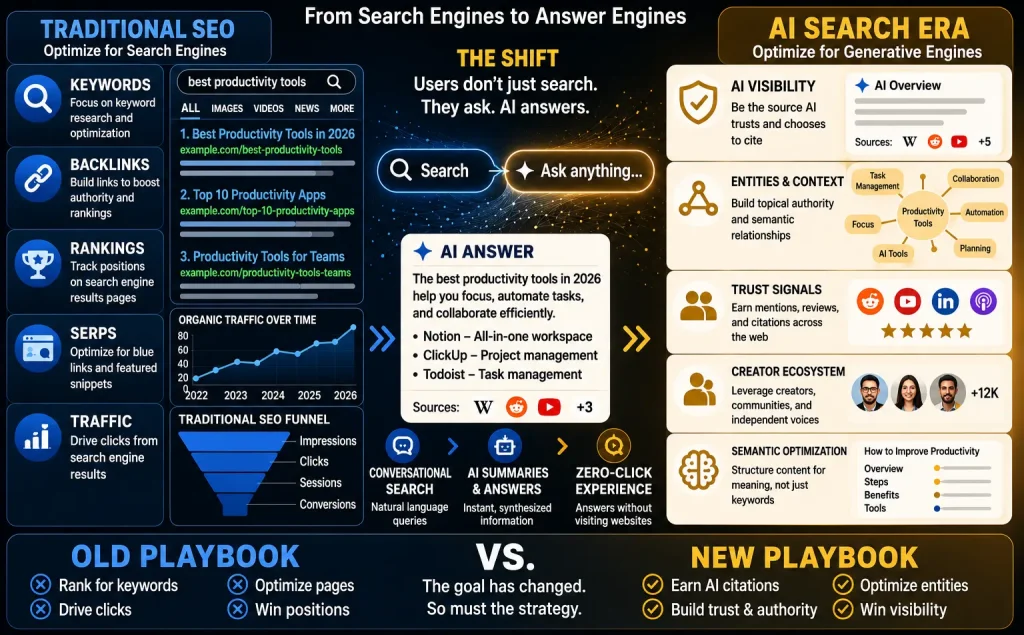
The industry now has names for what’s replaced the old model: Generative Engine Optimisation (GEO) and Answer Engine Optimisation (AEO).
GEO is the practice of making your content worthy of being cited inside AI-generated responses, on ChatGPT, Perplexity, Google’s AI Overviews, and Gemini. AEO is about structuring content to directly answer specific questions inside those responses.
Together, they change what ‘optimising content‘ means in practice:
- Entities over keywords. AI systems don’t think in keywords; they think in entities, relationships, and semantic meaning. Your content needs to clearly establish what you are, what you know, and why you’re credible.
- Structure that AI can parse. The first 30% of your article captures 44.2% of all LLM citations. Your introduction isn’t a warm-up; it’s the most strategically loaded section of any piece you publish.
- Authority signals, not just backlinks. AI systems look at your reputation across the web, who mentions you, in what context, and with what frequency. Brands are 6.5x more likely to be cited through third-party sources than through their own domains.
- Earned media as an SEO lever. Digital PR, expert quotes in industry publications, mentions in community discussions now drive a median citation lift of 239% in AI-generated responses.
The question used to be: Can we rank for this?
Now it’s: are we the kind of source an AI system would trust enough to cite?
What This Means If You Work in SEO
An analysis of 3,900 SEO job listings in 2026 found that the role has quietly expanded. SEO professionals are now expected to measure performance across paid and organic channels, connect content decisions to commercial outcomes, and increasingly understand how AI surfaces content.
The title is still “SEO.” The job description is something else.
The professionals who are becoming most valuable are those who can sit at the intersection of content strategy, digital PR, technical structure, and AI visibility. One industry report described it well: the modern SEO is no longer a Google specialist. They’re an AI-literate growth strategist.
For business owners and marketing leads, that has a hiring implication: if your SEO brief is still ‘rank for these keywords and write X posts per month,‘ you’re buying a service that solves last decade’s problem.
What to Actually Learn

The good news: the foundation still matters. Technical SEO, Core Web Vitals, keyword intent, content structure, none of this is obsolete. It’s just no longer sufficient.
What to add to it:
- GEO and AEO mechanics. Understand how to structure content for AI citation, entity clarity, question-direct formatting, inverted pyramid structure, FAQ and How To schema markup. This is still rare enough in the field that it’s a genuine differentiator.
- Multi-surface visibility thinking. Learn how search behavior differs across Google, Perplexity, ChatGPT, YouTube, and Reddit. Each surface has its own content logic. Optimizing for one and ignoring the others is leaving significant visibility on the table.
- Digital PR and earned media. Link building is evolving into brand-mention building. Understanding how to get your brand cited in credible third-party sources, publications, podcasts, and community discussions is now a core SEO competency.
- Automation, not just tools. AI skills aren’t ‘learn ChatGPT.’ They’re execution skills, knowing how to use tools like n8n, Make, or light scripting to automate repeatable workflows while keeping strategy human.
- AI citation monitoring. Only 14% of marketers currently track their brand’s presence inside AI answers. Setting this up now puts you meaningfully ahead of the field.
“Familiarity with AEO and GEO is still rare in job listings. That rarity is exactly the opportunity.”
Where to Start
If you’re an SEO professional: Audit one piece of existing content through a GEO lens. Does it clearly establish entity, answer a specific question directly in the first third, and point to third-party credibility signals? If not, that’s your first rewrite.
If you’re a business owner: Ask your SEO provider what percentage of your brand’s visibility is outside Google. If they can’t answer that, or if it’s not part of their reporting, we’ll need to update the strategy.
If you’re a marketer: Start tracking where your brand appears in AI-generated responses. Tools like Semrush’s AI Visibility Toolkit or HubSpot’s AEO dashboard make this measurable. You can’t improve what you’re not monitoring.
Keypoints
- Nearly 60% of Google searches end without a click. Traffic is no longer the right primary metric.
- The #1 organic position loses up to 58% of its clicks when an AI Overview appears. Ranking and visibility are no longer the same thing.
- GEO and AEO are the new core disciplines, optimising for citation inside AI responses, not just positions on a results page.
- The first 30% of any article captures 44.2% of LLM citations. Your introduction is your most strategically important section.
- Brands get 6.5x more AI citations from third-party sources than from their own domains. Earned media is now an SEO lever.
- Only 14% of marketers currently monitor their brand’s presence inside AI answers. That gap is the opportunity.
- The SEO role hasn’t disappeared; it’s expanded into an AI-literate growth strategy. The job title stayed. The job changed.
- What actually survives: genuine expertise, clear authorship, original perspective, and consistent presence across multiple surfaces.
The Honest Conclusion
The professionals who will struggle aren’t the ones who don’t know GEO or AEO yet. They’re the ones who treat this as another algorithm update to wait out.
This isn’t a cycle. Search didn’t shift temporarily toward AI and leave room for a correction back to blue links. The behavioral change happened first in users, in expectations, in what ‘finding an answer‘ feels like now. The product changes followed. The algorithm confirmed it. That sequence doesn’t reverse.
What this moment actually asks of anyone in SEO or anyone who depends on it is a more honest audit than most people are comfortable doing. Not behavioural ‘how do I adapt my current strategy?’ but ‘is the thing I’m building genuinely worth being cited?’ Not ‘how do I rank?’ but ‘why would an AI system choose me over anyone else who covers this topic?’
Those are harder questions. They require actual expertise, not just execution. And that, quietly, is the point.
The internet has always rewarded the thing most worth finding. It’s just finally getting good enough to tell the difference.
