
Most people follow an industry. A handful of people shape one.
There’s a quiet but consequential difference between being someone who learns about a technology and someone who helps that technology find its audience. One is passive. The other is how ecosystems actually get built.
The Agentic AI Foundation understands this distinction. Which is why, with applications closing on June 12, 2026, they’re looking for just ten people to help lead the global conversation about open-source agentic AI. Not ten employees. Ten ambassadors. The difference matters.
Introduction
The AAIF Ambassador Program 2026 is a newly launched global initiative from the Agentic AI Foundation (AAIF), a Linux Foundation project, designed to build a first cohort of educators, creators, and developer advocates who will represent and advance open-source agentic AI technologies around the world.
The program is intentionally small and intentionally selective. Ten spots. One cohort. Rolling applications, but a hard first deadline of June 12, 2026. Future cohorts will be selected in January 2027, but if being part of the inaugural group matters to you, the window is narrow.
This isn’t a certification or a course with a badge at the end. It’s a structured advocacy and community role with real access, real visibility, and a genuine role in shaping how developers worldwide discover and adopt technologies that are rapidly becoming foundational to how AI systems work.
What the AAIF Is and Why It Exists
To understand why this program matters, you need to understand the organisation behind it.
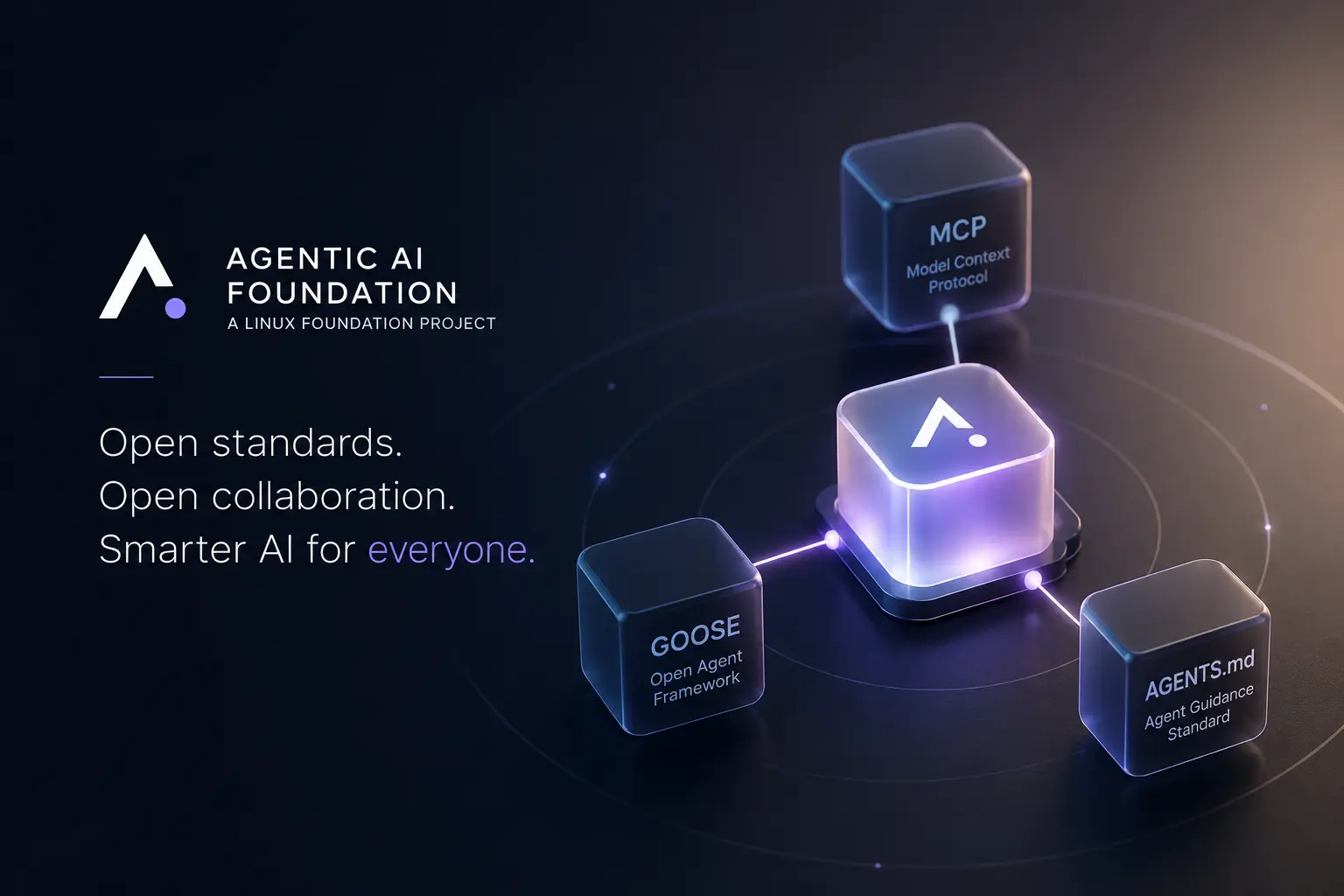
The Agentic AI Foundation was announced on December 9, 2025, by the Linux Foundation. Its founding contributions came from three of the most significant players in the current AI ecosystem: Anthropic’s Model Context Protocol (MCP), Block’s Goose agent framework, and OpenAI’s AGENTS.md standard. Platinum members include Amazon Web Services, Google, Microsoft, Bloomberg, Cloudflare, and others, a roster that signals this isn’t a side project.
By April 2026, just four months after launch, AAIF had grown to over 170 member organisations, more than double the membership that CNCF (the Cloud Native Computing Foundation) had at the same stage of its own growth. That growth rate is remarkable even by Linux Foundation standards.
The Three Projects at the Core
MCP (Model Context Protocol) is Anthropic’s open standard for connecting AI models to tools, data sources, and applications. It has become the dominant protocol for agentic integration, the plumbing that lets an AI agent actually reach the outside world. Microsoft’s Project Solara explicitly scans for MCP configurations. The ecosystem is growing fast. Goose is Block’s open-source, local-first AI agent framework. It combines language models, extensible tools, and MCP-based integration, allowing developers to build agents that can install, execute, edit, and test code using any underlying LLM. Block donated Goose to AAIF in April 2026, moving it to the aaif-goose GitHub organisation.
AGENTS.md is OpenAI’s contribution: a simple markdown convention that gives AI coding agents consistent, project-specific guidance across different repositories and toolchains. It’s deceptively simple in concept and surprisingly powerful in practice. The standard has already been adopted by more than 60,000 open source projects and agent frameworks, including Amp and Codex.
These three projects aren’t competing. They’re complementary, and AAIF’s role is to keep them open, interoperable, and governed transparently as they mature into critical infrastructure.
What Ambassadors Actually Do
The Three Goals
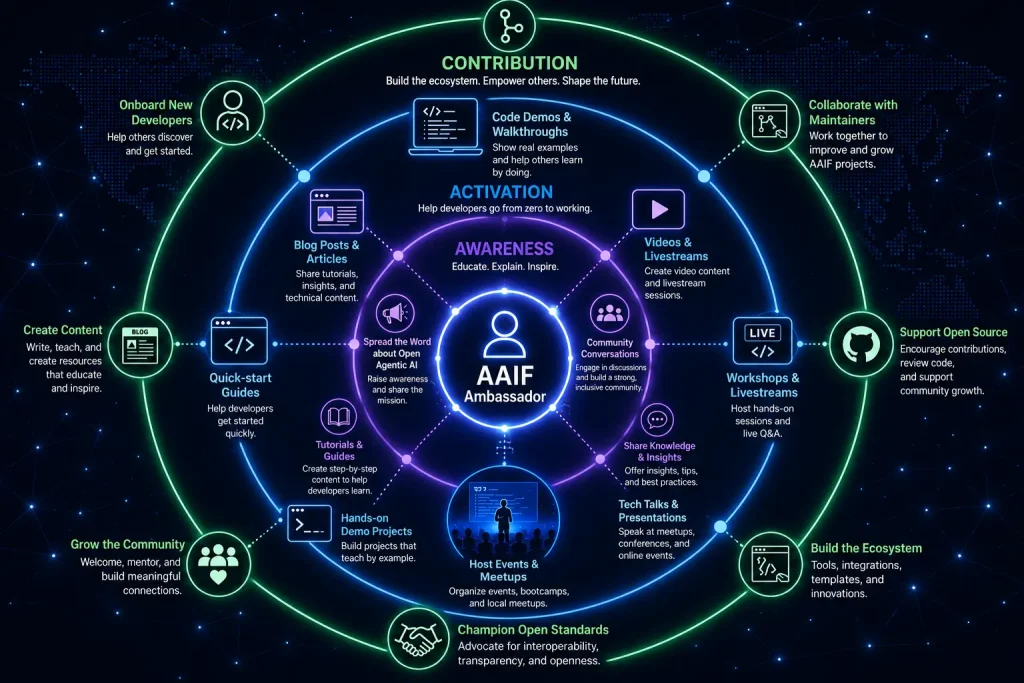
AAIF organised the program around three objectives: awareness, activation, and contribution. They sound like corporate buzzwords until you see what they actually mean in practice.
Awareness is about helping developers understand why these tools exist, what agentic AI is, how MCP connects agents to the world, and what Goose enables that traditional coding tools can’t. Most developers haven’t deeply explored this yet. The people who can explain it clearly are genuinely valuable.
Activation is hands-on. It means creating resources that get developers from zero to something working quickly: beginner tutorials, demo projects, quick-start guides, livestream coding sessions, and technical walkthroughs. The emphasis is on reducing time-to-value for developers who are curious but haven’t started yet.
Contribution means building the next layer of the ecosystem. Helping developers understand how to become contributors to AAIF projects. Explaining pathways. Hosting workshops. Collaborating with project maintainers. This is where a healthy open-source project sustains itself long-term.
The Monthly Commitment
Ambassadors are expected to make one meaningful public contribution per month, directly related to an AAIF project. The definition of ‘meaningful contribution‘ is intentionally flexible: a technical blog post, a conference talk, a livestream session, an educational video, an online course, or a workshop all count.
One contribution per month is a real commitment, not a symbolic one. It requires sustained engagement rather than a burst of enthusiasm in week one, followed by silence. That ongoing cadence is part of the design; it keeps the ambassador network active and the ecosystem continuously growing.
What Ambassadors Receive
The benefits package is comprehensive in a way that matters for developers and creators who are serious about their professional presence in the AI space.
Insider access includes a private Ambassador Discord, regular briefings with AAIF leadership, direct interaction with project maintainers, and early visibility into project roadmaps. If you’re building on MCP, Goose, or AGENTS.md, knowing what’s coming before it ships is genuinely useful.
Visibility: ambassadors are featured on the official AAIF Ambassador page, promoted through AAIF’s social channels, and amplified in newsletters. For someone building an audience in the AI developer space, that distribution matters.
Event access: VIP credentials at AAIF events, including AGNTCon and MCPCon, the foundation’s 2026 conference program anchored in North America and Europe, along with discounted tickets, VIP seating, lounge access, and recognition during keynote sessions.
Recognition infrastructure: a points and badge system, status titles, and project-specific badges that accumulate over time. Not superficial, this is a credential that will grow in meaning as AAIF grows in influence.
Who This Is Actually For
AAIF describes a broad range of potential candidates: open-source contributors, AI engineers, developer advocates, technical writers, YouTubers, livestream creators, community organisers, workshop facilitators, AI educators, technical bloggers, and conference speakers.
That list is wide on purpose. The program isn’t only looking for senior engineers. It’s looking for people who can communicate, who can take something technically substantial and make it accessible without losing accuracy. Some of the best developer advocates aren’t the deepest experts. They’re people who remember what it was like not to understand something, and can guide others through that transition.
What AAIF is not looking for: passive participation. The program has a contribution requirement for a reason. If your interest in open-source AI is primarily about consuming content rather than creating it, this probably isn’t the right fit.
What This Program Actually Represents
Ambassador programs in tech aren’t new. What’s different here is the timing.
The Linux Foundation has seen this pattern before; it hosted CNCF during the Kubernetes revolution, when cloud-native computing went from an interesting idea to default enterprise architecture. The Foundation’s model is neutral governance for technologies too important to be owned by any single company.
AAIF exists because the same dynamic is happening with agentic AI.
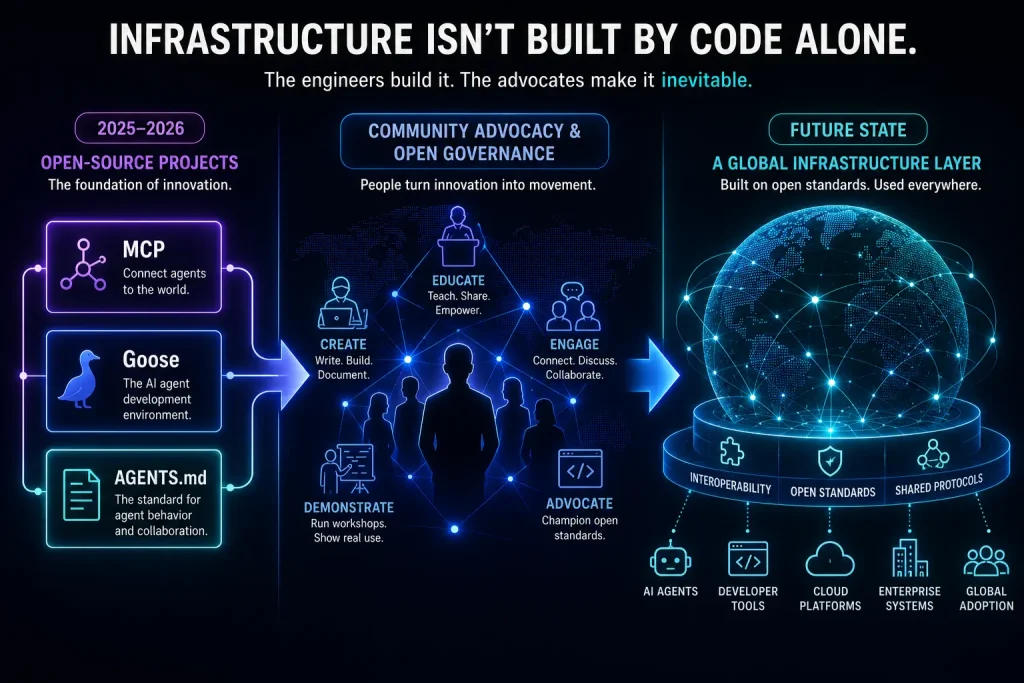
MCP, Goose, and AGENTS.md are becoming infrastructure. Not application-layer tools, the kind of thing developers will simply assume exists, the way they assume HTTP or OAuth exist today. That transition from novel project to assumed infrastructure doesn’t happen automatically. It requires people who can explain, demonstrate, and normalise the technology across the developer community.
That’s what ambassadors actually do. They’re not promotional vehicles. They’re how an ecosystem reaches critical mass.
There’s also a governance dimension worth naming. Whether agentic AI develops on open standards or proprietary ones has enormous long-term consequences. A fragmented ecosystem, each AI company maintaining its own incompatible agent protocol, is one where independent developers, startups, and research institutions lose. AAIF bets that open governance can prevent that fragmentation in the same way it did in cloud-native computing.
Ten ambassadors become a larger cohort in January 2027 and become a global network of practitioners who understand and teach these standards. The compounding is the point.
Key Takeaways
- The AAIF Ambassador Program is the first global cohort of open-source agentic AI advocates. Only 10 spots. Applications close June 12, 2026, at aaif.io/ambassadors, with future cohorts opening in January 2027.
- The Agentic AI Foundation was launched in December 2025 under the Linux Foundation, built around three open-source projects: Anthropic’s MCP, Block’s Goose, and OpenAI’s AGENTS.md. Platinum members include AWS, Google, and Microsoft. By April 2026, it had over 170 member organisations, growing faster than CNCF did at the same stage.
- The technologies are already gaining serious traction. AGENTS.md has been adopted by over 60,000 open-source projects. MCP is now the dominant protocol for connecting AI agents to external tools and data.
- Ambassadors commit to one meaningful public contribution per month, tutorials, talks, blog posts, videos, livestreams, or courses, all tied to AAIF projects.
- In return: insider Discord access, direct connections to project maintainers, early roadmap visibility, leadership briefings, and VIP credentials at AGNTCon and MCPCon.
- Ten spots. One deadline. The first cohort of what may become a foundational network in open agentic AI.
Conclusion
Open-source ecosystems don’t grow because the code is good. They grow because people who understand the code take the time to explain it, demonstrate it, teach it, and invite others in.
The Agentic AI Foundation is at a genuinely formative moment. MCP is becoming the default protocol for AI tool integration. Goose is becoming the reference implementation for open-source local agents. AGENTS.md is becoming the standard way to make AI coding agents reliable across projects. These aren’t hypotheticals; they’re things happening now, with 170 organisations behind them and the Linux Foundation’s governance infrastructure supporting them.
The ambassador program is an invitation to be part of that moment. Not as a spectator. Not as a student. But as someone who actively shapes how the developer community understands and adopts the infrastructure that agentic AI will run on.
