
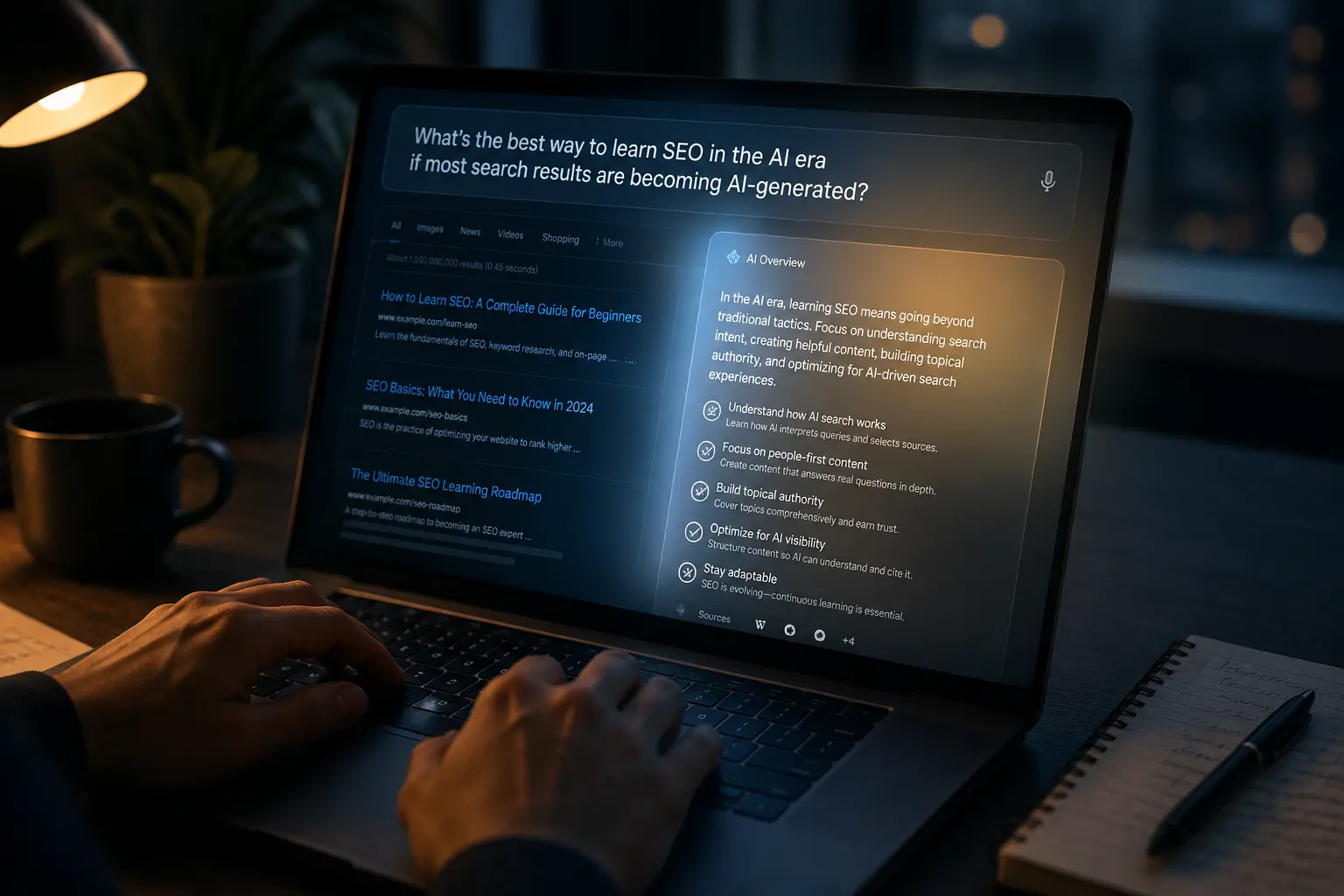

Think about how you phrased your last search. There’s a reasonable chance it wasn’t a search at all; it was a question. A specific one. Maybe even a multi-part one. You didn’t trim it down to a keyword phrase the way you used to. You just typed what you wanted to know, the way you’d ask someone who was already in the room.
That small shift in phrasing is one of the most significant behavioural changes in the history of the web. And it didn’t happen because users were taught to do it. It happened because the tools finally caught up to how people actually think.
The Psychological Shift Nobody Announced
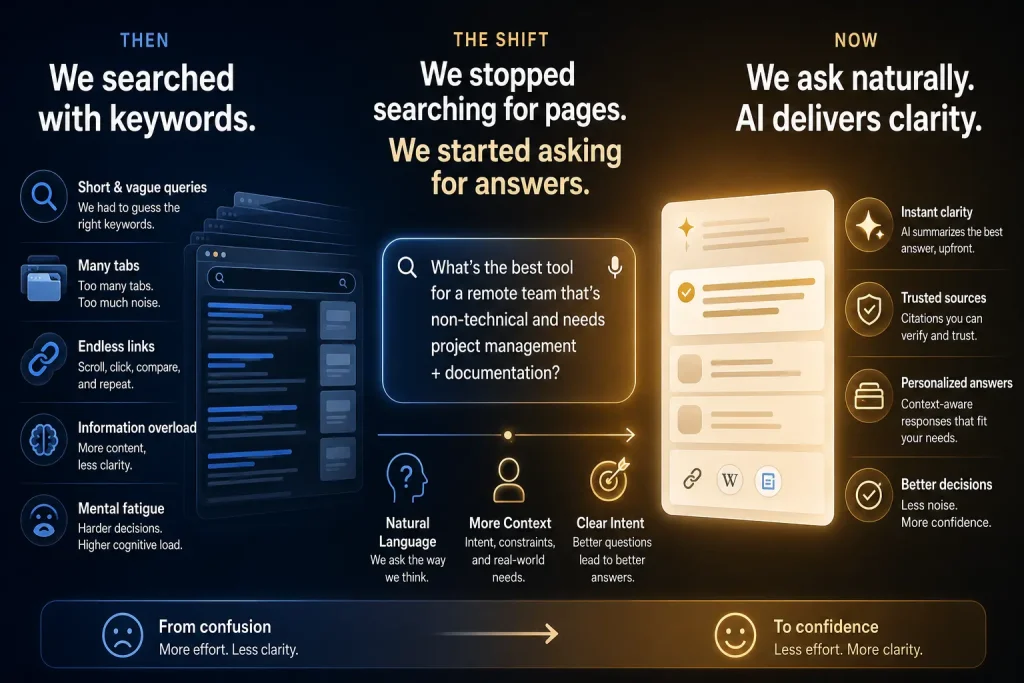
Search used to require a kind of translation. You had a real question in your head, ‘Is it worth switching from Notion to a different tool if my team is mostly non-technical?’, and you had to compress it into something a search engine could parse: ‘Notion alternatives teams.’ The engine couldn’t handle the full question, so you simplified it to fit the machine.
That contract has flipped. Users are no longer adjusting their language to match the search. Search is adjusting to match the way people actually talk. Queries are getting longer, more contextual, and more direct. The question now contains the intent, the constraint, and sometimes the decision criteria, all in one go.
Underneath this is a psychological shift worth naming. People are no longer browsing. They’re consulting. The expectation isn’t a list of links to evaluate, it’s a synthesis to trust. The mental model has moved from ‘show me where to look‘ to ‘tell me what I need to know‘. And once that expectation forms, it’s very hard to give back.
The downstream effects are real. Decision fatigue drove the shift as much as convenience did. Faced with ten links and twenty competing perspectives, many users started reaching for AI tools not because they were lazy but because the cognitive cost of traditional search had quietly become exhausting. An answer that feels authoritative and complete, even when it comes with the caveat of verification, is a significant relief.
“Users no longer adjust how they speak to fit the machine. The machine now adjusts to fit how people speak. That inversion changes everything.”
What Google Built in Response
At Google I/O 2026, the company announced what it called the biggest change to its search box in 25 years. That’s not marketing language, it’s a genuine structural overhaul, and understanding it explains a lot about where SEO is heading.
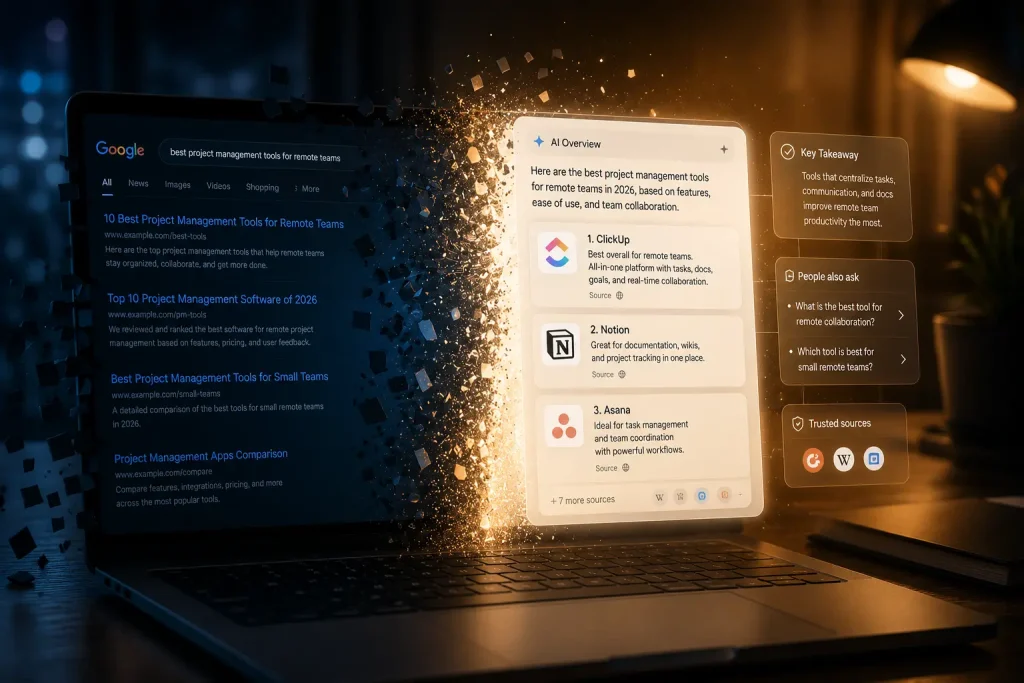
The centrepiece is AI Mode: a conversational interface powered by Gemini that replaces the traditional results page entirely. No blue links below the response. No positions two through ten. If your content is cited, it appears. If it isn’t, you receive no visibility at all. Google’s Head of Search described the result plainly: ‘AI search through and through.’
Alongside it, AI Overviews, which appear above organic results and still allow traffic from positions below the summary, now reach 2.5 billion monthly users. AI Mode, the deeper conversational layer, has passed 1 billion. Both surfaces are merging into what Google calls ‘one seamless AI Search experience,’ with context carrying across follow-up questions.
Google also launched Information Agents: background processes that monitor the web on a user’s behalf, surfacing relevant content before the user even thinks to search for it. The search bar still exists. The concept of search, as a reactive, user-initiated act, is quietly becoming something else.
“In AI Mode, you are either cited or you receive no visibility. There are no positions two through ten anymore.“
The Algorithm Caught Up Too
User behavior and product design shifted first. The algorithm followed.
Google’s May 2026 Core Update, arriving two days after I/O, which most SEO professionals didn’t treat as a coincidence, continued a trajectory that’s been building for eighteen months. Helpful Content signals folded into core ranking. Scaled content abuse targeted directly. Site reputation policies tightened. Each update fitting the same pattern: raise the floor on what ‘useful’ means.
The sites hit hardest share a profile: high-volume AI-generated content, thin informational pages, aggregator-style articles with no original input. The sites holding ground or gaining share a different one: clear authorship, first-hand experience, depth on a specific topic, and content that answers the actual question rather than orbiting it.
What changed in practice for content strategy:
- Query architecture shifted. Longer, conversational, question-based inputs now dominate AI Mode. Content built entirely around two-to-four word keywords is missing an increasing share of where real search intent lives.
- Depth over coverage. Google’s ‘fan-out’ technique in AI Mode means a single well-written page can surface for related queries it wasn’t directly written for, if it covers the topic with genuine depth. Volume of pages matters less. The quality of each page matters more.
- Multimodal is no longer optional. The new search box accepts uploaded documents, images, and active browser tabs as context. Content strategy that ignores visual, audio, and video formats is optimizing for a narrowing slice of how people actually interact with search.
- Citation is the new click. For AI Mode in particular, appearing as a cited source inside a response is now more strategically valuable than holding a position on a results page that fewer users ever see.
Why These Two Shifts Are the Same Story
The change in how people search and the change in how Google works aren’t parallel developments. One caused the other, and now both are accelerating each other.
Users started asking conversational questions because early AI tools showed them it was possible. Google built AI Mode because user behaviour was already moving there. The 2026 update penalised content that didn’t serve that behaviour. This pushes content creators to write differently. Which trains users to expect better answers. Which raises their expectations further.
It’s a loop. And it’s tightening.
For anyone creating content, running a business online, or managing an SEO strategy: the tactical question isn’t ‘how do I rank?’ anymore. It’s ‘how do I become the source of an AI confident enough to cite?’ That requires writing like the authoritative, specific, human expert you either are or need to become.
Key Takeaways
- Users stopped trimming questions into keywords. Search behaviour became conversational before search engines did, the tools caught up to the user, not the other way around.
- AI Mode replaces the results page entirely. No blue links below the response. No positions two through ten. You are cited, or you are invisibl, there is no middle ground.
- AI Overviews reach 2.5 billion users. AI Mode has crossed 1 billion. Both are merging into one seamless experience. The scale is no longer a pilot; it’s the default.
- Information Agents now monitor the web on a user’s behalf, surfacing content before anyone searches for it. Search as a reactive act is becoming something closer to ambient discovery.
- The May 2026 Core Update hit high-volume, thin, AI-generated content hardest. Sites with clear authorship, depth, and first-hand experience held or gained.
- Depth over coverage. One thorough page now outperforms ten thin ones. Google’s fan-out technique surfaces well-written content across related queries it wasn’t written for.
- Multimodal is no longer optional. The new search box accepts images, documents, and browser tabs. Text-only content strategies are optimizing for a shrinking share of actual search behavior.
- The right question is no longer ‘how do I rank?’ It’s ‘why would an AI system trust me enough to cite me?’ Everything else flows from that.
The Line Worth Remembering
Here’s what the data, the product changes, and the algorithm updates are all pointing at, underneath the technical noise:
Search didn’t get smarter. People got tired.
Tired of reformatting their questions. Tired of opening seven tabs. Tired of reading four paragraphs of preamble to find one sentence that actually answers the question they asked. The AI tools that rose to fill that gap didn’t win because they were more powerful; they won because they were less exhausting.
Google’s response wasn’t to fight that instinct. It was to build around it. AI Mode, Information Agents, the seamless conversational experience, these are products designed for a user who has already decided they’re done doing the translation work.
Which means the content that survives isn’t the content that’s best optimized. It’s the content that was worth the search in the first place.
