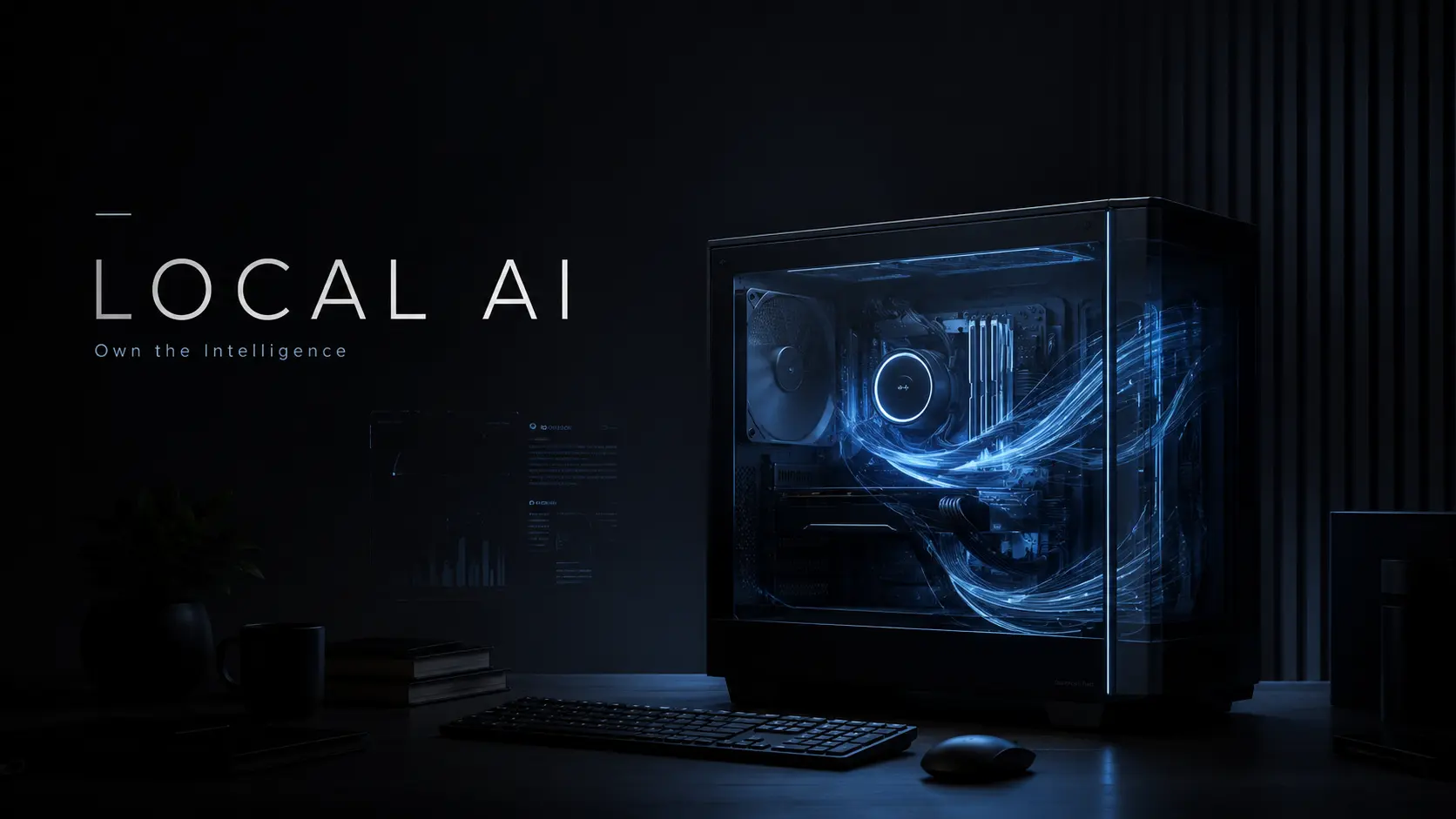

Every time you prompt a cloud-based model, you aren’t just getting an answer; you are exporting a piece of your intent, your data, and your process.
In a world where “AI-as-a-service” feels like an inevitability, the ability to run that same intelligence locally isn’t just a technical preference; it is a declaration of independence. We are witnessing a mass migration of reasoning back to the edge, where privacy is the default and latency is a relic of the past.
The Architecture of Visibility
The primary driver for the mass adoption of Ollama is a fundamental shift in Operational Security (OPSEC). When a Large Language Model (LLM) runs in the cloud, every prompt is a data point logged by a third party. Corporate strategy, personal health data, and proprietary codebases are all ingested to train the next iteration of the service. When it runs locally via Ollama, that data exists only within the volatile RAM of your physical machine.
Beyond privacy, we have reached the Latency Horizon. In 2026, real-time AI agents, those that perform research, code refactoring, or automation on your local filesystem, must operate at sub-millisecond speeds. The round-trip time required to send a query to a remote server farm, wait for orchestration to complete, and return a result makes true, agentic “machine-speed” interaction feel sluggish. Local inference turns the bottleneck of connectivity into an asset of pure speed.
The Ecosystem: Beyond the CLI
While Ollama began as a simple command-line interface, the 2026 ecosystem is vastly more sophisticated. It now serves as the Standardized Backend for a diverse array of professional tools, making it the bedrock of the local AI revolution.
- IDE Integration: Extensions like Continue and Twinny have matured to become daily drivers for professional software engineers. By using local models like Qwen-3 or Llama-4 for autocomplete, they ensure that sensitive proprietary codebases never hit a public cloud API, eliminating the risk of accidental exposure.
- Agentic Frameworks: Tools like OpenJarvis have evolved to utilize Ollama’s OpenAI-compatible API to perform multi-step reasoning. These agents can now autonomously navigate local directories, synthesise research, and orchestrate complex technical tasks. They don’t just “chat“; they operate.
- Multi-Modal Inference: Modern Ollama deployments now seamlessly handle vision and audio inputs. This enables workflows where the model “sees” your screen to assist with UI debugging or “listens” to meeting transcripts to generate automated summaries, all while entirely offline.
The “Run-Anywhere” Model
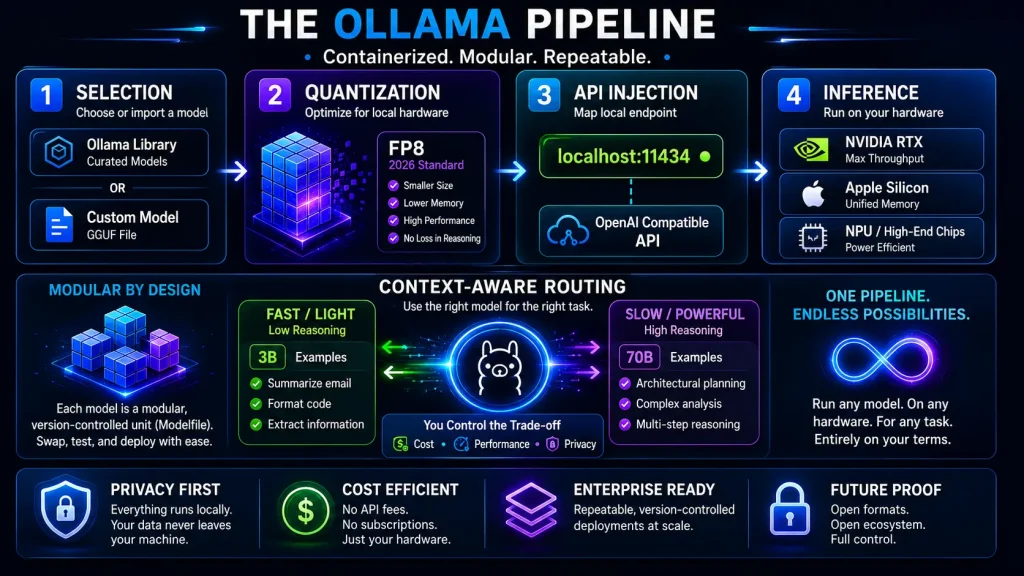
Ollama’s success stems from its Containerised Simplicity. It treats an LLM as a modular, version-controlled unit: the Modelfile. This allows for unprecedented repeatability in enterprise environments. The pipeline is now standardized across the industry:
- Selection: Pulling a model from the Ollama library or a custom GGUF file.
- Quantization: Leveraging automated techniques (like the 2026-standard FP8) to ensure massive models fit into consumer VRAM without losing reasoning capability.
- API Injection: Mapping the local endpoint (localhost:11434) to your application stack.
- Inference: Execution on local hardware (NVIDIA RTX, Apple Silicon, or high-end NPU-integrated chips).
This modularity means you can swap a “fast, low-reasoning” model for a “slow, high-reasoning” model depending on the task, a concept known as Context-Aware Routing. If you are just summarising an email, use a 3B model; if you are doing architectural planning, load the 70B parameter powerhouse. You control the cost and the performance.
The Hybrid AI Future
AI is not a monolith. The most sophisticated organizations are moving toward a Hybrid Intelligence Architecture.
- Tier 1 (Local): High-frequency, high-sensitivity, and repetitive tasks (summarization, code formatting, private RAG). These use Ollama-hosted local models to minimize costs and maximize security.
- Tier 2 (Cloud): Low-frequency, “frontier-reasoning” tasks (creative strategic planning, massive multi-modal analysis, or complex cross-domain synthesis). These leverage cloud-based models only when local hardware capacity is exceeded.
By decoupling the service from the intelligence, you stop paying for commoditized inference and start paying only for high-end reasoning. This shift represents the economic stabilization of AI costs.
Overcoming the Hardware Barrier
The persistent myth of the “AI Supercomputer” has been effectively dismantled by the rapid convergence of silicon innovation and intelligent software optimisation. In 2026, the barrier to local AI is not a lack of raw hardware, but a fundamental misunderstanding of heterogeneous compute. We are no longer limited by the throughput of power-hungry discrete GPUs; instead, we have entered the age of specialised silicon.
NPUs, found in platforms like Intel’s Lunar Lake and the Snapdragon X Elite, and the immense unified memory bandwidth of Apple Silicon have transformed consumer laptops into formidable inference engines.
This hardware evolution shifts the focus from raw clock speeds to memory capacity and bandwidth, where 32GB to 128GB of RAM now outweighs the need for high-end graphics cards. Furthermore, for teams and enterprises requiring massive reasoning capabilities, the industry has embraced distributed local inference. By partitioning a single 70B parameter model across multiple workstations on a private network, organizations are turning their entire office ecosystem into a private, high-performance inference pod. The hardware barrier has not just been lowered; for those willing to architect for the edge, it has vanished.
The Human Impact: Reclaiming Agency
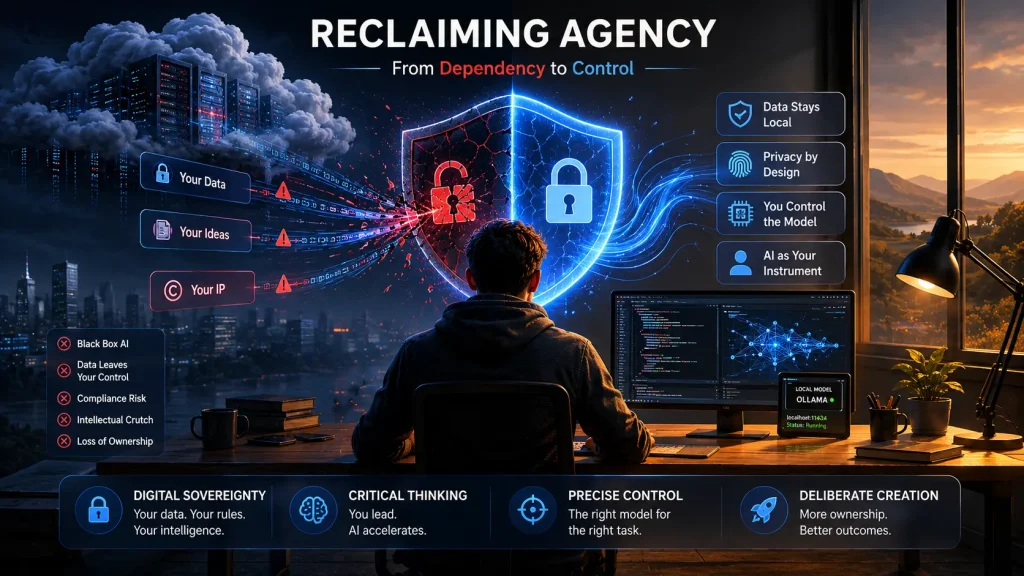
The reclamation of agency in the AI era is more than a technical preference; it is a vital assertion of digital sovereignty. As we navigate the 2026 enforcement cycle of the EU AI Act, the risks of “black box” cloud AI have become a liability nightmare for professional organisations.
Relying on remote models for proprietary code or sensitive strategy effectively exports one’s intellectual property to a third party. Conversely, local inference via Ollama creates a secure governance perimeter. Data never leaves the volatile RAM of your physical machine, turning privacy from a feature into an inherent state of the architecture.
Beyond compliance, this shift restores a psychological balance to our work. Constant reliance on cloud-based “God Models” can easily become an intellectual crutch, where the user defers all judgment to an external authority. By deploying local models, we transition back to a model of the “Local Expert.”
We utilise AI as a precise, controlled instrument rather than a monolithic oracle. This fosters a more deliberate, critical style of production, where the individual remains the primary architect of their process, and the AI serves only to accelerate the execution of their intent.
Looking Ahead: The Agentic Horizon
We are rapidly leaving the “Chatbot Era” behind as the focus of the industry pivots from mere interaction toward autonomous operation. The future of local AI is built on Multi-Agent Systems, where a “choir” of specialised agents, such as orchestrators, researchers, and tool executors, collaborates to solve complex, multi-step problems. These systems are no longer just summarising text; they are actively managing file systems, orchestrating deployments, and debugging code.
As these agents gain the autonomy to influence our digital environment, the next critical frontier is the implementation of robust Human-in-the-Loop protocols. Modern agentic frameworks now utilise strict role-based access control, ensuring that every high-stakes action is subject to explicit human verification. By integrating state-machine logic, these agents can now engage in cyclic workflows, where they are capable of identifying their own errors, correcting their path, and refining their output before a human ever sees the result.
We are entering a phase where the primary role of the engineer is not writing manual code, but designing the intelligent workflows that allow these agents to build it for us.
Key Takeaways
- Privacy as the Foundation: By keeping all data within the volatile RAM of your physical hardware, you eliminate the risk of third-party data ingestion, turning privacy from an optional feature into the default state of your operational architecture.
- Operational Velocity: Local inference bypasses the latency of remote server farms, enabling true “machine-speed” agentic interaction that is essential for real-time coding, research, and system automation.
- Ownership and Agency: Shifting from “AI-as-a-service” to locally hosted models allows you to reclaim control over your intellectual property and processes, effectively ending reliance on the availability, pricing, and policy shifts of external providers.
- The Hybrid Intelligence Architecture: You are not forced to choose between local and cloud; instead, you can adopt a strategic balance, using high-frequency, local “expert” models for daily execution and reserving the cloud only for rare, frontier-level reasoning that exceeds your local hardware capacity.
- Hardware-Agnostic Scalability: With the emergence of high-bandwidth memory, specialized NPU silicon, and distributed inference clustering, professional-grade AI is now accessible on everything from portable ultrabooks to multi-node office workstation setups.
- From Chatbots to Agents: The focus of 2026 has shifted from simple conversational interfaces to multi-agent, autonomous workflows capable of managing files, correcting their own errors, and executing complex technical tasks with human-verified oversight.
Conclusion
The evolution of local AI platforms like Ollama is forcing a total rewiring of our relationship with digital tools. The ultimate goal is not to abandon the cloud, but to move toward a mature, Hybrid Intelligence Architecture. By reserving the cloud for rare, frontier-level synthesis and keeping high-frequency, sensitive tasks on local hardware, organisations can achieve a sustainable economic and operational balance.
We are witnessing the democratization of high-level intelligence. The “black box” is no longer a corporate commodity to be rented; it is a tool to be owned, hosted, and secured. As these engines grow faster and our hardware becomes more efficient, the professional reality of 2026 is clear: your compute is your castle, and you are the sovereign architect of your digital environment.
If the world’s most powerful reasoning engine can run on the machine currently in front of you, why would you ever settle for a digital life that belongs to someone else?
