
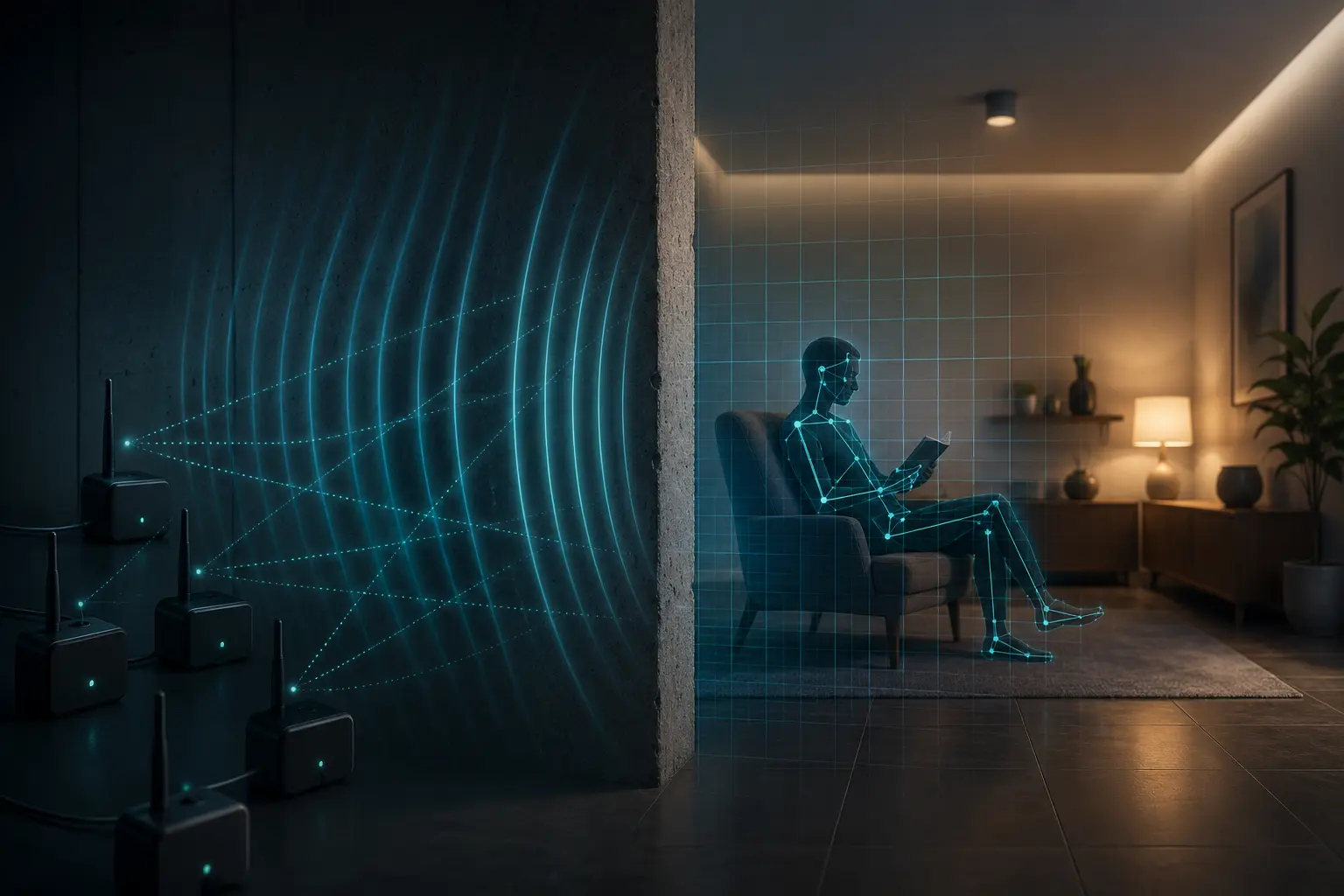

Every room you have ever been in, your bedroom, your kitchen, every hospital ward, every office, was already flooded with radio waves. Your WiFi router sends them out constantly. Nobody asked. Nobody noticed.
The waves bounce off your walls. They scatter off your furniture. And they bend very slightly, very measurably, when they hit a human body.
In late February 2026, a GitHub repository called RuView made the internet realise that someone had figured out how to read those bends.
What Is RuView?
RuView is an open-source project by Toronto-based developer Reuven Cohen (GitHub handle: ruvnet) that turns commodity WiFi signals into a real-time spatial sensing system. No cameras. No wearables. No app on anyone’s phone. Just physics, signal processing, and a $9 microcontroller.
The project went live on GitHub in March 2025 and spent months in active development before hitting the front page of the internet. On February 27, 2026, it reached #1 on GitHub Trending, racking up over 4,500 stars in a single day. By May 2026, it had crossed 60,000 stars and 7,800 forks, one of the fastest-rising open-source repositories in recent memory.
The headline that spread it everywhere?
“Developer turns your WiFi router into a full-body scanner.“
That’s both accurate and incomplete. And the gap between those two things is where this story gets interesting.
How It Actually Works
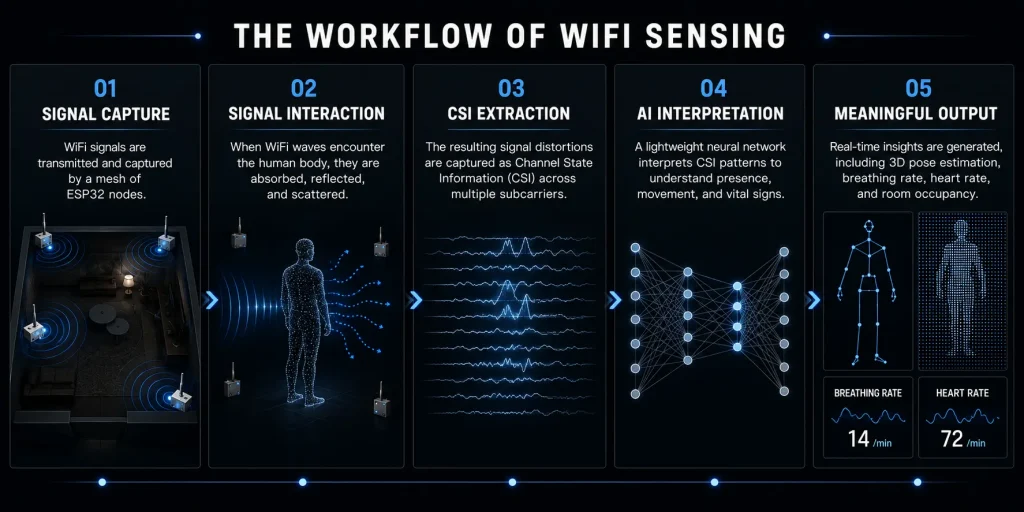
The core technology is Channel State Information (CSI), data that WiFi hardware already collects internally to manage signal quality between transmitter and receiver. CSI is not RSSI (Received Signal Strength Indicator), that simple signal-strength bar on your phone.
It’s richer, a full snapshot of how radio waves arrive across dozens of subcarrier frequencies simultaneously.
When a person stands in a WiFi-covered room, their body acts like a soft obstacle, absorbing some frequencies, reflecting others, and creating interference patterns that change with every breath, every heartbeat, every shift of posture. That pattern is subtle. But it’s consistent. And it’s legible to a machine learning model trained to read it.
RuView captures this data using ESP32-S3 microcontrollers, small, inexpensive chips that can stream raw CSI data over a local network. A mesh of four to six nodes, positioned around a room, gives the system enough angular coverage to triangulate position and movement in three dimensions.
The signal processing pipeline looks like this:
- WiFi signals pass through the room and are captured by the ESP32 mesh.
- Three WiFi channels (1, 6, 11) are fused into 168 virtual subcarriers per link.
- A coherence gate filters out noise and unstable measurements.
- Signal processing extracts clean features for breathing (0.1–0.5 Hz) and heart rate (0.8–2.0 Hz).
- A neural network (WiFlow architecture) maps the processed signals to 17 COCO body keypoints.
- Output: real-time pose skeleton, breathing rate, heart rate, and room presence data
The whole model, pretrained on 12.2 million training steps across 60,000 frames, fits in 8 KB in its 4-bit quantised form. It runs on a Raspberry Pi in microseconds. This is not a cloud system. Everything happens at the edge.
The Research Behind It
RuView didn’t invent this idea. It implemented it.
The academic foundation comes from Carnegie Mellon University’s 2023 paper “DensePose From WiFi” (arXiv:2301.00250), which demonstrated that WiFi CSI data could reconstruct dense human body surface maps using the same framework that Meta developed for computer vision. MIT, Stanford, and other institutions have published related work over the past decade. The underlying physics isn’t speculative; it’s peer-reviewed.
What RuView did was take that academic proof-of-concept and try to build a deployable, open-source implementation on hardware anyone could actually buy. A Python version shipped first. A Rust rewrite followed for better performance. By May 2026, the repository had accumulated 550+ commits, 28 releases, 96 Architecture Decision Records, and 60 edge intelligence WASM modules, a level of documentation that suggests something more than a weekend project.
The Controversy: What Works, What Doesn’t
When RuView went viral, the community split in a familiar way: true believers who took the README at face value, and sceptics who dug into the code. Both had points.
GitHub issues filed in March 2026 noted that no independently verified video of full 17-keypoint pose reconstruction through walls had been published. Critics pointed out that some earlier versions of the codebase used simulated data rather than live CSI signals. One audit repository called it “a non-functional AI-generated facade.” The developer responded directly: “No, this is not fake. Yes, it actually works. Read the docs.“
The nuanced truth appears to be this: basic presence detection and breathing monitoring via WiFi CSI on ESP32-S3 hardware almost certainly works; this is documented, commercially deployed technology (Verizon launched a WiFi sensing home awareness product in 2025 using similar principles). What’s less established is the full-body 17-keypoint real-time pose reconstruction through walls, reliably, on commodity consumer hardware, for multiple people simultaneously. That’s a much harder claim, and by the project’s own documentation, camera-supervised accuracy targets (35%+ PCK@20) remain pending as of May 2026.
The readme describes a future that the code is still catching up to. That’s not unusual in open-source. But it’s worth knowing.
What It’s Actually Useful For Today
Strip away the headline and what remains is still genuinely impressive in scope. RuView’s documentation outlines 60 deployable edge modules across 13 categories, all implemented in no_std Rust and running on-device with sub-10ms latency. The realistic applications span several domains:
Healthcare & Elder Care
Fall detection and overnight breathing monitoring for elderly patients, no wearables required, no camera in the bedroom. Sleep apnea screening and cardiac arrhythmia alerts using contactless vital sign detection. In hospital wards, continuous breathing rate monitoring for non-critical beds without wired sensors.
Smart Buildings & Retail
Real occupancy data for HVAC (Heating, Ventilation, and Air Conditioning) optimisation, not passive infrared (PIR) sensors that stop detecting presence after a few minutes of inactivity, but precise through-wall occupancy sensing with sub-second response times.
Queue length estimation, customer flow heatmaps, and desk utilisation tracking without a single camera in the space. Hotels can automate energy management based on real room occupancy rather than door-key signals.
Search & Rescue
The WiFi-Mat disaster module may be the most compelling use case: detecting breathing signatures through rubble and concrete to locate survivors after building collapses. A portable ESP32 mesh on a rescue vehicle, scanning for life signs through 30cm of concrete. No optical sensor can do this.
The Larger Shift This Represents
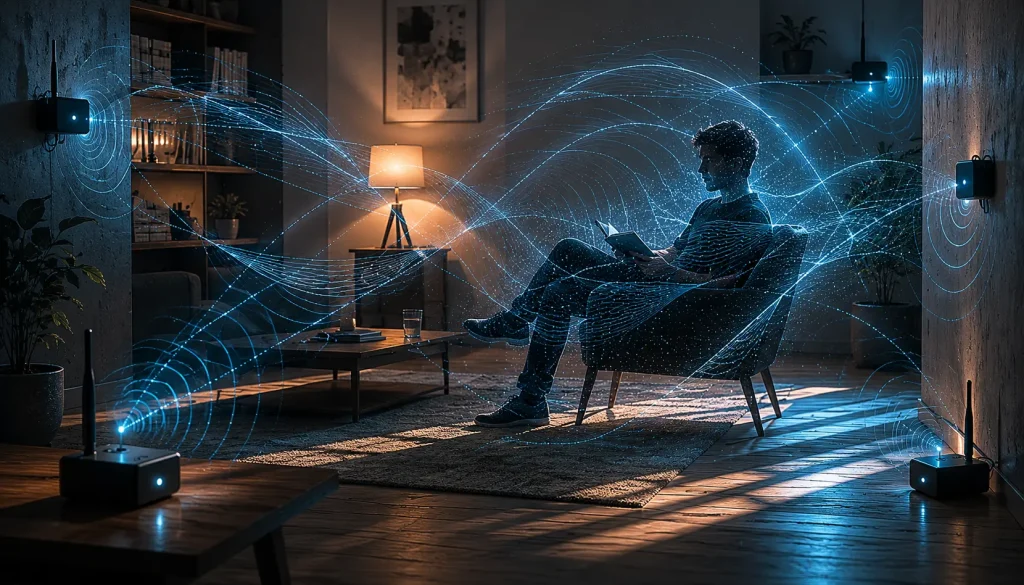
RuView’s virality was never really about the code. It was a sudden, collective, and unsettling realisation that the infrastructure for invisible sensing already exists all around us.
The IEEE 802.11bf standard, ratified in 2025, is the quiet detail that makes RuView matter regardless of whether its implementation is complete. 802.11bf will eventually bake WiFi sensing capability into every new router chipset on the market. Not as a feature you opt into, but as a hardware capability that ships by default.
Privacy researcher Claudiu Popa observed that once something becomes a standard, “optional becomes everywhere.” RuView made that abstract future feel immediate. Your neighbour’s router, standard hardware, standard firmware, could eventually run something like this passively, tracking movement through shared apartment walls without disclosure, without consent, without any visible indicator that sensing is occurring.
No consumer protection framework in the US or EU has been written to govern this yet. WiFi sensing doesn’t capture faces or recordings. It falls outside most existing surveillance regulations. It’s a category of observation that the law hasn’t caught up to.
That’s the real story. Not whether RuView’s pose estimation works at 87% accuracy. But what happens when this capability matures and becomes ambient?
Key Takeaways
- RuView is an open-source WiFi sensing platform by developer ruvnet, active since March 2025, with 60,000+ GitHub stars as of May 2026.
- It uses Channel State Information (CSI) from ESP32-S3 microcontrollers to detect presence, breathing, heart rate, and human pose, without cameras.
- The underlying science is legitimate, rooted in peer-reviewed research from Carnegie Mellon University.
- The most ambitious claims (real-time 17-keypoint through-wall pose for multiple people) remain partially unverified by independent parties; basic presence and vital sign detection is on much firmer ground.
- The project runs entirely on-device, no cloud, no cameras and hardware costing as little as $9 per node.
- IEEE 802.11bf will eventually make WiFi sensing a native capability of consumer routers, regulatory frameworks have not caught up.
- Legitimate applications include elderly care monitoring, hospital patient tracking, disaster rescue, and smart building automation.
Conclusion
The most honest framing of RuView isn’t “viral scam” or “revolutionary breakthrough.” It’s a working research prototype with ambitious documentation, built on real science, that arrived at the right moment to prompt a question that should have been asked for years.
The radio waves are already there. They pass through your walls right now, every second, carrying the distortion of your presence. The only question, the one RuView forces into the open, is who gets to read them, and under what rules.
That question doesn’t go away when the GitHub star count plateaus.
It gets more urgent every year a new router ships.
