

Every time you fill out an online form, upload a casual smartphone photo, or reuse an old username from a long-forgotten digital forum, you leave behind a microscopic crumb.
To you, it is just digital exhaust, the inevitable, invisible friction of living a modern, connected life. But to someone who knows how to look, those fragmented crumbs are not random noise.
They are a map.
1. The Architecture of Visibility
In the hyper-connected landscape of 2026, the barrier between public information and private life has effectively dissolved. Open Source Intelligence (OSINT) has evolved from a niche investigative tradecraft into a cornerstone of global cybersecurity, corporate risk management, and national security. It is defined as the systematic practice of gathering, evaluating, and drawing deep contextual insights from data that sits unconditionally in public view.
Unlike traditional cyberattacks that rely on exploiting zero-day software bugs or gaining unauthorised access to hardened, private networks, OSINT operates on a starkly different premise. It requires no backdoors, no malware, and no advanced infiltration tactics. Instead, it exploits a reality we have collectively accepted: we have already handed over the keys, one tiny piece of telemetry at a time.
Today, OSINT is undergoing a profound transformation. As digital footprints swell past human capacity to manage, specialised software intelligence platforms have stepped in to automate the collection, turning unstructured, global public data into weaponizable tactical dossiers in near real-time. This article explores how these modern OSINT engines function, the role of AI in scaling discovery, and what this new era of “total visibility” means for individual privacy and organisational security.
2. The Mechanics of Discovery: 2026 Edition
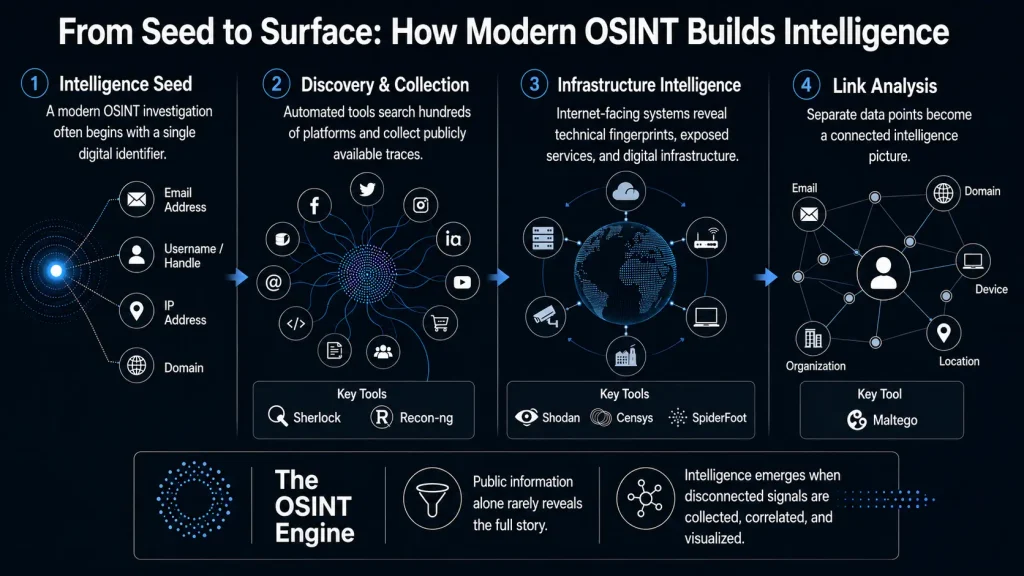
Modern OSINT engines do not simply scrape web pages. They normalise entirely disparate data layers to reconstruct identity. The workflow is modular and highly automated. It begins with a single point of telemetry, an “intelligence seed“, such as an email address, an online handle, an IP address, or a domain.
From Seed to Surface
Tools like Sherlock and newer AI-integrated alternatives serve as the front line, querying hundreds of social media platforms simultaneously to check for username registration. A pristine corporate email address can quickly link to an obscure e-commerce review profile or a long-dormant gaming forum. Once established, modular frameworks like Recon-ng systematically gather these raw discoveries and organise them into clean, relational database tables.
Infrastructure Intelligence
In 2026, infrastructure talks. Specialised search engines like Shodan and Censys do not just index traditional web content; they scan the physical devices directly attached to the internet, routers, industrial control systems, servers, and IoT nodes, revealing firmware versions and open ports. When these are combined with tools like SpiderFoot, which automates the correlation of over 200 data sources, an analyst can map the digital and physical footprint of an organisation or individual with frightening precision.
The Power of Link Analysis
The true “magic” happens when these markers are fed into a graphical link analysis tool like Maltego. It visually charts the hidden lines between a person, an open port, a corporate domain, and a physical location. What began as a single string of text transforms into a comprehensive, interactive web of life.
Practical Workflows: OSINT in the Field
In modern enterprise landscapes, cybersecurity operations units use this playbook for proactive threat modelling and defensive perimeter monitoring.
- Defensive Surface Mapping: Before an adversary can exploit an external boundary, security teams perform automated OSINT sweeps. They view exactly what a malicious actor views: misconfigured cloud staging environments exposed via Shodan, employee passwords appearing in active breach dumps, and corporate badges visible in high-resolution photos uploaded to social channels.
- Investigative Forensics: Investigative journalists and legal cells deploy these automated workflows to cross-reference corporate registries with real-time location coordinates. By mapping digital footprints, they slice through layers of shell corporations and trace physical movements in hours, converting passive internet records into a dynamic investigative lens.
4. The AI Escalation: 2026 Paradigm Shift
Moving into 2026, the OSINT paradigm has mutated. The historic structural bottleneck of OSINT was never a lack of data; it was the overwhelming, crushing volume of it. Today, Large Language Models (LLMs) and advanced neural classification networks are integrated directly into the core engine architecture.
Semantic Intelligence
Modern OSINT platforms now leverage semantic search to parse millions of unformatted blog posts, chat logs, and code repositories. The system no longer relies on strict, literal string matches. It can evaluate contextual intent. If an investigator is tracking a threat actor, the AI can correlate a user based on their unique writing style, the specific technical jargon they employ, or the temporal patterns of their digital activity, even if the username changes.
Multimodal Vision
Multimodal models, the hallmark of 2026 investigative tech, can ingest text, images, audio, and video simultaneously. They can instantly cross-reference an anonymous photo’s background architecture against global satellite databases or historical street-level imagery, rendering traditional manual geolocation pipelines obsolete.
However, this advancement brings challenges. As noted by industry research, the reliance on AI introduces risks of “hallucination” and bias. Consequently, the gold standard for 2026 is Human-in-the-Loop (HITL) systems, where AI handles the massive scale of data collection and initial correlation, while human experts provide the contextual verification and ethical oversight.
5. Strategic Implications: The Death of Obscurity
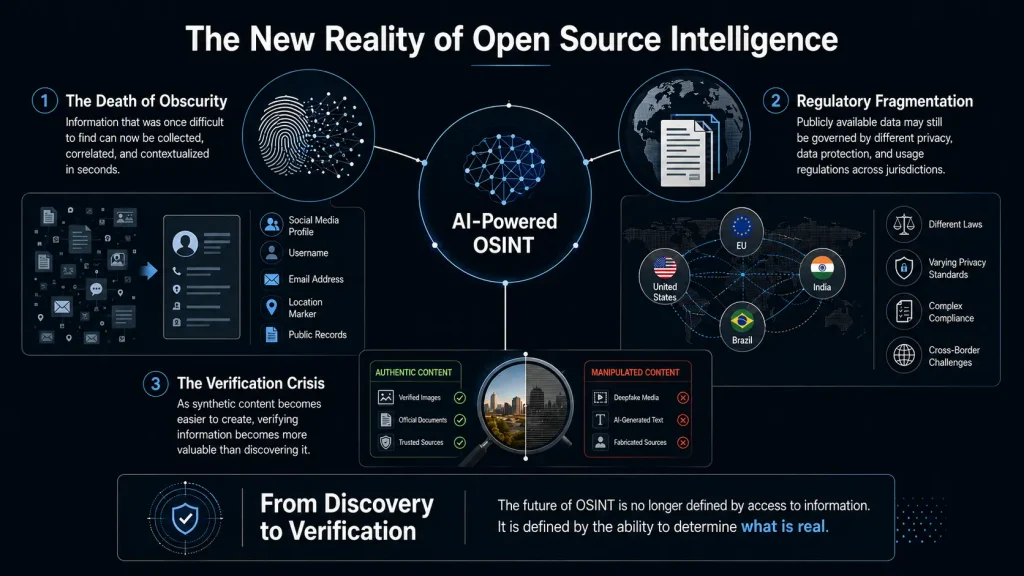
The integration of AI and machine learning into OSINT frameworks has shifted the strategic landscape from reactive to proactive. In 2026, the implications of this shift are felt across three primary domains:
- The Functional Death of Obscurity: Historically, personal privacy was protected not by perfect, absolute secrecy, but by the “security through obscurity“, the sheer difficulty and labour required to locate isolated data pieces. When an automated, AI-driven engine can scrape, correlate, and contextualise your entire digital life in milliseconds, passive exposure transforms from a minor inconvenience into a highly weaponizable strategic liability.
- Regulatory Fragmentation and Compliance: The surge in OSINT capabilities has outpaced global legal frameworks. As organisations use AI to scrape public data, they face a complex “patchwork” of international regulations, including the European Digital Omnibus and emerging localised laws like India’s DPDPA. Organisations must now navigate a landscape where “publicly available” does not always equate to “legally usable” for commercial or aggressive defensive purposes.
- The “Verification” Crisis: As bad actors utilise the same AI tools to manufacture deepfakes and spread disinformation, the OSINT discipline is pivoting toward breaking verification rather than breaking news. The most successful entities in 2026 are those that treat OSINT not just as a data-gathering exercise, but as a critical verification layer to validate information authenticity before making high-stakes decisions.
Key Takeaways for the Digital Citizen
- Your digital footprint is bigger than you think. Every username, photo, forum post, and online account contributes to a trail that can be discovered and connected over time.
- OSINT isn’t about hacking into systems. It works by collecting and analyzing information that already exists in public view, often revealing insights that were never intended to be obvious.
- Context is more powerful than individual data points. A single email address or username may seem insignificant, but when combined with other publicly available information, it can tell a much larger story.
- Artificial intelligence is changing the scale of investigations. Tasks that once required days of manual research can now be completed in minutes through automated analysis and pattern recognition.
- The biggest challenge is no longer finding information. In an era of deepfakes, misinformation, and AI-generated content, verifying what is real has become just as important as discovering it.
- Organisations need to understand their public exposure. Cybersecurity today is not only about protecting internal systems but also about knowing what information is already visible from the outside.
- Privacy increasingly depends on awareness. As the line between public and private information continues to blur, understanding your digital footprint is becoming an essential life skill rather than a technical one.
Conclusion
Ultimately, the evolution of the OSINT engine forces a fundamental rewiring of how we perceive our digital choices. We can no longer afford to treat data exposure as an abstract, future risk. We are living in an era where infrastructure talks, and our digital footprints are constantly being indexed, normalised, and analysed.
As these intelligence discovery platforms grow faster, smarter, and deeper, the most dangerous assumption one can make is that their data is “private” simply because it is fragmented. In 2026, the most effective defence is a proactive, disciplined approach to managing the crumbs we leave behind.
When the barrier between public information and your private life completely dissolves, the question is no longer “what can they find?” but rather “how do I control the narrative of what is found?”
As we move forward, the survival of privacy in both individual and corporate will depend on our ability to practice “Digital Minimalism” and maintain rigorous operational security in a world that never stops observing.
