
Your phone is a compromise. It was designed for apps, optimized for touchscreens, and built around the assumption that you’d go looking for information when you needed it. You’d open the app. You’d type the query. You’d wait.That assumption — that you navigate toward the computer — has quietly underpinned every major platform for fifty years. The PC, the smartphone, the tablet. All of them are passive until you engage them.Microsoft, at Build 2026, suggested it’s time to rethink the assumption entirely.
Introduction
On June 2, 2026, Microsoft unveiled Project Solara — a chip-to-cloud platform designed from the ground up for what the company is calling agent-first devices. Not smartphones. Not PCs. Something new: dedicated hardware built specifically to run AI agents rather than traditional applications.The announcement came from Steven Bathiche, Microsoft Technical Fellow, during the Build 2026 keynote, alongside a statement from CEO Satya Nadella that framed the ambition plainly: “We’re moving from building operating systems, devices for apps, to agents.”That’s a sentence worth sitting with. Microsoft built Windows. Windows built the PC era. And now Microsoft is saying the next era won’t be built on Windows at all.Project Solara is early — genuinely early, reference designs rather than shipping products. But the strategic signal is loud, and the companies already piloting it — Best Buy, CVS Health, Levi’s, Target, and AccuWeather — suggest Microsoft is serious about making this real.
What Project Solara Actually Is
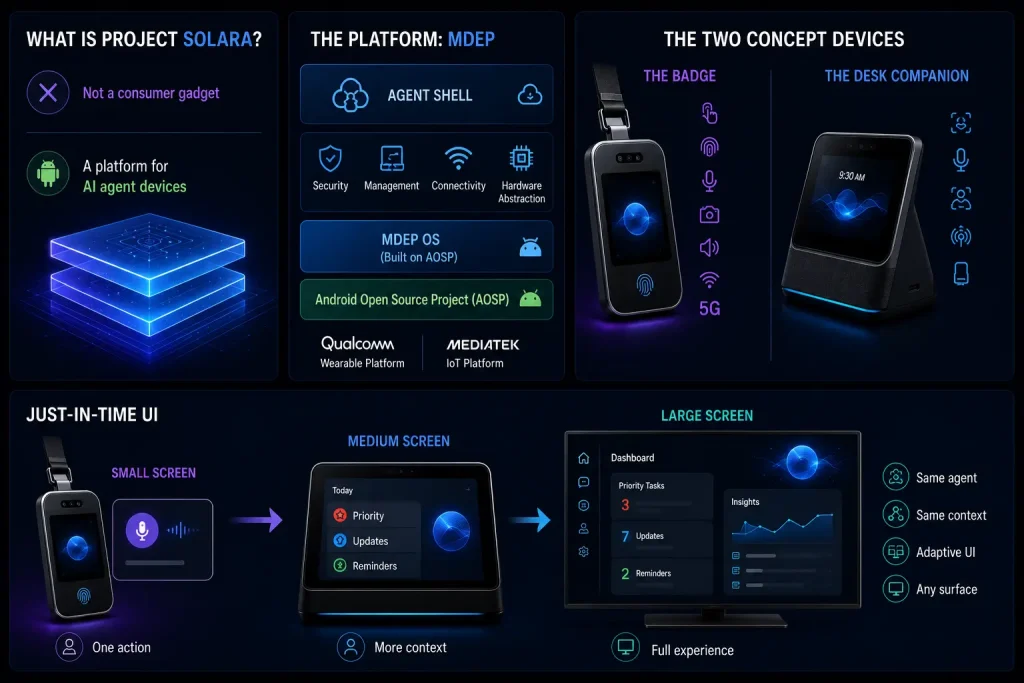
Start with what it isn’t. Project Solara is not a consumer gadget. Microsoft has been explicit: it won’t manufacture these devices. It’s building reference designs and a platform that hardware partners can use to create their own specialized AI devices for enterprise markets.Think of it the way Android worked for phones — not as the device itself, but as the platform underneath. That analogy is deliberate and instructive.
The Platform: MDEP
At the core sits MDEP — the Microsoft Device Ecosystem Platform, an enterprise-grade operating system built on the Android Open Source Project (AOSP). That choice — Android over Windows — is the first interesting decision Microsoft made.Windows carries decades of application compatibility expectations, memory overhead, and architectural assumptions that simply don’t fit on a wearable or a dedicated desk companion. AOSP scales naturally to constrained hardware. It gives Microsoft access to Android’s hardware driver ecosystem while letting them layer their own security model, management stack, and agent shell on top.The OS is designed to be invisible. On top of it runs an Agent Shell that manages both local and cloud-hosted agents dynamically. The user doesn’t navigate an operating system. They interact with agents.
The Two Concept Devices
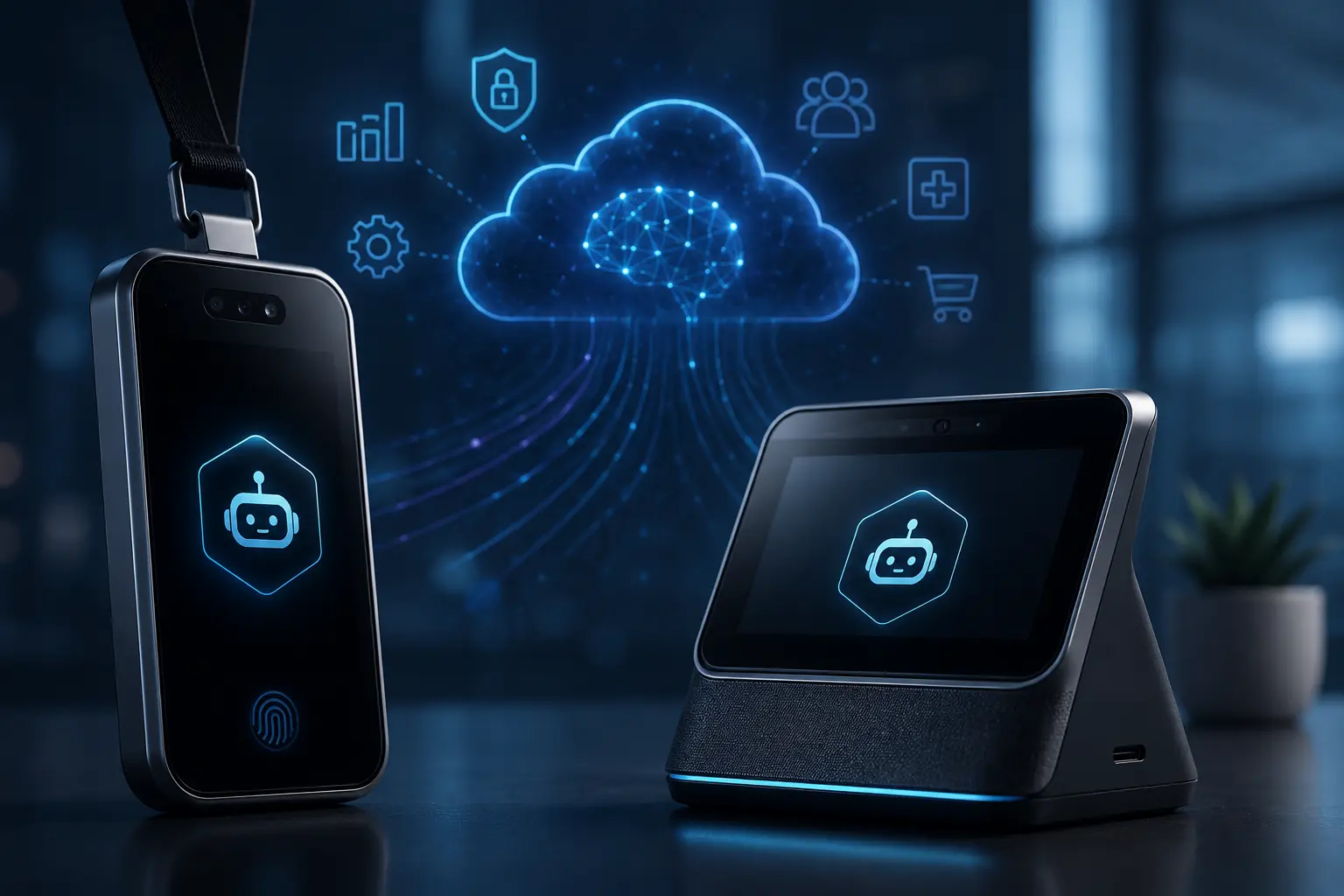
Microsoft showed two reference designs at Build 2026.The Badge reimagines the corporate access card that millions of employees clip to their lanyards every morning. Built on Qualcomm wearable silicon, it carries a touchscreen, a fingerprint sensor for Hello for Business authentication, a far-field microphone array, a side-facing camera, a speaker, and full wireless connectivity including 5G, WiFi, Bluetooth, and GNSS satellite. A single fingerprint press wakes an agent. A tap records and transcribes a conversation. The camera gives the agent visual context of what the user is looking at.The Desk Companion is a stationary device built on MediaTek IoT silicon. It has a touchscreen, a dual microphone array, facial recognition via Hello for Business, a UWB presence sensor for automatic login and lock when the user approaches or walks away, and USB-C connectivity. Attach a monitor, and it becomes a full Windows 365 machine running in the cloud — a thin client that eliminates the local PC entirely.
Just-in-Time UI
The most technically ambitious element of Solara is what Microsoft calls “just-in-time UI.” The idea: agents shouldn’t be locked to a fixed interface. Instead, the interface is generated dynamically based on the device and context.On the badge’s small screen, an agent renders a minimal card with a single action. On the desk companion, the same agent produces a richer layout. On an attached external display, it generates a full dashboard. The interface adapts to the surface — not the other way around.That’s a genuinely different way of thinking about software. Most applications today are designed for a specific screen. Solara agents are designed for a context, and the interface follows.
How This Works in the Real World
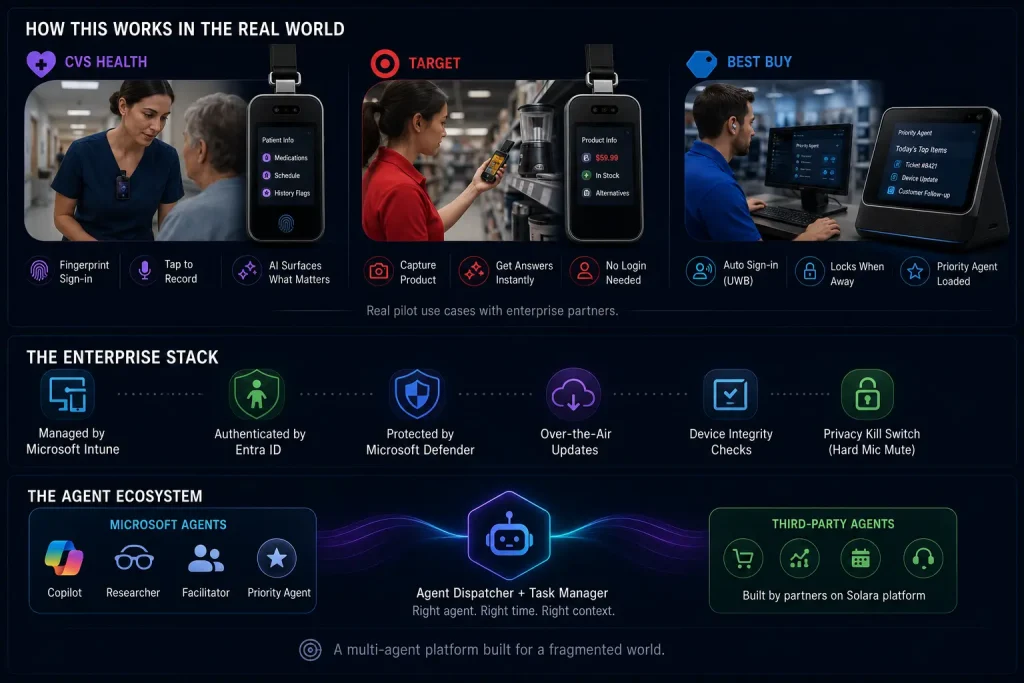
Picture a nurse at CVS Health. She clips the badge in the morning and it authenticates via fingerprint as she walks onto the floor. During a patient interaction, a single tap begins recording and transcribing. The agent surfaces relevant information — medication schedules, patient history flags — on the small display without her having to step away and open a laptop.A retail worker at Target approaches a product question she can’t answer. She taps the badge, the camera captures the product, and the agent surfaces pricing, stock levels, and comparable alternatives without a separate device or login.At Best Buy, a field tech pairs the desk companion with an external monitor at a service counter. The UWB sensor logs them in as they sit down and locks the screen when they step away. The agent — a Priority Agent surfacing the day’s most critical items — is already loaded when they arrive.These aren’t science fiction scenarios. They’re the specific pilot use cases Microsoft is running with named partners right now.
The Enterprise Stack
For IT departments, the management story is familiar by design. Solara devices are managed through Microsoft Intune, authenticated via Entra ID, and protected by Microsoft Defender. Over-the-air updates, device integrity checks, and patch management work the same way they would for any managed endpoint.The hardware includes a physical privacy kill switch — a hard mic mute button — which matters for industries like healthcare and legal where conversation recording is tightly regulated. These aren’t afterthoughts. They’re the features that make the platform deployable in real enterprise environments.
The Agent Ecosystem
Solara supports both Microsoft’s own agents — Copilot, Researcher, Facilitator, and the newly introduced Priority Agent — and third-party agents built on Microsoft’s platform. An agent dispatcher and agent task manager coordinate which agents surface and when, automatically, based on context.Microsoft is explicitly betting on a fragmented, multi-agent world. The platform isn’t designed around one agent replacing everything. It’s designed around a constellation of specialized agents, each doing one thing well, surfaced as needed.
What Solara Actually Represents
There’s a deeper architectural argument running underneath Project Solara, and it’s worth naming clearly.Every major computing platform shift has been a shift in the unit of interaction. The command line made the command the unit. The GUI made the window the unit. The smartphone made the app the unit. Each shift didn’t just change how computers looked — it changed what computers were for.Microsoft’s thesis is that agents are the next unit. Not the application that the agent lives inside — the agent itself. And if that’s true, the device designed around applications becomes the wrong tool.That’s the logic behind building on Android instead of Windows. Windows is an application platform. MDEP is an agent platform. They’re solving different problems.There’s also a competitive dimension that’s hard to ignore. Microsoft watched Apple build a dominant hardware-software ecosystem with iPhone. It watched Google do the same with Android. Project Solara is Microsoft’s attempt to define the next hardware category before anyone else does — not by manufacturing devices, but by controlling the platform underneath them.The Rabbit R1, various AI pin attempts, and OpenAI’s recently announced hardware ambitions all point at the same market gap. Microsoft is positioning Solara as the enterprise answer to the same question those consumer devices are asking: what does hardware look like when agents are the primary interface?The next platform shift isn’t from desktop to mobile. It’s from applications to agents — and the hardware has to change with it.And then there’s the workforce dimension. The badge concept isn’t aimed at knowledge workers with laptops. It’s aimed at frontline workers — nurses, retail staff, field technicians — who have historically been underserved by enterprise software because the devices assumed a desk. Solara’s most interesting potential might be in reaching the 80% of the global workforce that doesn’t sit at a computer all day.
Key Takeaways
- Microsoft unveiled Project Solara at Build 2026 — a chip-to-cloud platform for AI agent-first devices, not traditional apps.
- The OS is MDEP (Microsoft Device Ecosystem Platform), built on Android AOSP — a deliberate departure from Windows for lightweight, dedicated hardware.
- Two concept reference designs: a wearable Badge (Qualcomm silicon, 5G, camera, fingerprint) and a Desk Companion (MediaTek silicon, UWB presence sensor, facial recognition, Windows 365 support).
- “Just-in-time UI” generates interfaces dynamically based on device and context — the same agent adapts its display to the screen it’s running on.
- Enterprise pilots are underway with AccuWeather, Best Buy, CVS Health, Levi’s, and Target.
- Microsoft won’t manufacture devices — it provides reference designs and platform technology for OEM hardware partners.
- Silicon partners are Qualcomm (badge) and MediaTek (desk companion); management is through Intune, Entra ID, and Defender.
- Solara is Microsoft’s early claim on the next hardware category — agent-first devices — before the market defines itself.
Conclusion
Project Solara is, right now, a set of reference designs and a platform preview. You can’t buy it. Most people will never see it. The pilot companies are running controlled experiments, not deploying at scale.But the point of a platform announcement isn’t the product in the room. It’s the direction being declared.Microsoft is saying — with engineering resources, enterprise pilot partners, and a Build keynote slot — that the next computing era won’t be organized around applications. It’ll be organized around agents. And it’s saying that the hardware designed for the previous era isn’t the right vessel for what’s coming.The honest question isn’t whether Solara will succeed as described. Early platform visions rarely survive contact with the market intact. The question is whether the direction is right.And if agents do become the primary unit of human-computer interaction — if the interface really does adapt to context rather than constraining it — then the device in your pocket, designed around apps and touchscreens and notification feeds, starts to look like exactly what it is: hardware built for a different era.Your phone is a compromise. It was designed for apps, optimized for touchscreens, and built around the assumption that you’d go looking for information when you needed it. You’d open the app. You’d type the query. You’d wait.That assumption — that you navigate toward the computer — has quietly underpinned every major platform for fifty years. The PC, the smartphone, the tablet. All of them are passive until you engage them.Microsoft, at Build 2026, suggested it’s time to rethink the assumption entirely.
| Categories | AI & Machine Learning · Enterprise Technology · Microsoft · Developer Tools · Future of Work |
